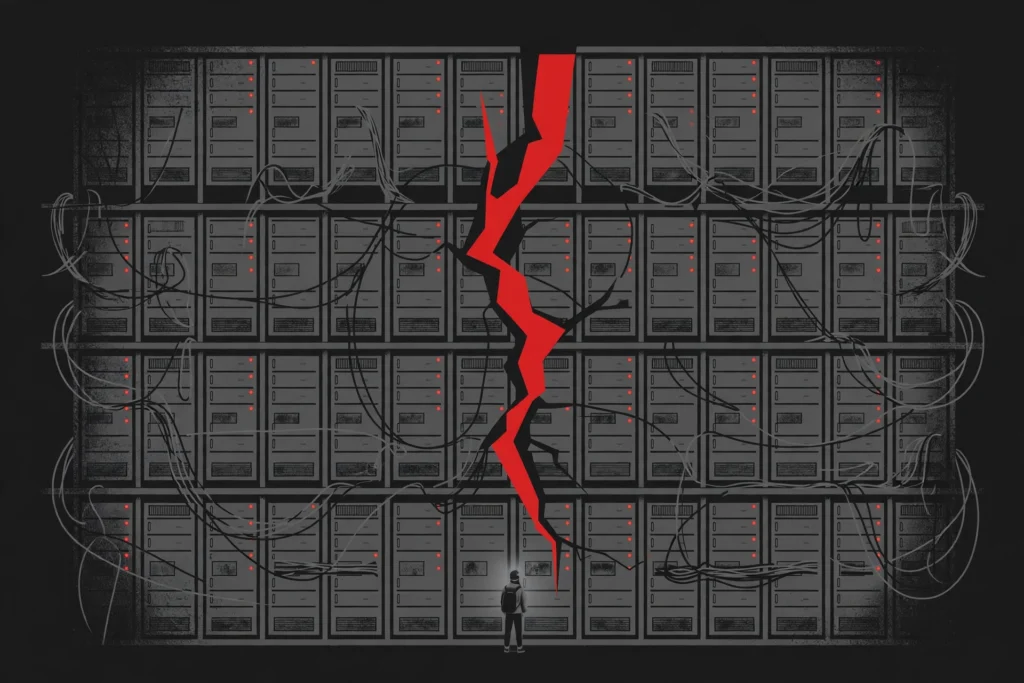
Picture the scene. You open Outlook to send a morning email, and nothing loads. You switch to your bank app, and it refuses to sign you in. By lunchtime, your flight is delayed and Apple’s services are flickering. Behind it all sits a quiet new force: AI vulnerability discovery.
That was not one unlucky day. It was last week, across half a dozen of the biggest names in technology. Between November 12 and 17, outages hit Microsoft 365, Apple, several US banks, United Airlines, and even the classified network of the NSA.
Officials insist there is no evidence of a coordinated attack, and every incident has its own ordinary explanation. But a growing number of security researchers say the incidents share a deeper cause: artificial intelligence is finding software flaws faster than the world can fix them.
According to Wired, the total number of vulnerabilities recorded in 2026 passed 100,000 this week. In 2022, the last full year before large language models went mainstream, the figure was about 25,000. This year’s total is already double the combined totals of 2024 and 2025.
Cloudflare chief executive Matthew Prince has a blunt forecast for what comes next. “It’s going to feel like the sky is falling for two years,” he said. In his view, the outages of the past week are not a one-off. They are the beginning of a new pattern.
The Week the Internet Kept Breaking
The streak began with Microsoft’s massive 365 outage, which the company blamed on a flawed update in its infrastructure, made worse by other network failures. Outlook, Teams and Copilot all went dark for many users.
Apple followed with its own problems, which the company said came from an internal update. Its services, including iCloud, the App Store and Apple Pay, were disrupted.
Around the same time, customers of several US banks found themselves locked out of their accounts, and United Airlines passengers faced delays. Then came the most striking case of all.
The NSA’s classified internal network went down, and officials said this week that the cause was botched patching following October’s critical updates to PHP, the programming language behind much of the web. The flaws in PHP had lurked for roughly a decade before researchers using AI finally found them.
How AI Vulnerability Discovery Broke the Old Patching Rhythm
For decades, software security ran on a forgiving rhythm. A vendor found a nasty bug, released a patch, and IT teams had days or weeks to test it before rolling it out. That breathing room is gone.
AI tools can now scour millions of lines of code with infinite patience, finding weaknesses that human researchers missed for years. Attackers can then use the same tools to build working exploits within hours. The result is a race that defenders are losing.
“Historically, even a couple of years ago, a vendor releases a patch for a nasty bug. You might have some time to do some validation and apply it,” says Joe Slowik, director of threat research and cyber engineering at Dataminr.
“Now, that may not even be an option, because we’re talking about turnaround times that completely defeat the ability to do patch verification.”
Microsoft chief executive Satya Nadella made the same point this week, warning that more “instability” could be coming. A patch, he said, “needs to go instantly from being available to being patched in production because it’s being exploited in the wild.”
US senator Mark Warner put it more bluntly still. AI vulnerability discovery and the resulting patching, he said on Tuesday, are “putting tremendous strain on systems that weren’t built to handle that pace of change.”
100,000 Flaws and Counting
The numbers behind the warning are stark. More than 100,000 vulnerabilities have been recorded so far in 2026, according to Wired’s Kernel Panic newsletter. October alone saw more than 17,000 new flaws logged, up from fewer than 5,000 in October 2025.
In the last few days, researchers disclosed AI-found critical vulnerabilities in PHP for the second time, in the web server software NGINX, and in the programming language Java.
On October 21, researchers using AI identified critical flaws in PHP, in what some are calling “Black October”. The NSA issued an alert urging any site running PHP to patch immediately, warning that attackers could steal sensitive data or move deeper into networks.
Government and private websites across the US and UK took themselves offline to patch. Cloudflare saw thousands of people probing the PHP flaws within ten hours. Forty-five minutes after it went public, that number had jumped to tens of thousands.
The same dynamic is playing out openly. Amazon reported this week that autonomous AI agents found a zero-day flaw in a medical imaging server in about eleven minutes, a task that once took human researchers weeks of painstaking work.
Why the Fixes Themselves Cause Outages
Here is the cruel paradox at the heart of the story. Patching fast breaks things. Patching slowly leaves you exposed. There is no safe speed anymore, only a choice between two kinds of risk.
The NSA’s outage is the clearest example. Its classified network did not go down because of an attack. It went down because the patching itself went wrong, after October’s urgent PHP updates. In each case this week, the cure caused the symptoms.
Part of the problem is old. Many organisations carry what engineers call “tech debt”, the result of years of cutting corners and putting off upgrades and maintenance. Those systems were always fragile.
They could survive a slow, careful patching schedule. They cannot survive one that runs at machine speed.
“AI can help, but people still need to understand what went wrong, check that the patch addresses the cause, and look for similar issues elsewhere,” says Lea Schönherr, a researcher at the CISPA Helmholtz Center for Information Security. “Rolling out patches across widely used systems also takes time.”
The Two-Year Warning
That is the backdrop to Matthew Prince’s warning. The Cloudflare chief says his company already knows of other severe vulnerabilities in critical software, and he expects disclosures to keep security teams under pressure for months.
He is not alone. Jason Clinton, Anthropic’s deputy chief information security officer, has predicted a “vulnerability tsunami” in the coming months and said flatly: “There won’t be enough time to patch critical infrastructure.”
Not every AI-discovered flaw matters. “The number of vulnerabilities has certainly exploded, but the number of vulnerabilities that you need to care about has remained somewhat constant,” Slowik says. “The caveat is that the pace at which they’re being used or weaponized has increased dramatically.”
The figures support him. Only 300 vulnerabilities have been added to the US Cybersecurity and Infrastructure Security Agency’s catalogue of exploited flaws this year.
VulnCheck, which runs its own database, puts the number of known exploited vulnerabilities higher, at 1,500 so far in 2026. That is still just 1.5 percent of all the bugs discovered this year.
Prince himself is optimistic in the long run. He suspects that AI acceleration will eventually help defenders get on top of common vulnerabilities.
“These new threats and new security vulnerabilities won’t happen as often, and the background noise will actually tick down quite a bit,” he predicts. Every flaw found and fixed, in his view, leaves the internet a little safer.
What Happens Next
For now, the storm is still building. Expect more disclosures, more rushed patches, and more outages in the months ahead.
For the people who run that software, the lesson is to focus on what is actually being exploited, not on the raw count of flaws. The CISA catalogue of exploited vulnerabilities is a better guide than the total.
Patch testing needs to get faster and more automated, because the old manual checks no longer fit the timeline.
When your email, your bank or your flight goes down in the coming months, it may not be an attack at all. It may be the sound of the internet finally fixing the holes it left open for a decade, all at once.
Schönherr has one more warning. “What matters to me is that we avoid blaming AI when things go wrong,” she says. “Responsibility lies with the people and companies that choose to use AI and give it access to infrastructure, and there should be consequences and regulations that can be applied.”
The tools are faster than ever. The accountability still has to catch up.


