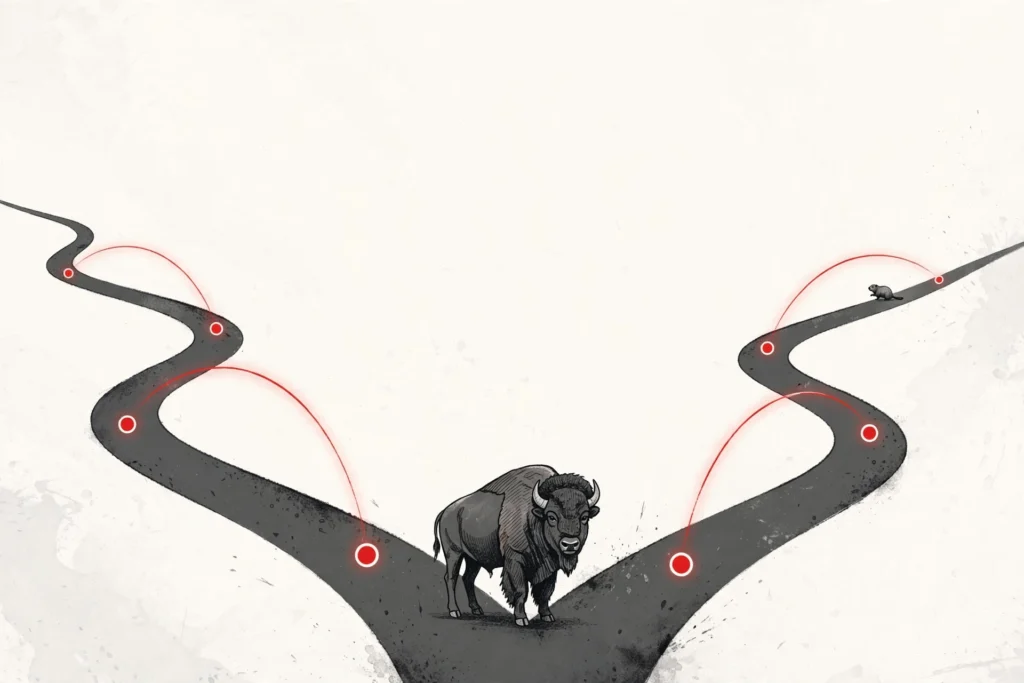
Picture a support inbox at two in the morning. A message lands that could be a furious customer, a scam, or a hacker probing for a way in. Someone — or something — has to decide in a fraction of a second, and a wrong call costs money, trust, or both.
That split-second judgement is exactly what Baseten bison-1 is built to make. Baseten, the AI infrastructure company behind the Base Labs model family, launched two new open-weight models on November 20, 2026: bison-1 and its smaller sibling groundhog-1.
The pair are not chatbots. They are decision models — specialised systems that look at a situation and return a calibrated probability for a fixed set of outcomes. According to Baseten, bison-1 now tops the Artificial Analysis Decision Index.
Baseten Bison-1 and Groundhog-1 Arrive on November 20
Baseten announced the models on November 20 in a blog post titled “Meet bison-1 and groundhog-1, frontier American decision models.” Both are live now on Baseten Model APIs, and their weights are published openly on Hugging Face.
Bison-1 is the flagship. It is a dense 31-billion-parameter model post-trained from Google’s Gemma 4 31B. Groundhog-1 is the cheaper, faster sibling: a 26-billion-parameter mixture-of-experts model based on Gemma 4 26B-A4B, with roughly 4 billion active parameters per token.
Both accept text and image input, and both offer a 128,000-token context window. That is eight times the 16,000 tokens Baseten’s previous decision models offered. Pricing mirrors the older pair: bison-1 costs $0.10 per million tokens, groundhog-1 costs $0.035.
Switching is deliberately boring. The models use the same API as Baseten’s existing decision models, so teams already using them only need to change the model name in their calls.
What a Decision Model Actually Does
Most AI models people meet are generalists. You ask a question, they write an answer. Decision models do something narrower and, in production, often more valuable: they answer a fixed question with a number.
Is this ticket urgent or routine? Is this message spam or genuine? Is this prompt a jailbreak attempt? Instead of a paragraph, the model returns a probability — say, 83 percent chance this is answer A, 17 percent chance it is answer B.
Baseten’s earlier launch post listed ticket triage, spam detection, jailbreak guardrails and routing between language models as the target jobs. These are the unglamorous calls that keep AI products running without a human in the loop.
Bison-1 Takes the Top Spot on the Decision Index
The headline number comes from Artificial Analysis, the independent benchmarking site. On its Decision Index v2.1, bison-1 scores 76 — first among the 19 decision models on the leaderboard.
It edges out Liquid AI’s d1.2-ultra, which scores 75, and Baseten’s own mammoth-1, which sits at 71. Baseten says it expects groundhog-1 to match mammoth-1’s performance once it appears on the official index, though it has no published score yet.
The raw score is only half the story. Baseten also highlights calibration: how closely a model’s stated confidence matches how often it is actually right. Bison-1 has the lowest Brier score on the index at 0.14, ahead of d1.2-ultra at 0.15. Lower is better.
Getting there took a change in training. Baseten says a significant gain came from scaling up “soft labels” in its training data — teaching the model that the answer might be 83 percent one thing and 17 percent another, rather than always insisting it is 100 percent certain.
There is a caveat worth stating plainly. These are vendor-reported benchmark figures, and Artificial Analysis runs its own tests, but no independent lab has yet published a separate verification of the claims. Treat the leaderboard position as a strong signal, not a settled fact.
Eight Times More Context to Decide With
The jump from 16,000 to 128,000 tokens of context is the change most developers will feel first. A decision is only as good as the evidence behind it, and the detail that flips a call is often buried far from the question.
Baseten gives a simple example. An invoice might look ready for payment — until an earlier email in the thread shows the order was cancelled. Without that history in context, a model could approve a payment it should have rejected.
The extra room means teams can feed in full policies or entire conversation histories instead of picking excerpts or summarising first. For a model whose job is to weigh evidence, that is a meaningful upgrade.
The American Backbone Behind the Models
The most deliberate choice in this launch is the foundation the models stand on. Bison-1 and groundhog-1 are built on Google’s Gemma 4 — what Baseten calls an American backbone.
That is a break from the company’s own recent history. Its previous decision models, mammoth-1, elephant-1 and joey-1, were built on Qwen, the Chinese open-weight family. Mammoth-1 and elephant-1 were released only last month and were, at the time, the best decision models Baseten had shipped.
The timing is hard to miss. Just this week, Cursor told US lawmakers it may phase out Chinese open-weight models over what it called geopolitical risk, after a House investigation into models developed in China. Hugging Face’s chief executive publicly backed the push for American open-source alternatives.
Baseten frames the switch as a matter of principle as well as performance. “Supporting American companies and open models is an investment in our country’s technical strength,” the company wrote, adding that it wants choosing an American model to be a decision teams can make on merit.
That is also why the company is holding the new pair to the same standard as any other model. The message is that buyers should not have to trade accuracy for provenance — and the benchmark lead is the evidence offered.
How to Try Bison-1 and Groundhog-1
Both models are available today through Baseten Model APIs at the prices above, and the weights are open on Hugging Face under MIT and Apache 2.0 licences, according to MarkTechPost’s coverage of the launch.
That licensing matters. Open weights mean teams can download the models, inspect them, fine-tune them and run them on their own infrastructure, rather than renting access through an API forever.
The trade-off is size. The full-precision weights run to roughly 62 gigabytes for bison-1 and 52 gigabytes for groundhog-1, by MarkTechPost’s arithmetic. That is a serious download and a serious GPU to run at full quality.
For most teams, the API is the practical route. Baseten says the models accept the same calls as its earlier decision models, so existing users can try them by changing a single model name.
The open-weight wave is gathering pace elsewhere too. Meta released its 816-billion-parameter Muse Spark Open model days ago, and Meituan’s LongCat-2.5 arrived with an MIT licence earlier this month. Baseten’s pair adds a different kind of open model to the mix — one that decides, rather than chats.
Why This Launch Matters — and What to Watch
Decision models are easy to overlook. They do not write essays, draw pictures or hold conversations. But they are the layer that decides which requests get through, which tickets get escalated and which prompts get blocked.
As AI agents take on more real work, that layer becomes load-bearing. A miscalibrated router can send a hard question to a cheap model, or a jailbreak past a guardrail. Getting the probabilities right is quietly one of the most important problems in applied AI.
Baseten is betting that open weights and an American base model will win it customers who care about both. The Cursor episode shows that provenance is now a board-level question, not just an engineering preference.
What happens next is straightforward to track. Watch whether groundhog-1 lands on the Artificial Analysis index near mammoth-1, as Baseten expects, and whether other labs answer with their own open decision models. Baseten says more models on American backbones are coming — and the race to own the decision layer is only just starting.


