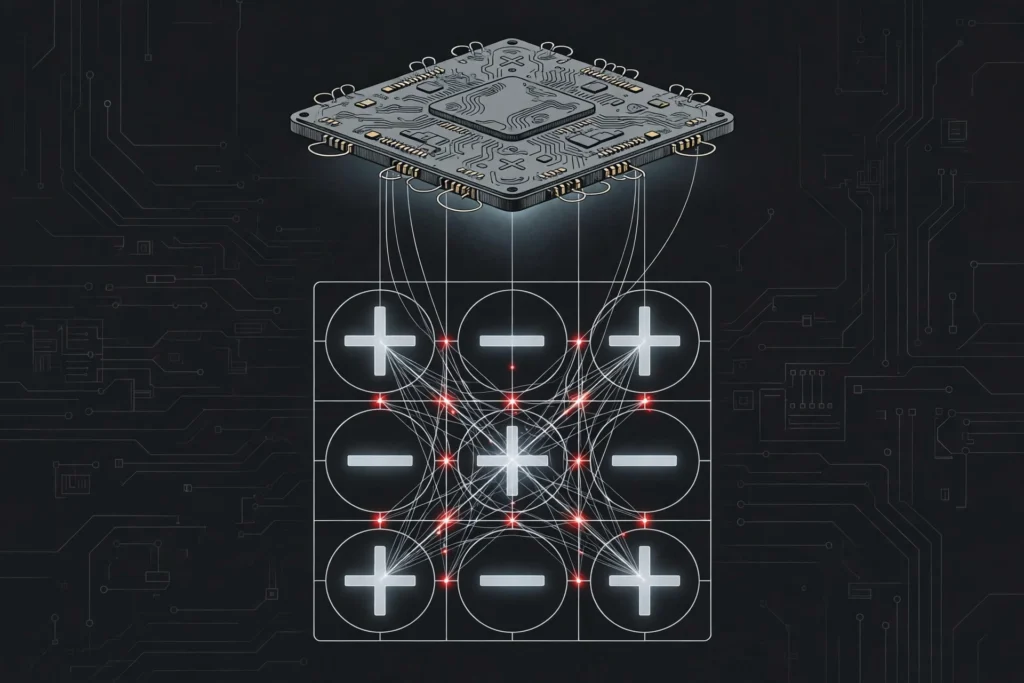
Imagine two players, a three-by-three grid, and a rulebook that makes the game impossible to win. Fill every row with numbers that multiply to plus one. Fill every column with numbers that multiply to minus one. And make the shared cell agree.
There is no way to do it. Not with a clever plan, not with a supercomputer, not with all the time in the world. The maths simply says no — any strategy written down in advance wins at most eight of nine rounds.
Google’s Willow quantum chip just won 98.3 percent of them.
The result, published on the cover of Science on November 19, 2026, is the latest milestone from Google Quantum AI, according to Interesting Engineering.
Across 900,000 rounds of the Mermin-Peres magic square game, Willow beat the classical ceiling of 88.9 percent. Then the team pushed the same strange quantum property, called contextuality, all the way up to all 105 qubits on the chip.
The Game No Classical Computer Can Win
The magic square game is a trap disguised as a puzzle. Two players, Alice and Bob, each receive part of the grid. Alice gets a row, Bob gets a column.
They fill their cells with plus one or minus one, without talking to each other, and they win only if their numbers agree where the row and column cross.
The catch is the arithmetic. Every row must multiply to plus one, every column to minus one. No single grid of plus and minus ones can satisfy both rules at once. So any team that agrees on its answers beforehand is doomed to lose at least one round in nine.
That is the classical ceiling: 88.89 percent. It is not a matter of computing power. It is a proof. A classical system, where every answer is fixed before the game begins, cannot do better.
Quantum mechanics plays by different rules. When two qubits are entangled, their answers are not fixed in advance. The outcome of a measurement can depend on the other measurements being made alongside it. Physicists call this contextuality, and it is one of the strangest features of quantum theory.
How the Willow Quantum Chip Played the Game
Willow is Google’s 105-qubit superconducting processor, first announced in December 2024. For the magic square test, the team used just four of those qubits, arranged as two entangled Bell pairs. Alice held two qubits, Bob held two, and the chip played all nine versions of the game 100,000 times each.
The result was a win rate of 98.30 percent, with an uncertainty of just 0.01 percent. In other words, Willow lost roughly once in every sixty rounds — and almost every loss came down to noise in the hardware, not to the rules of the game. A perfect quantum machine would win every single round.
The team did not stop at the game itself. They also measured a Bell-Kochen-Specker inequality, a second test that combines the row and column products into a single score. Any model where outcomes are fixed in advance scores at most four. Quantum mechanics allows up to six.
Willow scored 5.590, with an uncertainty of 0.008. That is comfortably above the classical limit and only about seven percent below the quantum maximum. Because the test is independent of the starting state, the score describes the machine itself rather than a lucky choice of input.
From Four Qubits to 105: Scaling the Test
The most striking part of the paper is not the four-qubit game. It is what happened when Google scaled up. The team extended the tests to multi-player GHZ-type games, playing with up to 71 players — one per qubit — on a 72-qubit Willow processor.
Then they went further. In a hidden linear function problem, a task designed to separate quantum and classical computers working with limited resources, they ran circuits across grids of increasing size until they reached all 105 qubits on the chip.
Google describes this as the first unconditional quantum advantage for a restricted class of circuits, with the advantage tracing back to contextuality. It is a careful claim, and the word “restricted” does a lot of work. These are not general-purpose calculations. They are tasks chosen precisely because contextuality gives quantum hardware an edge.
Even so, the scale is new. Contextuality testing has moved from small few-particle systems to large two-dimensional qubit arrays. The experiments also give the field a hardware benchmark that is sensitive to coherent control errors — a practical yardstick for how well a quantum chip is really performing.
What the Result Does — and Doesn’t — Prove
It would be easy to overread this paper, and the honest version of the story is more interesting than the hype. The 105-qubit separation rests on a conjecture. According to the paper, the proven classical lower bound for the hidden linear function problem only becomes relevant at around a million qubits.
At 105 qubits, in other words, the advantage depends on a widely believed but unproven assumption about how hard the task is for classical circuits. The results are a careful demonstration and a promising hardware benchmark, not a proof that quantum computers beat classical computers in general.
There is also no independent replication yet. The headline figures come from Google’s own team, and the work travelled a long road to publication: a preprint first appeared on arXiv on December 1, 2025.
Peer review in Science followed almost a year later. That journey to the journal’s cover is a mark of scrutiny, but other labs will still want to reproduce the results on their own hardware.
None of this diminishes the experiment. What Google has shown is that contextuality — the property at the heart of quantum weirdness — does not wash out as systems get bigger. It survives, it can be measured precisely, and it can be turned into a benchmark that future chips will be judged against.
Why It Matters for the Future of Quantum Computing
Quantum computing has spent years arguing about milestones. Supremacy claims, error-correction breakthroughs, and qubit counts have all had their moment. Contextuality offers something different: a test that is rooted in the foundations of quantum theory itself.
Google points to molecular simulation in chemistry and materials science as a possible downstream application, though the paper reports no domain simulation of its own. The nearer-term value is likelier to be in benchmarking: a standard, physics-based check that separates real quantum performance from marketing numbers.
The result also lands in a busy year for quantum hardware. IBM is preparing a 1,040-qubit system for 2027, and AMD has bought into PsiQuantum — both stories we have covered on Wasl Tech.
Google’s answer is not a bigger qubit count. It is a deeper claim: that its chip behaves quantum-mechanically at a scale where classical explanations fail.
What Happens Next
Expect other quantum labs to try the same tests. A benchmark only becomes a standard when more than one machine passes it, and rival teams at IBM, IonQ, and elsewhere will want to see how their own hardware scores on the magic square game.
For now, the scoreboard reads: classical physics, 88.9 percent. Willow, 98.3 percent. The game was rigged against everyone — and the quantum chip won anyway.
Read the full coverage of the experiment at Interesting Engineering, and explore Google’s other big bets in our reports on Project Suncatcher, Gemini 4 Carbon, and IBM’s 1,040-qubit Nighthawk system.