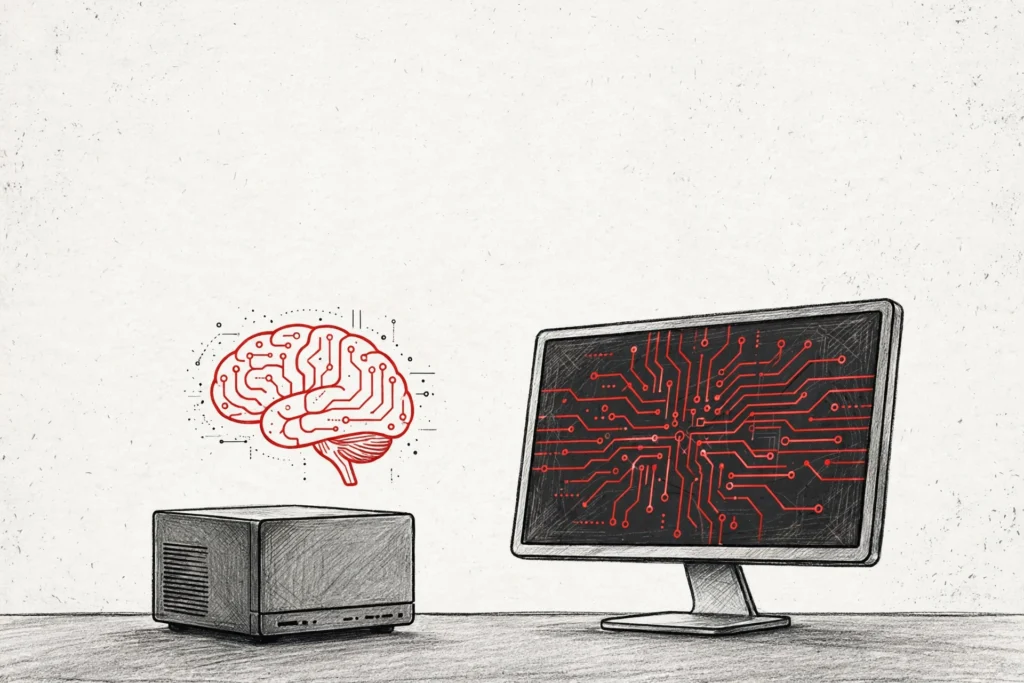
Picture a desk with a computer the size of a sandwich box. It has no tower, no tangle of cables, no fan roaring under load. Yet inside it sits enough AI power to run a 120-billion-parameter language model entirely on its own, with no cloud and no monthly subscription. That box went on sale this week.
Nvidia’s RTX Spark mini PCs have arrived. Asus, Dell and MSI are the first companies selling them, and the first machines are available to buy now. They are the desktop version of a chip Nvidia first showed in laptops earlier this year, and they mark the company’s clearest attempt yet to put serious AI hardware on an ordinary desk.
The price tells you who these machines are for. The Asus ProArt GR1X starts at $4,499. That is not a casual purchase, and Nvidia is not pretending otherwise. These are workstations for developers, researchers and creators who want their AI models running locally, not in a distant data centre.
What Are the New RTX Spark Mini PCs?
The launch came on November 18, when Nvidia confirmed that its RTX Spark N1X chip had moved out of laptops and into compact desktops. Asus, Dell and MSI are the first three vendors, with more systems from Acer, Gigabyte and HP expected to follow. Microsoft’s Surface RTX Spark Dev Box is also due to start shipping this month. Nvidia already sells a related machine, the DGX Spark developer kit, which clusters the same kind of Grace-Blackwell silicon for bigger jobs.
Every machine is built around the same silicon. The N1X is a Grace-Blackwell superchip that pairs a 20-core Grace CPU with a Blackwell RTX graphics processor carrying 6,144 CUDA cores. The two share a single pool of unified memory, up to 128GB of LPDDR5X, so the processor and the graphics chip never have to copy data back and forth.
Nvidia rates the platform at up to 1 petaflop of AI performance. That figure is a peak measurement at FP4 precision, the low-precision maths modern AI inference relies on. It is not a promise about how fast every application will run, but it is a useful signpost: a lot of compute for a box this small.
Inside the RTX Spark N1X Chip
The desktop version of the N1X runs harder than the laptop version. Where the laptop chips operate between 45 and 80 watts, the desktop chip is rated for 140 watts sustained. The extra thermal headroom in a desktop enclosure is what lets it hold its performance under a long workload instead of throttling back after a few minutes. AMD is attacking the same AI market from the server side, with 256-core EPYC 6 Venice chips built for the age of AI agents.
Memory is the real story here. The Asus GR1X runs its LPDDR5X memory at up to 300GB/s of bandwidth, and it comes in 64GB or 128GB configurations. On the 128GB models, the graphics allocation can rise to 96GB through Nvidia’s app, which is what lets very large models fit entirely in local memory.
Storage is handled by two M.2 slots, one PCIe 5.0 and one PCIe 4.0, for up to 4TB in total. Networking is 10Gb Ethernet alongside Wi-Fi 7 and Bluetooth 5.4, and the machine drives up to four screens through three USB-C ports with DisplayPort 2.1 support and one HDMI 2.1 port.
The 20-core Grace CPU was co-designed with MediaTek, and it runs on the Arm architecture. These machines run Windows on Arm, so most everyday x86 software still runs through emulation — a trade-off buyers need to understand before spending this kind of money.
The $4,499 Question: Who Are RTX Spark Mini PCs For?
Asus has set the price anchor. The ProArt GR1X starts at $4,499 for a configuration with 64GB of memory and 1TB of storage. MSI’s EdgeMesa N AI+ is listed at $4,699 for the same 64GB configuration, with the 128GB version climbing to $7,999 in some listings, though prices have shifted between retailers. Dell has not published full pricing yet.
For comparison, the RTX Spark laptops launched on October 16 at $2,599, and those include a screen, keyboard and battery. The desktops cost more for the same chip, but the 140-watt chip never has to worry about battery life, and the machine is designed to sit on a desk running all day.
Nvidia’s pitch is aimed squarely at developers. The company describes the machines as a “dedicated Windows PC for local models and always-on agents”. It is not a gaming PC that happens to run AI, and it is not a general-purpose desktop for a family. It is a machine for people who run AI agents and models as part of their daily work.
Local AI Is the Whole Point of RTX Spark Mini PCs
The strongest reason to buy one of these machines is privacy and control. A model running on your own desk never sends your data to a cloud provider. Your prompts, documents and code stay on hardware you own. For developers working with sensitive code, that alone can justify the price.
Nvidia says the most powerful configuration can run language models of up to 120 billion parameters locally, with a context window of one million tokens. That is the scale of model that normally lives in a data centre, and it is what makes the memory figure matter: a 120-billion-parameter model simply does not fit in the 32GB or 64GB of a typical desktop.
Always-on agents are the other half of the story. An agent that watches your inbox or monitors a system needs to run continuously, and running it in the cloud means paying for every token forever. A local machine turns that into a one-off hardware cost. Nvidia’s framing of these boxes as machines for “always-on agents” is a bet that this kind of computing becomes normal.
The software support is already there. The machines have native CUDA support, and Linux development tools are available through Windows Subsystem for Linux. AI-powered features in Adobe Premiere and Photoshop run on the hardware — Adobe has been pushing AI agents across Photoshop and Firefly — and Blender 5.3 gains DLSS 4.5 Ray Reconstruction support. Tools like ComfyUI, the image-generation workflow app, are also part of the pitch.
The Mac Mini Problem Nvidia Has to Solve
Every RTX Spark desktop will be compared with Apple’s Mac Mini and Mac Studio, and Nvidia knows it. Apple has spent years selling small, quiet, powerful desktops, and its machines run the same local models with a mature software ecosystem and a much lower starting price.
Nvidia’s answer is CUDA. Apple’s machines cannot run CUDA software, and a huge amount of AI development work is built on it. For a developer whose workflow depends on CUDA libraries, an RTX Spark box is the only small desktop that speaks the language natively. That is a real advantage, but a narrow one.
The Windows on Arm issue is the bigger obstacle. Most x86 applications still run through emulation on these machines, and emulation costs performance. Nvidia claims the desktops can run AAA games at 1440p above 100 frames per second with DLSS, but nobody has independently checked that claim on the desktop hardware yet.
What We Still Don’t Know About RTX Spark Mini PCs
The most important unanswered question is how these machines actually perform. A 140-watt chip in a 1.1-litre box is a thermal challenge, and small desktops have a long history of running hot and loud under sustained load. Until reviewers test long AI workloads, the 1-petaflop figure remains a lab number.
Pricing is also unsettled. Asus has published a price, MSI’s listings have moved between retailers, and Dell has said nothing at all. Some listings have shown thin or no stock, and Asus’s own product page was still offering a notify-me sign-up rather than a buy button in some regions. The launch is real, but it is not yet the kind of launch where anyone can click and buy.
What Happens Next for RTX Spark Mini PCs
The next wave is already scheduled. Acer, Gigabyte and HP are all preparing their own RTX Spark desktops, and Microsoft’s Surface RTX Spark Dev Box is due to start shipping this month. More vendors should mean more choice, and eventually more competition on price.
If that bet pays off, the RTX Spark mini PCs will look like the start of something. A petaflop of AI performance in a box the size of a paperback is genuinely new, and the idea of a personal AI computer that never phones home is easy to like.
Either way, the launch matters. Nvidia has taken its most powerful AI silicon and put it in a form factor anyone can carry home in a shopping bag. The question now is not whether the hardware is impressive. It is whether enough people have a job for it. According to Tech News Vision, which reported the launch, the first machines are on sale now.