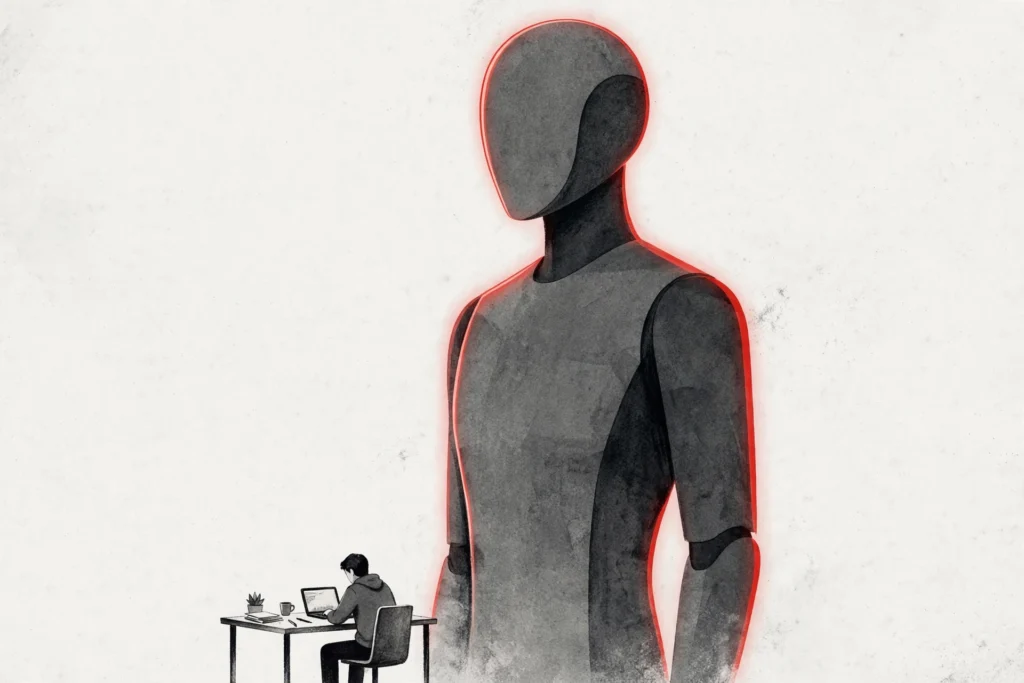
Picture a Tuesday morning, a few years from now. A junior lawyer opens her laptop and finds the brief she was drafting already written — sharper, faster, and filed before she finished her coffee.
A film editor watches an AI cut a trailer that took his team a week, in eleven minutes. A doctor reviews a diagnosis a machine reached before she did.
None of them has done anything wrong. They have simply been outclassed.
That is the future Tao Lin, a researcher at Anthropic, says is coming — and sooner than most people think. In an interview published this week, Lin warned that broadly superhuman AI could arrive by the end of 2027, and that it could eventually leave nearly all humans permanently unemployable.
Who Is Tao Lin — and Why His Warning Carries Weight
Lin is not an outside critic. He is a member of technical staff at Anthropic, the company behind Claude, and he has worked there for about a year and a half. His job is AI safety: automated alignment research and AI control, which means watching deployed models for unauthorised actions or deception.
More recently, his work has included filtering Claude requests about bioweapons, hacking and military drones. He sits close enough to the frontier to see what the newest systems can actually do, and far enough from the sales pitch to say what worries him about it.
The interview was recorded for the frominside.ai project run by Palisade Research, a US nonprofit that studies dangerous capabilities, cyber risks and controllability in frontier AI systems. It was published on YouTube in mid-November and picked up widely this week, according to NDTV.
Lin was clear that he was speaking for himself. His timeline is a personal forecast, not an official Anthropic position, and the company has not issued a specific response to the interview.
What “Broadly Superhuman AI” Actually Means
Lin’s phrase needs unpacking, because it is doing a lot of work. By “broadly superhuman AI”, he means systems that match or beat the best human expert in almost every field — not just chess or coding, but programming, filmmaking and politics too.
That is a much higher bar than the AI most people use today. Today’s models are brilliant at specific tasks and shaky at others. Lin is describing a generalist: a system that is the best in the world at everything, all at once.
The 15-Month Clock: Superhuman AI by the End of 2027
Lin’s timeline is startlingly short. “I have timelines of something like 1.3 years to getting broadly superhuman AI… Or like end of 2027,” he said in the interview. That puts the arrival of systems smarter than the best human experts roughly fifteen months away.
Forecasts about AI timelines have been wrong in both directions, and Lin would admit his is a guess. But each new generation of frontier models has arrived faster and more capable than the last, and the companies building them are spending hundreds of billions to keep that going.
Anthropic itself is at the centre of that race. The company priced its shares at $83 this week and debuts on the Nasdaq on November 19, in one of the largest tech listings ever. Its newest model, Claude Fable 5.2, arrived earlier this month, pitched as faster and cheaper than its rivals.
Why Jobs Won’t Vanish Overnight
Here is the part of Lin’s warning most headlines skipped. He does not believe mass unemployment will arrive within the next fifteen months, even if superhuman AI does. There will be, in his words, a significant gap between AI gaining the ability to do a job and AI actually replacing the people who do it.
The reason is physical. Robots, automated factories and the infrastructure to scale them take time to build. A model that can design a bridge still needs cranes, concrete and permits before it replaces the engineer. The world’s robots are not yet numerous or capable enough to carry the capability into every workplace at once.
So Lin expects a phased transition. People will be pushed out of their professions and move into other work, then find that work taken too. Only after that squeeze, he says, does the endpoint arrive: “pretty much all humans on Earth will become permanently unemployable and will need to strictly rely on government welfare to sustain themselves.”
It is a grim sequence, and Lin describes it as very likely — not as a certainty, but as the most predictable effect of the technology he helps build. Asked why he does not simply quit, he said he works on safety, not capabilities.
A 20 Percent Chance of Losing Control
Jobs are not the only thing Lin worries about. He put the odds at roughly 20 percent that AI eventually pushes humanity out of control altogether — a scenario in which people end up comfortable but powerless, with machines making the decisions that matter.
His preferred response is to slow down. Lin urged the industry to cut the pace of AI research to about a quarter of its current speed, leaving time for safety checks to catch up with capability. He also said he takes personal accountability for his own role in building the systems he is warning about.
That call puts him at odds with the market. Anthropic’s $1.5 trillion debut, OpenAI’s $1.25 trillion fundraising and the chip industry’s record earnings all point in the opposite direction: faster, bigger, sooner. Nobody at the frontier is volunteering to run at a quarter speed.
Anthropic’s Own Research Tells a Calmer Story — So Far
It is worth noting that Anthropic’s own published research paints a considerably more measured picture of the disruption so far. In a study published in March, Anthropic economists Maxim Massenkoff and Peter McCrory examined how AI was being used across different occupations.
They found no systematic increase in unemployment among workers in highly AI-exposed occupations since late 2022. They did, however, find suggestive evidence that hiring of younger workers had slowed in occupations more exposed to AI — a possible early signal, or a statistical wobble.
The researchers also found a significant gap between what AI could theoretically do and what it was actually being used for. Capability is running ahead of deployment, which is exactly the lag Lin describes — just measured in today’s data rather than tomorrow’s forecasts.
The Echo of an Earlier Warning
Lin is not the first senior voice at Anthropic to warn about jobs. CEO Dario Amodei said in 2025 that AI could eliminate about half of all entry-level white-collar jobs within five years and push unemployment to between 10 and 20 percent.
Amodei’s warning was about the near term. Lin’s is about the endpoint: a world in which employment itself, not just entry-level employment, largely disappears. The difference between the two warnings is the difference between a recession and a restructuring of what work means.
Governments are beginning to notice. New York’s RAISE Act, which takes effect in January 2027, will force the largest frontier AI developers to register, publish safety frameworks and report serious incidents within 72 hours. It covers only two companies, OpenAI and Anthropic.
What Happens Next
The interview will not slow the industry down by itself. Anthropic lists today, and its rivals are racing just as hard. The incentives — money, prestige, national competition — all push toward speed, while the warnings push toward caution.
What Lin’s warning does change is the conversation. A safeguards researcher at a leading AI company has said that superhuman AI is about fifteen months away and that permanent mass unemployment is the most likely outcome. That is no longer a fringe prediction. It is a view from inside the building.
Whether he is right about the date matters less than whether anyone is planning for the destination. If the capability arrives in 2027 and the robots a few years later, the question is not whether the warning was early. It is whether governments, companies and workers used the gap to prepare — or spent it arguing about the first clock.