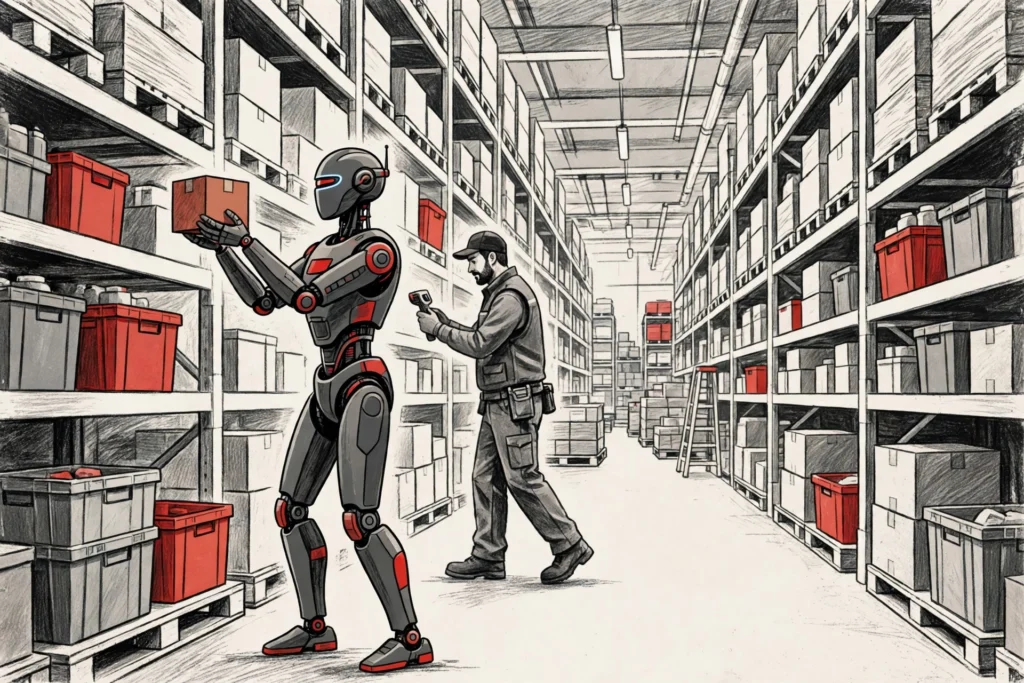
It is two in the morning in a warehouse the size of several football fields. A worker reaches for a small box on a shelf, scans it, and drops it into a tote. Beside her, a two-legged machine does the same thing — picking, scanning, moving on to the next shelf without a word.
That scene is no longer a demo video. On November 12, GXO Logistics, the world’s largest pure-play contract logistics provider, signed a letter of intent with Apptronik that could put up to 1,000 of the company’s Apollo humanoid robots to work in its warehouses over the next four years.
The deal is the biggest commitment to humanoid robots in warehousing yet. If the robots pass their tests, the first commercial deployments will begin in North America in late 2027 — and the warehouse floor will never look the same again.
What the GXO Apptronik Apollo Robots Deal Actually Covers
GXO and Apptronik announced the agreement on November 12, according to GXO. It is a letter of intent, not a binding purchase order, and that distinction matters.
Under the deal, the two companies will expand joint trials of Apollo in live warehouses starting in 2027. The robots will be tested across five kinds of work: goods-to-person picking, person-to-goods picking, case and tote movement, packing, and sortation.
Each job will be judged against productivity, safety, and operational targets the two companies have agreed on together. Only if Apollo clears those bars will the rollout move forward.
The commercial model is just as important as the robot count. GXO will not buy a thousand robots outright. Instead, the deployment will run as a Robotics-as-a-Service arrangement, meaning GXO pays for robotic labour as a service and scales the fleet up or down like any other service.
Apollo Humanoid Robots Have Already Been Tested in GXO Warehouses
This is not a cold start. GXO and Apptronik have worked together since 2024, when they began a proof-of-concept programme to find practical jobs for Apollo inside a warehouse.
Earlier this year, Apollo completed a successful pilot deployment at a GXO site in the United States, focused on autonomous picking of small consumer goods. The two companies have also run data collection and live autonomous evaluations on more than 50 different logistics tasks at Apptronik’s Robot Park training facility.
Apollo is built for exactly this kind of work: repetitive, physically demanding tasks that strain human bodies over long shifts. GXO says the technology should help with labour availability, improve throughput and uptime, and free employees to focus on higher-value activities.
“Humanoid robots are the latest evolution of intelligent automation, and their increasing dexterity will make them one of the most transformative applications of physical AI in logistics,” GXO chief executive Patrick Kelleher said in the announcement.
How Much Do Apptronik Apollo Humanoid Robots Cost to Run?
Neither company has disclosed a price for the deal, a per-robot cost, or a contract value. But Kelleher has talked openly about the economics elsewhere.
In an interview with FreightWaves in August, he said a humanoid’s operating costs — excluding the robot itself — run between $10 and $15 an hour today, and should fall below $10 within two years.
The price of the robots themselves should drop by half over the same period, he added. All in, he expects humanoids to cost $15 to $20 an hour within two years.
That is the number that matters. At that price, a robot working around the clock competes directly with human labour costs in many markets — and it never takes a sick day.
The robotics-as-a-service model makes the maths easier still. GXO does not need to spend hundreds of millions upfront. It rents robot hours, and if a site does not need the capacity, it does not pay for it.
Why GXO Is the Perfect Test Bed for Humanoid Robots
GXO is not a small experiment. The company employs more than 150,000 people across more than 1,000 facilities, covering over 200 million square feet of warehouse space.
It has spent years testing automation at scale, and it expects to have nearly 20,000 robots working across its network by the end of 2026. It has run more than 45 humanoid pilots with vendors including Agility, Reflex Robotics, and Apptronik.
That makes GXO the logistics industry’s biggest humanoid test lab — and the company whose verdict carries the most weight. If Apollo works inside GXO’s warehouses, it works anywhere.
“We started working with GXO in 2024, and through our partnership we’re defining what it takes to put humanoid robots to work in logistics — measured against real operational KPIs in live facilities, and delivering real value,” said Jeff Cardenas, Apptronik’s chief executive and co-founder.
Who Is Apptronik, the Company Behind Apollo?
Apptronik is based in Austin, Texas. It grew out of the Human Centered Robotics Lab at the University of Texas at Austin, and its engineers have built 15 robots before Apollo — including NASA’s Valkyrie humanoid.
Apollo 2, the current version of the robot, launched at the end of June alongside the company’s nearly 90,000-square-foot Robot Park facility, where robots train on warehouse tasks before they ever reach a customer site.
The company has raised around $935 million this year across a Series A round and an extension, and now employs close to 500 people. That funding gives it the runway to build robots at the scale GXO is talking about.
Apptronik describes itself as a human-centred physical AI company. Its robots are designed from the start to collaborate with people, not replace them in isolation — a point Cardenas stressed in the announcement.
The Catch: 1,000 Apptronik Apollo Robots Is a Ceiling, Not a Guarantee
For all the excitement, the headline number comes with a large asterisk. The agreement is a letter of intent, and the 1,000-robot figure is a ceiling, not a purchase order.
Everything depends on the 2027 trials. Apollo must hit the agreed productivity, safety, and operational targets in live buildings, use case by use case. If it falls short, the rollout stops — or shrinks.
The companies have not published the KPI thresholds, the trial sites, or any pricing. So the market is being asked to trust the process, not the paperwork.
That caution is sensible. Humanoid robots have a long history of impressive demos and disappointing deployments. GXO’s staged approach — pilot, measure, then scale — is designed to avoid exactly that trap.
Humanoid Robots Are Racing Into Real Work
The GXO deal lands in the middle of a fast-moving race to put humanoid robots into real jobs. Google DeepMind’s Gemini Robotics 2.5 recently put Apptronik’s Apollo 2 to work on automotive kitting at Mercedes-Benz plants, hitting 96% success rates.
Nvidia, meanwhile, is building the software brains for the whole category with its GR00T 2 robot foundation model, which learns by watching humans work. And startups like Hedra are building platforms that let robots improve themselves through training.
What makes the GXO deal different is scale and intent. This is not a research project or a marketing stunt. It is the world’s biggest contract logistics company laying out a path to a thousand robots — and saying it will pay for them by the hour, like any other workforce.
Other logistics giants will be watching closely. If GXO’s trials succeed, expect competitors to follow with their own humanoid orders. If they fail, the whole industry will learn what the limits are.
What Happens Next for GXO Apptronik Apollo Robots
The next checkpoint is public and dated. Expanded trials begin in 2027, with each warehouse workflow tested against the agreed targets in live operations.
The first commercial deployments are targeted for North America in late 2027. From there, the plan is a global rollout over four years — if the robots earn it.
For the workers on the warehouse floor, the change will arrive gradually. Apollo will start with the most repetitive jobs: picking small goods, moving totes, packing boxes. The human staff will shift toward the work robots cannot do — supervising, handling exceptions, and managing the flow.
Four years ago, the idea of a thousand humanoid robots in warehouses sounded like science fiction. Now it has a timeline, a customer, and a price target. The only question left is whether Apollo can hit its marks — and 2027 will give us the answer.
Source: GXO press release