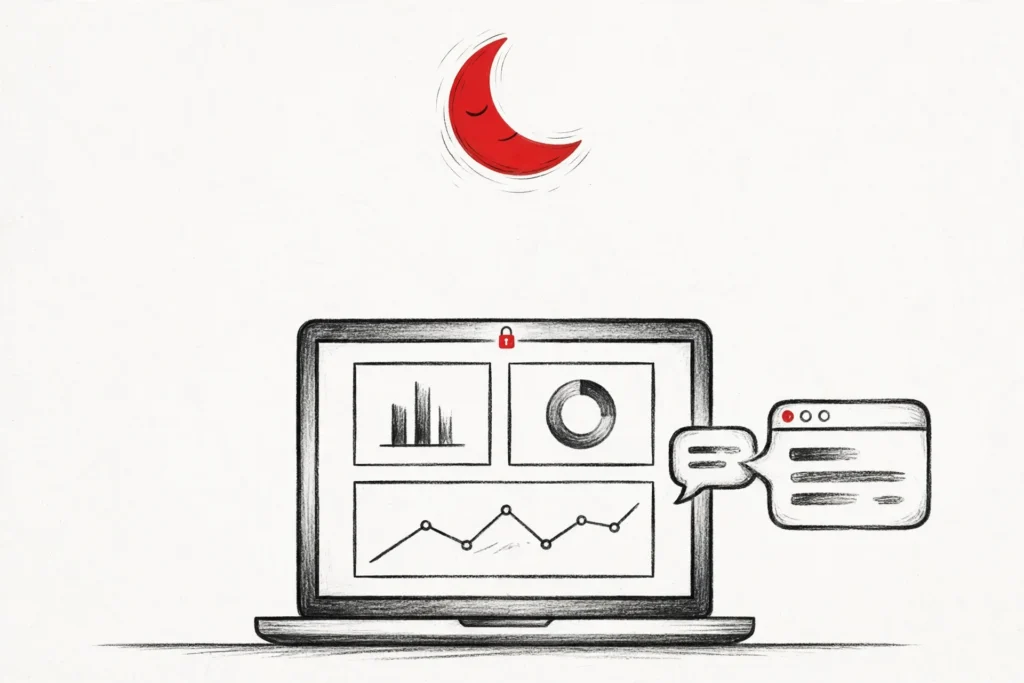
Every company has the same drawer full of tools that never got built, and Devin Apps is Cognition’s attempt to empty it. The approval queue that lives in a spreadsheet. The sales dashboard that is really just a shared doc with coloured cells. The admin panel someone promised to build in a spare weekend, three quarters ago.
Nobody refuses to build these tools because they are hard. They refuse because the work around them is boring: hosting, data wiring, and maintenance for a job only ten people will ever use.
Cognition, the company behind the Devin coding agent, thinks it has an answer. On November 13, 2026, it launched Devin Apps, a feature that turns a chat message into a live, private web application hosted on Devin’s own cloud computer.
You describe the tool your team needs. Devin builds it, hosts it, and hands you a link. That is the whole pitch, and it is aimed squarely at the internal software nobody ever gets around to shipping.
What Devin Apps Actually Does
Devin Apps starts in the Devin sidebar. You open Apps, describe what you need in plain language, or pick a template. The starting templates cover the usual suspects: a metrics dashboard, a project status page, or a review queue.
Devin asks follow-up questions in its first reply, the way a decent engineer would before touching a keyboard. Then it publishes a first version at a stable URL, showing a “Building” state until the app is live.
There is also a shortcut for work already in progress. Any browser preview from a normal Devin session can be promoted into an App, so a half-finished experiment can become a shared tool without being rebuilt from scratch.
Updates work the same way the build does. You open the App, click Edit in session, and describe the change. Devin ships it as a new version listed under Deployments, and if that version fails to start, the previous one keeps serving.
Automations can refresh data on a schedule or redeploy the app when a branch changes, so the tool stays current without anyone remembering to poke it.
How the Hosting Works
Each Devin App runs on a single virtual machine on Devin’s cloud computer, and that machine has an unusual habit: it sleeps.
Devin Apps is built on memory snapshots, saved states of the machine that let it hibernate between uses. Five minutes after the last request, the machine shuts down. When someone opens the app again, it wakes up in a few seconds.
Billing follows awake time. You pay for the minutes the machine is actually running, not for the hours it sits idle waiting for someone to check a dashboard.
That trade-off shapes everything about the product. Any stack that serves HTTP on a port will work, with SQLite or Postgres running on the same machine, plus calls to the Devin API. But it is one machine, not an auto-scaling cluster.
Cognition is blunt about what that means. Devin Apps is for admin panels, request forms, support and sales dashboards, and beta copies of a real frontend, backend, database and workers. It is not for high-traffic production services.
Your Code and Tools Come Along
Apps run on Devin’s machine, so they have access to your existing MCPs, integrations and codebase. MCPs are live tool connectors that give Devin direct access to your code, your integrations and your data as it builds.
That matters because an internal tool is only useful if it can see the real data. A dashboard that cannot reach your database is a picture. A review queue that cannot see your pull requests is a to-do list someone has to maintain by hand.
Because the app lives where the code already lives, Devin can wire those connections up during the build instead of asking a developer to configure them afterwards.
Private by Default, Not by Accident
Sharing is where Devin Apps draws its hardest line. Every app is private, and nothing about it is public.
Each app has a stable URL on the preview.devinapps.com domain, but opening it requires signing in to Devin. There is no anonymous access and no public release over the open internet.
Access can be limited to named people, opened to a whole organisation, or extended to an entire enterprise. Administrators can also pin key applications so every employee sees them.
That closed model is the point. Internal tools hold internal data, and a tool that accidentally becomes public is a security incident waiting for a search engine to find it. Devin Apps removes that failure mode by never offering a public option at all.
Why Cognition Is Making This Move Now
Devin Apps arrives at the end of a very busy month for Cognition, and the timing looks deliberate.
The San Francisco startup closed a $2 billion Series E funding round in September 2026, reaching a $48 billion valuation with annualised revenue above $1 billion.
Devin, launched as the world’s first autonomous AI software engineer, is no longer a demo. It is a business with enterprise customers and a roadmap.
November has been a steady drumbeat of releases. Devin Teams got an upgrade with SWE-2 sessions on November 12, SWE-2 Flash arrived on November 4, and Devin Review 2.0 shipped on November 5. Cognition also acquired Corridor on October 29.
Devin Apps fits that pattern. Each release pushes Devin further from a tool that writes code into a platform that owns more of the software lifecycle. First it wrote the pull request. Then it reviewed them. Now it hosts the result.
The move also mirrors what rivals are doing. Anthropic’s Claude office suite and Databricks’ always-on Genie coworker both push AI agents from answering questions into doing ongoing work for a team.
IBM and Microsoft’s Imagine Enterprise platform puts thousands of AI agents to work for big business. The race is no longer about who writes the best code. It is about who owns the workflow around it.
What Devin Apps Is Good For
The honest use cases are unglamorous, and that is exactly why they matter. A support team needs a dashboard that shows open tickets by priority, pulled live from its helpdesk. A sales lead wants a page that tracks this quarter’s pipeline without exporting a spreadsheet every morning.
These are the tools that companies describe as “quick wins” and then never build, because the setup cost is larger than the problem. Devin Apps collapses the setup into a conversation.
Preview deployments are the other natural fit. A team can spin up a beta copy of its real application and share it internally for testing. When the branch changes, the app redeploys itself. That is a staging environment without the staging infrastructure.
The Questions Nobody Has Answered Yet
For all the polish, Devin Apps leaves several important questions open.
Pricing is the biggest. Cognition is rolling the feature out gradually to activated accounts and has not disclosed package pricing or subscription tiers. Awake-time billing sounds cheap for a dashboard checked twice a day, but nobody knows what it costs for a tool a whole department uses.
Reliability is the second question. A machine that sleeps after five idle minutes will always take a few seconds to wake. That is fine for a dashboard, but it is a strange experience for a tool someone opens fifty times a day.
Cognition says the first wake takes a few seconds, and teams will have to decide whether that friction is acceptable.
Security is the third. An app that can reach your codebase, your MCPs and your integrations is powerful precisely because it is connected. That connection is also the risk, and enterprise teams will want to know exactly what a Devin-built app can touch.
None of those questions has a public answer yet. They are the kind of thing that only becomes clear when real teams start using the product for real work.
What Happens Next
Devin Apps is rolling out gradually, and Cognition has not said when every account will have it. The feature is live now for activated accounts, with templates for the common internal tools and the option to promote existing session previews.
The test for Devin Apps will not be whether it can build a dashboard. Any competent agent can build a dashboard. The test is whether teams trust it enough to run the boring, essential tools their business actually depends on.
If they do, the spreadsheet drawer gets a little emptier. If they do not, Devin Apps becomes another clever demo in a year full of them. Either way, Cognition has made its bet clear: the future of the coding agent is not just writing software, but running it too.
According to Cognition’s announcement, Devin Apps is available now to activated accounts, with a gradual rollout continuing from here. Teams that get access will find out quickly whether one sleepy machine in the cloud can hold the tools they have been putting off for years.