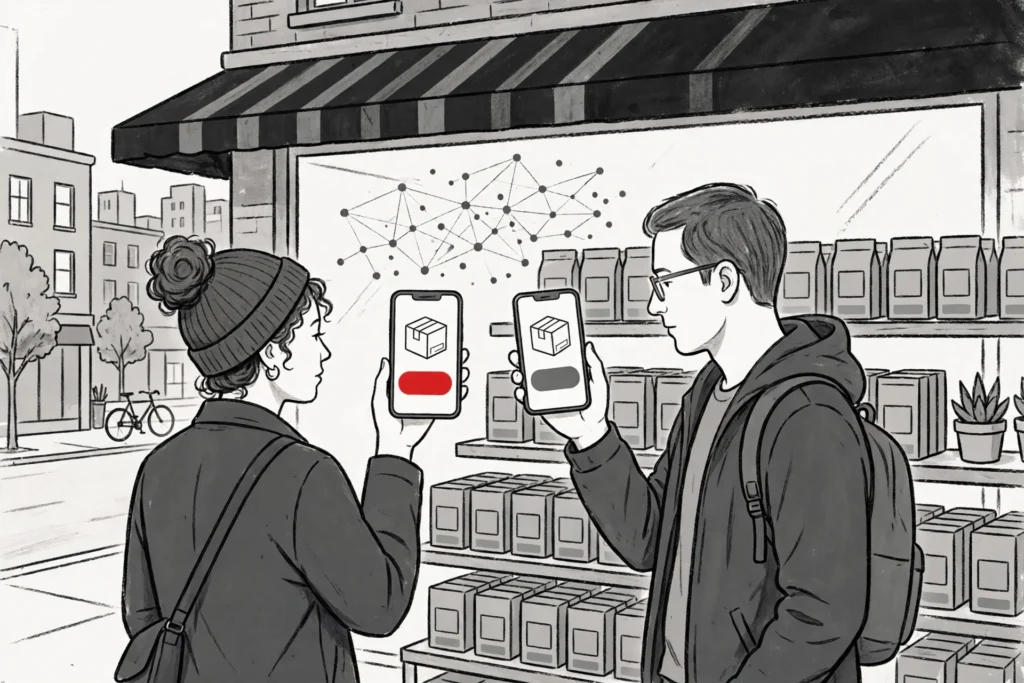
Picture two shoppers standing side by side in the same New York store, reaching for the same box of cereal. One scans the barcode and sees $4.99. The other sees $6.49. Same shelf, same product, same moment — different price.
Neither of them did anything wrong. One of them simply looked more willing to pay. That quiet difference is called surveillance pricing, and on Thursday, November 12, New York City voted to ban it.
The City Council passed Introduction 891-A by 44 votes to 5, in what the Council itself described as one of the strongest surveillance pricing bans in the country. The bill now sits on Mayor Zohran Mamdani’s desk for signature.
He has already said he supports it, and the Council’s legislative record lists its status as enacted and awaiting his signature. When he signs, the clock starts: the law takes effect one year after it becomes law.
What Is Surveillance Pricing?
Surveillance pricing is what happens when a company uses your personal data to decide how much you should pay. The price is set completely or in part by an algorithm that feeds on information about you.
That information can include your browsing history, your location, your shopping habits, your demographics, even your social media activity. The algorithm then offers a different price to different customers for the same goods or services.
The idea is simple and unsettling. A retailer that knows you usually buy a product at full price has no reason to offer you a discount. An airline that knows you have searched for the same flight three times can nudge the price up on the fourth.
None of this is science fiction. Uber, Lyft, Target, Instacart and several airlines have all faced public scrutiny over the practice, according to the Times of India. Consumer advocates have warned for years that the technology to personalise prices has quietly outrun the rules meant to keep pricing fair.
The problem is not that prices vary. Prices have always varied. A student discount, a loyalty coupon, a sale on a slow Tuesday — all of those are visible, and anyone can claim them.
Surveillance pricing is different because it is invisible. You cannot see the price your neighbour was offered, and you cannot know what the algorithm learned about you before it quoted you a number.
What the 44-5 Vote Actually Bans
The new law is deliberately broad. It bars any business from setting prices, wholly or partly, through an algorithm that uses a customer’s personal data to charge different prices for the same thing.
The definition is written to catch the practice in all its forms, whether the sale happens online or at a shop counter.
It also bars companies from collecting, using, selling, retaining or sharing personal data for the purpose of making surveillance pricing possible. The data pipeline that feeds the pricing engine is part of the ban, not just the final number on the screen.
It also stops companies from advertising, promoting or publishing a price that was set this way. A retailer cannot quietly run personalised prices and then advertise the lowest one as though everyone gets it.
The law was sponsored by Council Speaker Julie Menin, who framed it as a consumer protection measure. Speaking at City Hall, she called surveillance pricing an unfair practice that could quietly hurt ordinary shoppers.
The measure passed the Council’s Committee on Consumer and Worker Protection 10-0 on the same day as the full vote, a sign of how little opposition it faced inside the chamber.
The Fines — and What’s Still Allowed
Enforcement falls to the city’s Department of Consumer and Worker Protection, which gains broad authority to investigate suspected violations. Companies that break the law face civil penalties of up to $1,000 per violation.
Each affected consumer or transaction can count as a separate violation — a structure that could turn a single pricing scheme into a very expensive mistake. The department also plans to use its new Research and Analytics Division to audit algorithmic compliance.
The legislation also requires companies to maintain procedures that let consumers ask what data was used to determine the price they were shown. That transparency rule matters: it gives shoppers a way to challenge a price instead of simply accepting it.
Importantly, the ban is aimed at discriminatory pricing, not at every form of variable pricing. Genuine discounts, coupons, loyalty rewards and group discounts — for veterans, seniors and similar groups — remain allowed, because they are transparent and open to everyone who qualifies.
Why New York Acted Now
New York is not the first place to move against the practice, but it is the biggest. Seattle became the first US city to ban surveillance pricing, according to Supermarket News, and New York City now becomes the second.
At the state level, the New York Legislature passed its own ban, the One Fair Price Act, in June — though that bill is still awaiting Governor Kathy Hochul’s signature.
Together, the city ban would make New York the fifth US jurisdiction to outlaw surveillance pricing, and lawmakers in other cities and states are watching closely.
The timing is no accident. Artificial intelligence has made personalised pricing cheaper and more powerful than ever. The same technology that lets a shop personalise a recommendation lets it personalise a price.
New York has already moved to regulate AI in other ways this year, with the RAISE Act requiring large AI developers to register and report safety incidents. The surveillance pricing ban extends that instinct to the checkout.
There is also a privacy dimension that goes beyond money. The same data that sets your price is the data that reveals your life, so limiting how it can be used for pricing also limits the incentive to collect it.
What Happens Next
The immediate next step is the mayor’s signature. Mamdani has publicly backed the bill, posting that New Yorkers’ personal data should never be used as a weapon against them, and there is no sign he will hesitate.
Once signed, businesses get a year before the ban takes effect — a window that was lengthened from 120 days in an earlier draft, after industry groups argued they needed time to rework their systems.
That year will be busy. Large retailers, delivery apps, ride-hailing companies and airlines that operate in the city will need to audit their pricing systems and strip out personal-data inputs.
Some will simply turn off personalised pricing for New York customers. Others may rebuild their systems entirely, since running two different pricing engines — one for New York, one for everywhere else — is expensive and complicated.
The state bill remains a wild card. If Governor Hochul signs the One Fair Price Act, the same rules would apply across all of New York, removing the incentive for companies to treat the city as a special case.
If she does not, the city law still stands on its own — and other cities may follow New York’s lead before the state acts. Legal challenges are also likely, as industry groups have argued elsewhere that pricing bans interfere with how businesses operate.
What It Means for You
For shoppers in New York, the practical effect is straightforward: the price you see should be the price anyone sees. A company can still offer you a coupon, a loyalty discount or a sale price.
But it cannot quietly charge you more because its algorithm decided you would pay it. For everyone else, the vote is a signal about where the rules are heading.
The tools that make surveillance pricing possible — the tracking, the profiling, the real-time price experiments — are the same tools that power much of the modern internet. They range from AI systems that read your emails and files to patented AI that can rewrite live speech.
The question New York has answered is whether companies should be allowed to turn that knowledge into a price tag. The Council’s answer, by 44 votes to 5, was no.
That answer will echo beyond the city’s borders. When the largest city in America bans a practice, the companies that used it have to decide whether it is worth keeping anywhere.
For millions of shoppers who never set foot in New York, the vote in the Council chamber on November 12 may be the moment the price on their screen finally became the same as everyone else’s.