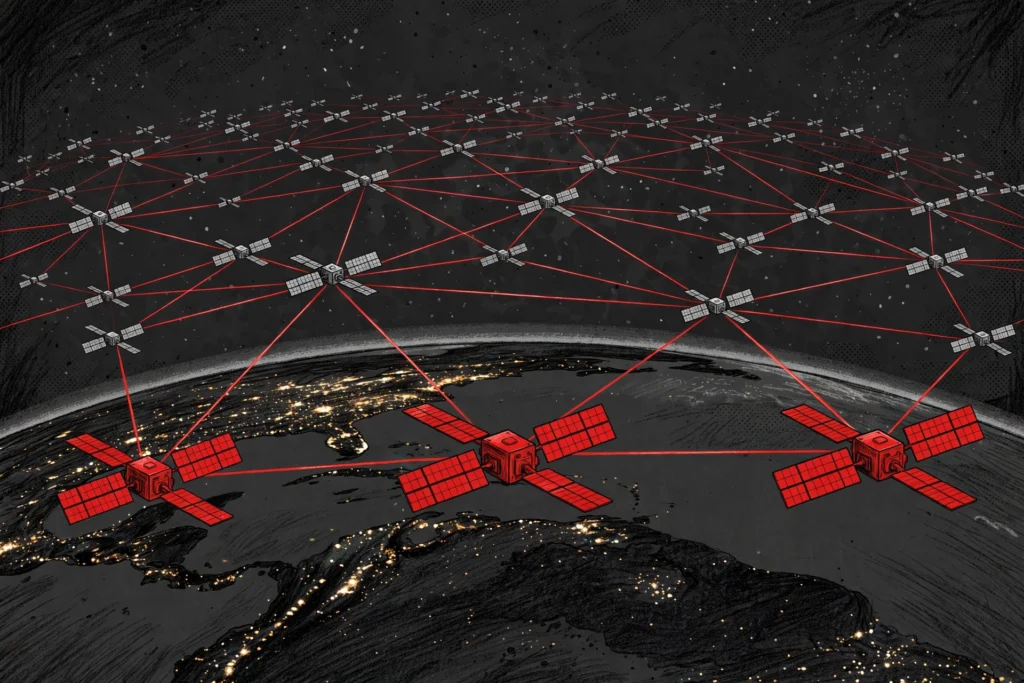
On a clear night in 2040, the sky above you might look a little busier than it does today. Not with stars, but with machines — a million of them, quietly thinking.
That is the future the US Federal Communications Commission opened the door to on Wednesday, when it approved SpaceX Starmind, a plan to put one million AI data center satellites into orbit.
The decision, announced on November 25, 2026, is the first time the United States has ever authorised a constellation of space-based data centers. SpaceX now has permission to build the largest satellite network ever conceived — roughly fifty times the number of satellites currently circling the Earth.
What Is SpaceX Starmind?
Starmind is SpaceX’s answer to a problem that has started to worry the whole AI industry: where will all the computing power come from? Training and running today’s AI models takes enormous amounts of electricity, land and cooling water. SpaceX’s idea is to move the computers off the planet entirely.
Each Starmind satellite would be a small, solar-powered data center in its own right. Thousands of them would link together with high-bandwidth laser beams, forming one giant computer in the sky. The satellites would process AI workloads in orbit and beam the results back down to Earth.
SpaceX describes the concept as “capturing solar energy in space to power low-cost, high-performance AI compute for Earth.” In space, sunlight is constant and unfiltered by clouds or night. A satellite never has to wait for sunrise, and it never needs a river or a cooling tower to stay cold.
The company first put the idea on paper in an application to the FCC on January 30, 2026. Ten months later, the regulator said yes — mostly.
A Million Satellites: The Scale of the Approval
The numbers behind SpaceX Starmind are hard to picture. Right now, about 17,000 satellites orbit the Earth in total. SpaceX’s own Starlink broadband network accounts for just over 11,000 of them. Starmind alone would add up to one million more.
That is not a rounding error. It would increase the population of working satellites in orbit by roughly fifty times. No company, and no country, has ever attempted anything close to that scale.
The satellites would fly in shells between 500 and 1,002 kilometres above the Earth, at 30-degree and sun-synchronous inclinations. They would talk to each other mainly through lasers, with radio links kept only as a backup for emergencies and for keeping track of the fleet.
Why Put AI Data Centers in Space?
The timing is no accident. Demand for AI computing has exploded, and the data centers on the ground are struggling to keep up. Power grids in parts of the United States are already stretched, new data center projects face years of waiting for grid connections, and local communities are pushing back against the water and electricity these buildings consume.
Space offers a way around all three problems at once. Solar power in orbit is abundant and free. The cold vacuum of space is a natural cooling system. And nobody complains about a data center’s noise or water use when it is 500 kilometres overhead.
That logic is not unique to SpaceX. Google and Blue Origin are both pursuing their own orbital data center plans, according to Gizmodo, and the FCC said it is still reviewing other proposals in the same field. SpaceX is simply the first to get a green light.
There is also a strategic angle. The FCC’s chairman, Brendan Carr, framed the decision as a matter of national leadership.
“This action opens a bold new frontier for the computing infrastructure needed to power America’s leadership and growth,” he said in a statement. “By moving compute capacity beyond Earth, SpaceX and the many competitors working on their own orbital data centers are meeting the moment.”
The FCC’s Conditions — and What It Didn’t Approve
The approval comes with a long leash, but it is a leash. SpaceX must launch its first working Starmind satellite by November 2033.
After that, the milestones get steep: 10 percent of the constellation — 100,000 satellites — by November 2035, half of it by November 2038, and the full million by 2040. Miss a deadline, and the authorisation becomes void.
That gives the company seven years to get the first satellite up and fourteen years to finish the job. SpaceX has said it hopes to move much faster.
Its chief financial officer, Bret Johnsen, said last week that the company plans to launch its first orbital data centers in 2027 and expand through 2029. Elon Musk has previously said a demonstration could come by late 2027, with wider deployment as early as 2028.
Not everything SpaceX asked for was granted. The company wanted permission to move satellites flying above 600 kilometres into so-called graveyard orbits at the end of their lives, instead of bringing them down to burn up in the atmosphere. The FCC deferred that request, saying SpaceX had not provided enough information about its disposal plan.
The radio licence is also narrow. SpaceX may use radio frequencies only for backup and emergency telemetry, tracking and command. The real work of moving data between satellites must happen over lasers.
The Objections: Debris, Astronomy and the Night Sky
The approval did not come quietly. Amazon’s Kuiper Systems, the satellite operator Viasat and the American Astronomical Society all filed petitions asking the FCC to deny the application. Their concerns were orbital debris, congestion, radio interference and the effect on ground-based astronomy.
The FCC denied all three petitions. It also declined to carry out a comprehensive environmental assessment of the constellation, arguing that several of the concerns raised fell outside its regulatory authority. The Secure World Foundation had urged regulators to assess the cumulative risks to orbital sustainability before granting approval.
Astronomers have a specific worry. A million new satellites, even small ones, would reflect sunlight and streak across telescope images. The American Astronomical Society warned that the constellation could significantly interfere with ground-based astronomy — a field that has already had to adapt to Starlink’s 11,000 satellites.
Then there is the debris question. With a million objects in orbit, even a tiny failure rate would mean thousands of dead satellites drifting through crowded shells. The FCC’s decision to defer the graveyard-orbit question leaves one of the biggest safety issues unresolved for now.
What Happens Next for SpaceX Starmind
A licence is not a launch. Building a million satellites and getting them into orbit will require a launch rate and a payload capacity far beyond anything conventional rockets can provide economically. That is where SpaceX‘s giant Starship rocket comes in.
Money is the other open question. SpaceX has not said what Starmind will cost, and the FCC did not publish an estimate. The company disclosed in filings ahead of its planned initial public offering in June that satellite deployment could begin as early as 2028, but the price tag of a million-satellite constellation remains anyone’s guess.
For now, the race is on. SpaceX has the first approval, its rivals are lining up behind it, and the regulators have signalled they are willing to say yes.
The next milestone to watch is not in 2033 — it is whether SpaceX can put a working orbital data center in space by 2027, as its own executives have promised.
Why SpaceX Starmind Matters
Whether Starmind ever reaches a million satellites or not, the FCC’s decision marks a turning point. Computing is no longer something that only happens in buildings on the ground.
The same forces that pushed AI into giant data centers — the hunger for power, the need for cooling, the search for scale — are now pushing it into orbit.
For the AI industry, the approval removes one of the biggest obstacles to a space-based future: the paperwork. For astronomers and satellite operators, it raises the stakes of a debate about who gets to use the sky. And for everyone else, it is a reminder of how fast the frontier is moving.
A decade ago, the idea of a data center in space sounded like science fiction. As of this week, it has a licence, a deadline and a name: SpaceX Starmind. The night sky may never look quite the same again.
Source: Reuters