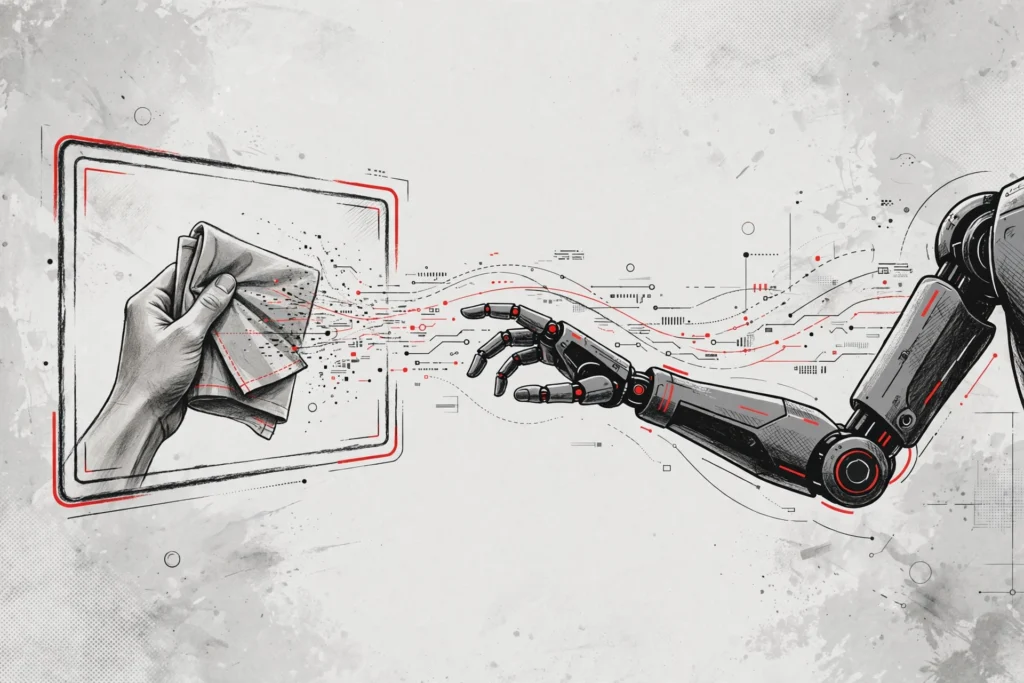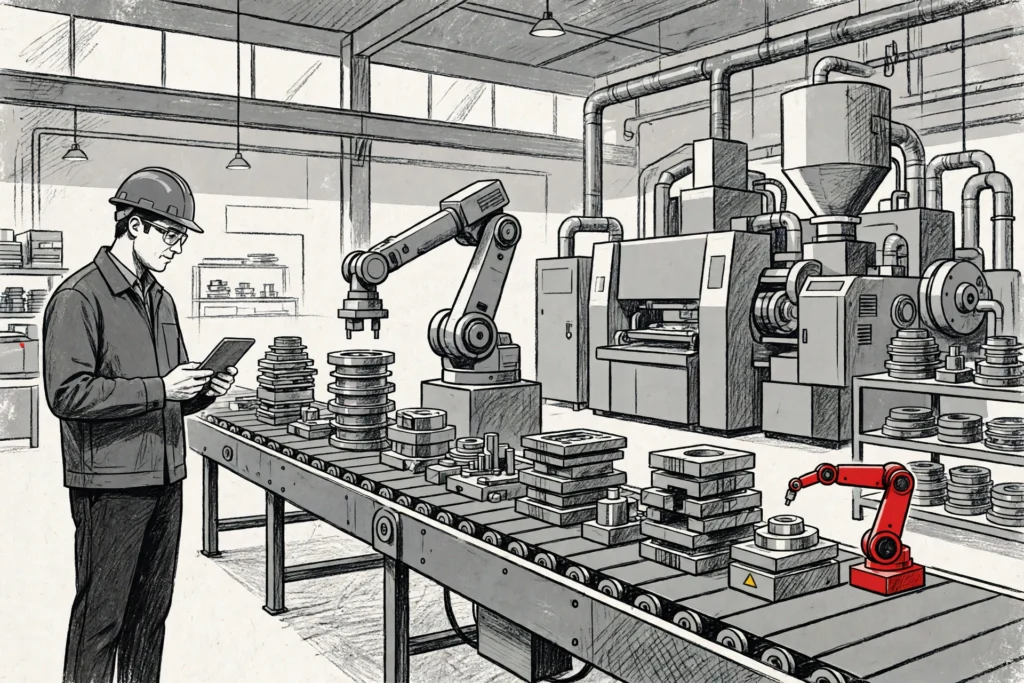
The clipboard has ruled the factory floor for a hundred years. Claude for Manufacturing, a new plugin announced on November 13, brings 17 ready-made AI skills to the people who run production lines — and plugs Claude straight into the design files, purchase orders and production records where the real work happens.
It is Anthropic’s most practical move yet. The company has spent the past month shipping workplace tools, from an office suite to a managed-agents beta, and this one is aimed at the least digitised corner of the economy: the factory.
Manufacturers, Anthropic says, are drowning in work their experienced people have no time to finish. The plugin’s answer is to take the repetitive back-office jobs off their plates, while leaving every real decision in human hands.
What Claude for Manufacturing Actually Does
The plugin is a set of 17 preconfigured skills that sit inside Claude. Each one handles a specific factory job: preparing a quote, documenting a failed inspection, diagnosing a machine fault, sourcing a part, or pulling together production data for a report.
Crucially, Claude is not working from a blank page. The plugin connects to Autodesk Fusion, Infor, Microsoft 365 and Oracle NetSuite, according to Dataconomy, so the AI can read the same design files, order books and spreadsheets the team already uses.
The skills span six areas: sales, quality, operations, supply chain, design and setup. A plant manager can ask for output against target, downtime and what both cost. A buyer can ask Claude to draft a request for quotation and compare the bids that come back.
From a Failed Inspection to a Finished Report
Take the quality engineer. A part fails inspection on the line, and the usual routine begins: photos, notes, and a hunt through old reports to see whether this defect has shown up before.
With the plugin, Claude documents the incident, searches past reports and email histories for similar defects, ranks the most likely causes, and drafts the corrective-action report. The engineer still reviews it — but the hours of digging are gone.
The same pattern repeats across the plant. An estimator hands Claude a customer request and gets back a list of missing information, cost comparisons with similar jobs, and a draft quote. A technician feeds in sensor data, repair notes, photos and the operating manual, and Claude works through the likely causes of a machine failure.
Lauren Collett, Anthropic’s head of enterprise industries go-to-market, put it plainly: manufacturers told the company they have “more work than their experienced people have time to get through.” The tools, she said, aim to cut repetitive back-office work and help companies get more from the staff they already have.
Claude for Manufacturing Meets Autodesk Fusion and Infor
The deepest integrations are with the systems factories already run on. An Autodesk Fusion user can ask Claude to create design variations — a lighter version of a metal bracket, for instance — and score each one against strength, weight and cost.
Infor, meanwhile, released its own plugin on the same day. The Infor connector inside Claude for Manufacturing permits record lookups, while a second tool, Infor Industry AI for Claude, lets authorised users change records too, subject to their Infor permissions.
Infor’s chief executive, Kevin Samuelson, said manufacturers “need answers grounded in how their business really runs, and then the ability to act on them.” His example: a buyer learns a steel shipment will be two weeks late.
Claude can work out which customer orders are affected and how much steel other sites hold. With the buyer’s approval, it can issue a purchase order to another supplier and reschedule production around the gap.
The One Thing Claude Will Not Do
For all its reach, the plugin stops at a hard line: Claude for Manufacturing does not operate equipment. No machine moves, no valve opens, no line restarts because the chatbot said so.
That boundary matters. Factory floors are places where a wrong command can injure someone or scrap a shift’s output. Anthropic is keeping Claude in the office of the factory, not on its controls — for now.
The company is separately developing a research preview called the Model Hardware Standard, intended to give programmable machines a common language for measurements, settings and safety limits. It is an early signal that Anthropic is thinking about the machine layer, carefully, rather than rushing into it.
Why Factories, and Why Now
The timing is no accident. A 2025 Manufacturing Leadership Council survey found that 79% of manufacturers said they still entered data manually. The factory floor runs on software, but much of the paperwork around it is still done by hand.
That gap is exactly what Claude is built to close. The plugin processes individual jobs or task sequences until a human must review the output — a design that fits a world where the cost of a mistake is measured in scrapped parts and missed deliveries.
There is also a defensive logic to the move. Factory data is messy, scattered across decades-old systems, and hard for a generic chatbot to use. By building skills that speak the language of bills of materials, inspection reports and purchase orders, Anthropic claims ground its competitors would have to rebuild from scratch.
It also fits Anthropic’s wider strategy. The company launched its Claude office suite earlier this week, taking on Microsoft and Google in the workplace, and it is heading toward a public listing with a valuation that could reach $1 trillion. Manufacturing is a huge market its rivals have barely touched with AI assistants.
Microsoft and Google sell factory software too, but neither has put a general-purpose AI assistant this deeply into the daily jobs of estimators, technicians and buyers. Anthropic is betting that the factory floor, not the boardroom, is where the next AI battle is won.
What Happens Next
Enterprise and Team users can install the plugin through a prompt inside Claude. Once installed, Claude checks which systems are connected and flags any skills that are unavailable — so a team without NetSuite, say, simply does not see those skills.
Infor Industry AI for Claude is available to select Infor Velocity Suite customers who hold their own Claude licences. Anthropic plans to release more manufacturing skills, and it has scheduled a technical webinar on the plugin for November 17 at 11 a.m. Eastern time.
The real test will come on the factory floor itself. If the plugin saves an estimator an afternoon, or catches a defect pattern a tired engineer missed, it will spread plant by plant. If it produces confident-sounding answers that fall apart under review, the clipboard will win another round.
Anthropic is not the only company eyeing the plant. Microsoft and Google both sell industrial software, and startups have pitched AI for predictive maintenance for years. But most of those tools were narrow: one job, one machine, one dashboard. Claude for Manufacturing is broader by design, covering a factory’s whole back office in a single plugin.
For now, though, the direction is clear. AI assistants have spent two years learning to write emails and summarise meetings. Claude for Manufacturing is their first serious attempt to learn how things get made.