Picture the scene on a Thursday morning in mid-November. The opening bell rings on the Nasdaq, and a company most people had never heard of a few years ago starts trading at $111.50 a share.
Within hours, Anthropic — the maker of the Claude AI assistant — is worth roughly $2 trillion on paper. By the closing bell, its shares settle at $97.17, still 17% above the $83 IPO price.
The headlines that day were all about the money. The biggest initial public offering in history. A record $81.3 billion raised. Thousands of new AI millionaires minted overnight.
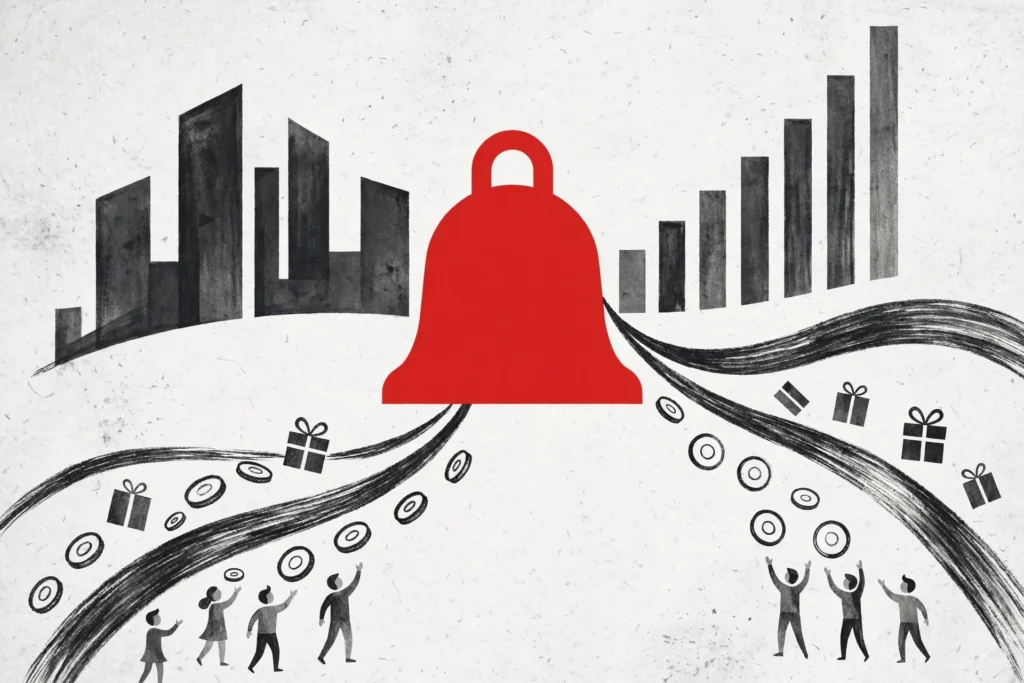
But the most extraordinary number from Anthropic’s debut may not be the one on the stock ticker. According to TechCrunch, the IPO could ultimately route around $156 billion toward philanthropy — one of the largest charitable windfalls ever created by a single company.
A record IPO with a conscience built in
Anthropic did not stumble into this by accident. The company was founded by former OpenAI employees, and its leadership grew out of the effective altruism movement — a philosophy that treats doing the most good possible as a serious, evidence-driven project.
That thinking was baked into the company long before bankers got involved. Anthropic is a public benefit corporation, which means its directors are legally required to weigh the public good alongside shareholder returns.
It is now by far the largest publicly traded public benefit corporation in the world. Its seven founders still hold 50.1% of the voting control, and an independent trust can appoint several board members.
The structure is being tested in real time. Anthropic’s business is booming — third-quarter revenue reached $17 billion, up more than 1,100% on the same period a year earlier — but the company also carries enormous spending commitments.
It needs about $70.7 billion just to cover compute and infrastructure spending over the next 12 months, and it has disclosed roughly $1.05 trillion to $1.08 trillion in infrastructure commitments in total.
The $80 billion Public Benefit Fund
The centrepiece of the Anthropic IPO charity story is the company’s Public Benefit Fund, or PBF. It works a little like OpenAI’s foundation, and it was allotted 5% of Anthropic’s shares — almost 850 million of them.
At a recent trading price of about $95, that stake is worth roughly $80 billion. That alone would make the fund one of the biggest charitable endowments on the planet.
The fund could grow further. Anthropic may add another 2% of shares every time the company’s valuation climbs more than 50% above the $83 IPO price — the next threshold sits at about $124.50 a share.
Its first commitment is already public: $200 million to study the impact of AI on workers. Anthropic has also said it will consider donations to philanthropic organisations, or even direct distributions to specific populations.
That last phrase has raised eyebrows. It reads like a hint that the fund could one day experiment with something resembling a universal basic income, paid for by AI profits.
Founders cash out — then promise 80% away
The seven founders did not walk away empty-handed. Each of them sold about 3.4 million shares in the IPO, pocketing roughly $280 million apiece before underwriting fees and taxes.
Between them, the founders cashed out nearly $2 billion from the record-breaking listing. It is a staggering sum for a group that has always presented itself as motivated by mission rather than money.
Anthropic’s IPO filings suggest the founders are not entirely in it for the money, though. Each co-founder has pledged to dedicate 80% of their personal equity in the company to philanthropy.
There is an important catch. The company itself points out that these commitments are voluntary and revocable — expressions of philanthropic intent, not legally binding obligations.
If any founder finds it hard to live on the quarter of a billion dollars they just banked, they can scale the pledge back. The promise is real, but so is the escape hatch.
The employee match that could add $76 billion
The third channel is the one most people missed: Anthropic’s own employees. Roughly half of them are taking part in an equity-donation matching programme, pledging shares to causes of their choice.
The company matches those gifts generously. Longer-tenured employees get a 3-to-1 match, while newer staff get a 1-to-1 match — turning every donated dollar into two or four.
In its S-1 filing, Anthropic said it had reserved more than 550 million shares to fulfil pledges made before September 30. Working backwards from that figure, TechCrunch estimates employees have pledged about $23 billion of donations.
The company’s match on those pledges would be worth roughly $53 billion, depending on the share price when the matches are delivered. Together, the employee channel alone could be worth $76 billion.
Add the three channels together — $80 billion from the Public Benefit Fund, $23 billion in employee pledges and $53 billion in company matches — and you reach the $156 billion figure.
All told, roughly 20% of Anthropic’s shares are now earmarked for public-good initiatives. It is a share of the company no other tech giant has ever set aside.
Why $156 billion is a promise, not a cheque
Before anyone starts spending it, the caveats matter. Every dollar in the $156 billion estimate is a moving target, because it is denominated in shares whose price has already swung dramatically since the debut.
Employees still have to make good on their pledges, and the value of the company’s match will depend on when Anthropic actually delivers it. Some of the shares could also end up in donor-advised funds, which would limit their immediate impact.
Where will the money go? Interviews with employees and institutions suggest the most likely recipients are effective-altruism-flavoured charities such as Longview Philanthropy, GiveWell, Coefficient Giving, the Foresight Institute and Giving What We Can.
To put the scale in context, total charitable giving in the United States reached $617 billion in 2025. Anthropic’s commitments would equal roughly a quarter of that entire national figure.
Anthropic has also shown it is willing to give locally. The company announced a $50 million donor-advised fund for Bay Area philanthropy on November 10, and donated $50 million to the city of San Francisco last week.
A company spokesperson told TechCrunch that the San Francisco donation did not come from the Public Benefit Fund — a sign that the giving is happening through several separate channels at once.
What happens next
The charitable windfall is already drawing attention in Washington. Four senators have introduced bipartisan legislation that would require publicly traded companies to disclose more information about AI, according to The Neuron.
Anthropic’s debut has also put its governance model under the microscope. A public benefit corporation must balance shareholder returns with its mission to develop AI safely — and its shareholders now include some of the biggest names in tech.
Amazon and Google will together own nearly 30% of Anthropic after the IPO, according to TechCrunch. That gives the two giants a large stake in a company whose charter tells it to put safety ahead of profit.
For now, the $156 billion figure remains a projection, not a bank balance. It depends on employees keeping their word, founders keeping theirs, and a share price that has already swung by double digits in a single day.
But even if only part of it materialises, Anthropic’s IPO has already done something no listing has done before. It has turned a stock-market debut into the largest charitable funding experiment in corporate history — and the whole world will be watching to see whether the money follows the mission.
For the full picture of the listing itself, read our earlier coverage of Anthropic’s IPO and its trillion-dollar valuation, and how TSMC’s $1 billion bet on Anthropic and OpenAI fits into the same story. The contrast with OpenAI’s $10 billion quarter — and its widening loss — shows just how unusual Anthropic’s finances really are. The charity estimates in this article come from TechCrunch’s reporting on the IPO’s philanthropic windfall.