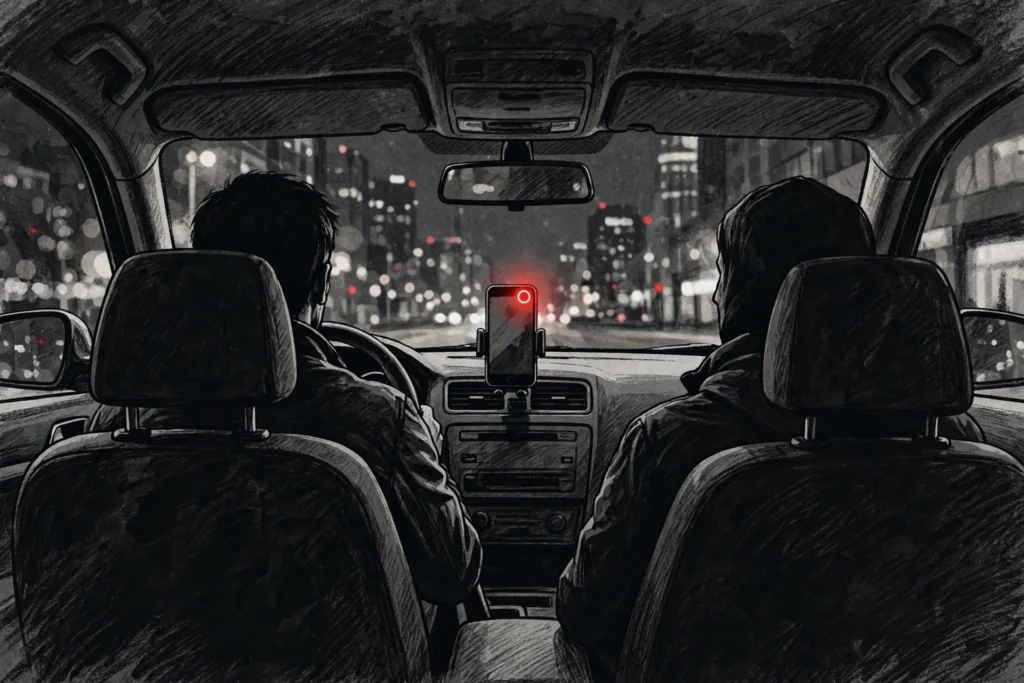
It is past midnight in Baltimore, and the streetlights slide past the windows of your Uber. You settle into the back seat, check the driver’s name, and then notice a small red glow from the phone on the dashboard. The camera is on. With Uber Recorded Rides, that is the ride you chose.
For the first time, that is not one driver’s dashcam. It is a booking option. Uber’s new feature lets passengers book a trip that is filmed from start to finish, and the idea is simple: when everyone knows the camera is rolling, everyone behaves better.
What Uber Recorded Rides Actually Does
Uber announced Recorded Rides on November 23, and it is already live in four American cities: Baltimore, Indianapolis, St. Louis and Raleigh, North Carolina. When you open the app there, a new choice appears on the booking screen next to UberX and UberXL.
Tap it, and Uber matches you with a driver who has switched on its recording tool, Record My Ride. The driver’s phone, mounted on the dashboard, uses its front camera to film the cabin for the whole trip. Video and audio are both captured, from pickup to drop-off.
Choosing the option costs nothing extra. According to TechCrunch, the fare is the same as a standard trip, so safety comes with no surcharge. The catch is availability: the option only appears when a recording driver is nearby, so in quieter areas the request can come back unmatched.
Uber says the feature is aimed above all at people riding alone or late at night, the trips where a passenger most wants a witness. It is a small change to the booking screen, but it turns recording from something that happens to you into something you ask for.
How Record My Ride Works Under the Hood
Recorded Rides is built on a tool drivers have used for years. Record My Ride first appeared in a pilot, then launched in San Francisco in 2023 and went nationwide the next year. Uber says more than half of its active drivers in the United States now use it.
The mechanics are deliberately boring, which is the point. The recording lives on the driver’s phone, encrypted, and nobody can watch it — not the driver, not the rider, not even Uber. It deletes itself after 14 days unless attached to a safety report or an insurance claim.
Only then does anyone at Uber see the footage. If you report a safety problem, the recording is uploaded with your report so the support team can see what happened. Until that moment, the video is a sealed envelope that only an incident can open.
Riders are told when they are matched with a recording driver, and the app shows a message in the trip screen. That matters, because not every camera in a rideshare car announces itself. Many drivers also run their own dashcams, often pointed at the back seat, and Uber allows those if drivers follow local laws.
The Next Step: Recording That Switches Itself On
The booking option is only the first half of Uber’s plan. The second half is more ambitious, and more controversial: recordings that start by themselves, with nobody pressing a button.
Uber says it will soon test switching Record My Ride on automatically for certain trips, beginning with late-night rides and rides on teen accounts. Drivers will be able to opt out in their settings, but the default will be on.
The company is also testing a trigger based on RideCheck, which already watches for signs of trouble. If it detects a possible crash, or a car straying well off its route, recording would start on its own. Earlier this year, Uber introduced live video streaming for rides booked for teenagers.
The change that reaches furthest involves the passenger’s own phone. In selected cities, Uber plans to test turning on audio recording in the rider’s app during nighttime trips. Riders who do not want it can tap “Don’t Record” on the in-app notification, making recording the default. Uber calls that “one less thing to remember”.
For drivers, the opt-out works the other way round. A driver can switch automatic recording off in settings. For riders, the choice arrives as a notification they can dismiss. Either way, the direction is clear: recording is becoming the normal state of an Uber trip, not the exception.
Why Uber Is Doing This Now
Uber has spent years adding safety features to its app, from the emergency button to trip sharing and audio recording. Recorded Rides is the most visible step yet, because it puts the camera on the booking screen itself, where every rider can see it.
The timing is not random. Late-night rides and trips for teenagers are when both sides feel most exposed. A driver alone with a stranger at 2 a.m. shares the worries of the passenger in the back seat. A recording protects both, and gives Uber something concrete to review when two accounts of a trip disagree.
The move fits a wider pattern across travel. Companies are drawing firmer lines around how technology is used inside their services, whether that means United Airlines banning AI agents from booking flights or Uber putting cameras on the booking screen. The tools change, but the question is the same: who controls the trip?
The Privacy Question Nobody Can Dodge
For all its safety benefits, a camera in every car raises a question that will not go away: who is comfortable being filmed on an ordinary journey home?
Uber’s answer is that the recordings are locked down. They are encrypted, they stay on the device that made them, and they delete themselves. The company says it reviews only recordings uploaded with a report, and both sides are told when recording is on. On those terms, it is a witness, not a surveillance feed.
But the details matter. Automatic recording flips the usual deal: instead of choosing to be recorded, you have to choose not to be. A rider who misses the notification, or a teenager who does not understand it, is recorded by default. Privacy campaigners argue that defaults are the real decision, whatever the settings screen says.
There is also the question of what else a camera sees. A late-night ride home can include a phone call, a conversation with a friend, or a moment nobody would choose to share.
Uber says audio pauses during phone calls, and the 14-day deletion limit is meant to keep recordings from lingering. Even so, a recording that exists can be uploaded, and an upload can travel further than anyone intended.
It is the same tension behind every product that watches its users for their own good. Google’s Gemini can now read personal files to give better answers, a trade-off we covered when its privacy terms changed. The convenience is real, and so is the unease.
What Happens Next for Uber Recorded Rides
For now, Recorded Rides is a small pilot. Four cities, one ride option, and a promise to expand later. Uber has not said when, or even whether, it will reach other American cities, let alone other countries. Riders elsewhere should not expect the option in their app yet.
The automatic-recording tests are the part to watch. If late-night and teen trips start recording by default, and the rider-phone audio test follows, the feature will stop being a choice on a booking screen and become the background condition of every Uber trip after dark. That is a much bigger change than a new button.
Meanwhile, the wider rideshare world is moving the same way. Driverless cars already carry passengers in American cities, including the Zoox robotaxis now running in Las Vegas, and those vehicles record everything as a matter of course. The human-driven Uber may simply be catching up with the robot one.
For riders in the four pilot cities, the advice is simple. If you want the camera on, choose Recorded Rides when you book. If you do not, check the notifications on your trip screen, and remember a driver’s own dashcam may still be running. The red glow on the dashboard is no longer a surprise.


