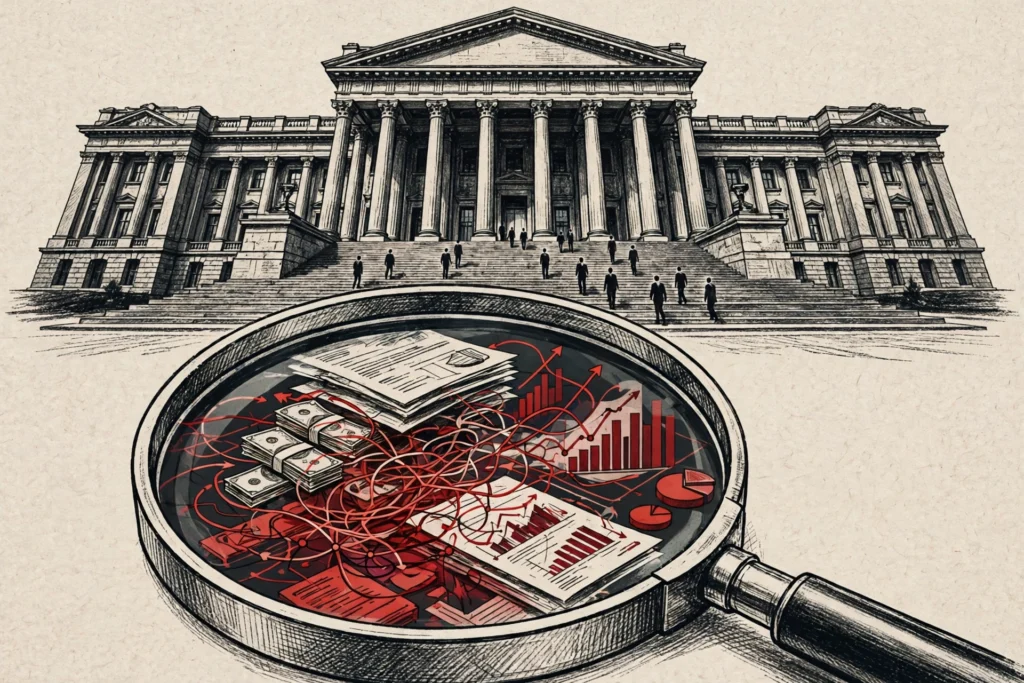
What the AUDIT AI Act Would Actually Require
Imagine you own shares in a company that just announced a fifty-billion-dollar bet on artificial intelligence. The press release is glowing. The chief executive talks about the future. But one question never gets answered: where is the money actually coming from, and who is on the hook if the bet goes wrong? That unanswered question is exactly what the AUDIT AI Act, a new bill in the United States Senate, is designed to fix.
That question is now sitting at the centre of American politics. Four United States senators — two Democrats and two Republicans — have introduced a bill called the AUDIT AI Act, and its message is blunt. If public companies want to spend trillions on AI, investors deserve to see the full picture first.
The bill’s full name is the Advancing Uniform Disclosure of Investments and Transparency of Artificial Intelligence Act. It was introduced on November 19 by Senator Mark Warner of Virginia, Senator John Kennedy of Louisiana, Senator Angela Alsobrooks of Maryland and Senator Mike Rounds of South Dakota. According to the senators’ announcement, it would force the Securities and Exchange Commission to write new disclosure rules for how public companies invest in, deploy and manage AI.
The timing is no accident. AI has become the biggest spending story in the global economy, and also the hardest one to understand. Companies are pouring money into data centres, chips and energy at a pace nobody has seen before. Yet the financing behind many of those deals is hidden inside joint ventures, special-purpose vehicles and layers of debt that ordinary investors cannot see through.
The $10.3 Trillion Question
To understand why four senators from both parties are suddenly worried about AI bookkeeping, start with the scale of the spending. A recent report from the Brookings Institution estimates that building out AI infrastructure could require $10.3 trillion in investment between 2025 and 2032. That works out to roughly 3.6 percent of American economic output every single year.
The senators’ office notes that this buildout could surpass the great infrastructure booms of American history — the railroads, the highways, electrification, canals and telecommunications. No previous boom, however, was financed quite like this one. Much of the money moves through complex arrangements that sit partly off the balance sheet, where traditional financial statements reveal only part of the story.
That opacity is exactly what the AUDIT AI Act is designed to attack. The bill would require the SEC to issue rules within 180 days of the law taking effect, forcing covered public companies to disclose whether they have an AI governance policy and whether a dedicated board committee oversees their AI work. If a company has no such policy, it must explain why. If it does have one, the policy must be made public.
Round-Trip Financing: The Deal Behind the Deal
The most eye-catching part of the bill deals with how AI infrastructure is actually paid for. Section 4 of the legislation targets what some industry watchers call round-trip financing — arrangements in which chipmakers, cloud providers and AI companies effectively fund each other’s purchases in a circle.
Picture the pattern. A chipmaker invests in an AI startup. The startup uses that money to buy the chipmaker’s chips. The chipmaker books the sale as revenue, and its share price rises on demand it helped finance. Nobody has broken a law in this simplified version of the story. But an investor reading the revenue numbers has no idea how much of the demand is real, and how much is a loop.
Under the AUDIT AI Act, non-financial public companies would have to disclose AI-related joint ventures, special-purpose vehicles, variable interest entities and other major debt arrangements in their SEC filings. The SEC would also gain discretion to demand more detail where it sees fit. The goal is to make the plumbing visible before a failure, not after one.
Why Washington Is Acting Now
The bill lands in a week when the AI industry’s finances have rarely looked shakier. Nvidia, the company at the centre of the AI chip boom, has spent November under a cloud. Its former chief executive resigned after an affair with a woman the US government believes is a Chinese spy, and the Securities and Exchange Commission has opened an accounting probe that sent the company’s shares down 14 percent in a single day.
Even the US government is struggling to track the money. A House committee revealed this week that the Trump administration approved shipments of nearly 900,000 advanced Nvidia and AMD AI chips to Chinese companies between December 2025 and May 2026, though it remains unclear how many were ultimately shipped.
At the same time, Anthropic — the maker of the Claude AI models — has just completed the largest public listing in history, raising more than $81 billion at a valuation above $1 trillion. Investors piled in, but the speed of the debut raised its own questions about how much of the AI boom is built on solid ground and how much on enthusiasm.
Kennedy, the bill’s Republican co-sponsor, framed the issue in the language of ordinary investors. “AI is the future, but investing in it shouldn’t be a guessing game,” he said. “Companies are spending trillions of dollars on this technology, and investors deserve to know where that money is going.”
Standardising the Risks Investors Face
Beyond governance and financing, the bill would standardise how companies talk about AI risk. Section 6 would direct the SEC to amend the annual Form 10-K filing to include a standard AI risk section for companies with significant AI exposure. That section would cover dependence on third-party models, concentration of computing supply, costs and data liabilities.
Today, such disclosures are scattered and inconsistent. One company may warn in detail about its reliance on a single chip supplier, while a rival with the same exposure says almost nothing. A standard section would let investors compare companies side by side, in the same format, for the first time.
The bill would also order the SEC to study how companies account for AI research and development, revenues and capital spending, and to recommend future policymaking or standard-setting. And it would require the regulator to report every year on how automated investment strategies are affecting price discovery, market efficiency and herding behaviour in financial markets.
Supporters from inside the regulatory world have lined up behind the idea. Robert J. Jackson Jr., a former commissioner of the SEC, said the bill would give investors critical insight into whether corporate leaders are overseeing the technology that will define the future.
What Happens Next
For all its ambition, the AUDIT AI Act is still only a proposal. It has been introduced in the Senate, but it imposes no new requirements unless it is passed by Congress, signed into law and then implemented by the SEC through rulemaking. That process would take months at minimum, and the bill could change substantially along the way.
Its bipartisan backing gives it a better chance than most technology bills. Warner is one of Congress’s leading voices on AI policy and sits on the Senate Banking Committee, which oversees the SEC. Kennedy and Rounds bring Republican support, and Alsobrooks adds a second Democratic voice. The coalition was deliberately built to cross party lines, and its sponsors are already framing the bill as investor protection rather than technology regulation.
Whether it becomes law or not, the bill has already changed the conversation. The AI boom is no longer judged only on benchmarks and product launches. It is now judged on balance sheets, board minutes and financing structures too. The senators behind the AUDIT AI Act are betting that investors will eventually demand the same transparency from AI companies that they expect from banks, airlines and every other industry that moves trillions of dollars.
If they are right, the next phase of the AI race will not be won only by the company with the fastest model. It will be won by the company that can show, in plain numbers, exactly how it paid for the race — and who carries the risk if it stumbles.