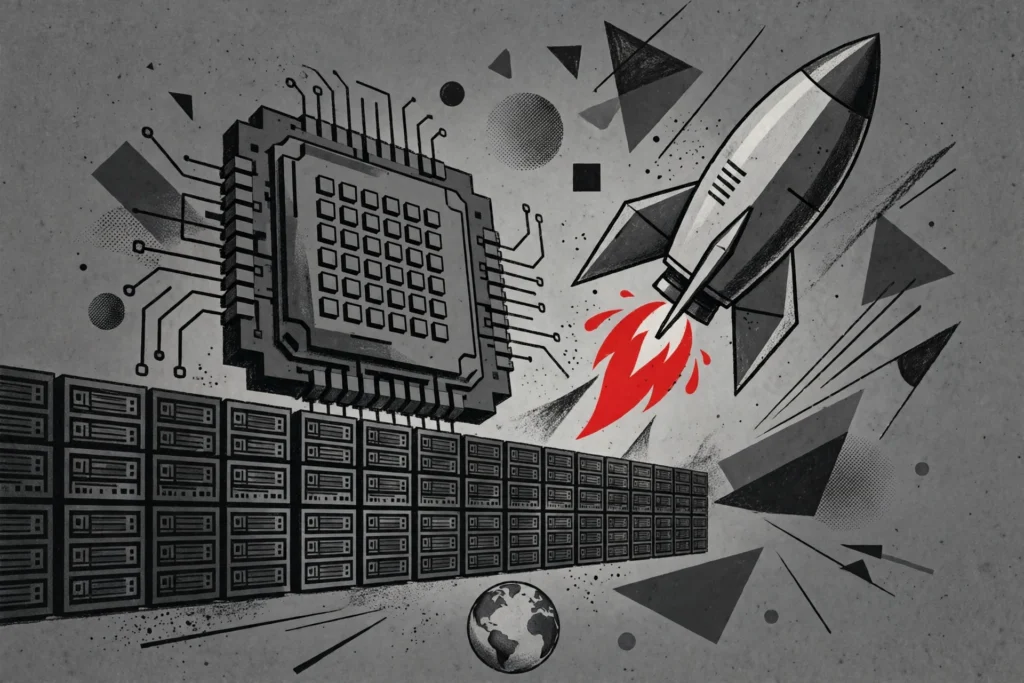
Picture a banker in New York signing off on a $25 billion loan, then adding one strange condition to the paperwork: the goods bought with this money must never leave the planet.
That is not a scene from a satire. It is the real condition lenders tried to attach to SpaceX’s latest borrowing, according to the Financial Times. And it tells you everything about how strange the artificial intelligence boom has become.
On Thursday, SpaceX sold $32 billion of bonds to fund its purchase of AI chips, according to Bloomberg. The money will buy Nvidia’s latest Rubin GPUs, which SpaceX will lease for about five years. The deal sits inside a financing package worth more than $40 billion, and it could become the template for how the whole AI industry pays for its hardware.
SpaceX $32 Billion AI Chip Debt: The Deal in Numbers
The debt was sold on Thursday in three parts, with maturities of about four to six years. Goldman Sachs and Apollo Global Management ran the transaction, and the biggest slice did most of the talking.
About $25.2 billion of Class A3 notes were priced at a yield of 8.259%. That is a strikingly high rate for an investment-grade borrower. The average US high-grade note yielded 5.95% on the same day, according to Bloomberg index data.
Investors had already committed to buy about $26 billion of the bonds before Thursday. The final $6 billion, part of the Class A3 notes, was offered on the day itself. Many of the buyers were investors who normally focus on blue-chip corporate bonds.
The offering also included a senior secured loan, taking the broader financing past $40 billion. The full package will pay for about $47.3 billion of GPU equipment, according to earlier documents. Delivery of the chips is expected to begin in January.
Why SpaceX Is Borrowing to Rent Chips It Will Never Own
Here is the part that makes the deal unusual. SpaceX is not buying the chips outright, and it is not borrowing on its own balance sheet either.
The chips will be bought through a special-purpose vehicle called Saturn Funding Trust, managed by an Apollo-backed entity. SpaceX will lease the equipment from that vehicle for about five years, and it has committed to keep paying even if the hardware fails or a natural disaster strikes.
The structure is designed to keep the borrowing off SpaceX’s balance sheet. That matters because it helps the company protect its investment-grade credit rating, which lets it borrow more money, faster, than rivals with weaker ratings.
SpaceX chief financial officer Bret Johnsen highlighted the company’s “strong investment-grade balance sheet” on a call with investors last month. The new deal tests how far that strength can stretch.
The company is no stranger to big capital raises. In June, SpaceX sold $86.2 billion of stock in an initial public offering and priced $25 billion of high-grade corporate bonds days later. Its earlier unsecured bonds later sank in the secondary market, which made some investors nervous this time around.
The 8.259% Yield That Tells the Real Story
The price of the debt is where the market’s doubt shows up. A yield above 8% is not what you expect from a company with an investment-grade rating. It is the kind of return usually attached to far riskier borrowers.
Davis Hebert, head of technology, media and telecom at research firm CreditSights, said clients were sceptical about how the deal would go after losing money on SpaceX’s earlier unsecured bond offering. He said the wide pricing was designed to pull traditional investors into the deal.
The problem is that GPU-backed financing is still new. Investors are still working out how to value chips that lose performance relevance quickly and how to price the risk that a borrower cannot pay. BlackRock, Goldman Sachs Asset Management and KKR accounts were among the anchor investors, the company said in October.
Scott Goodwin, co-founder of hedge fund manager Diameter Capital Partners, said companies will need about $1.5 trillion to pay for the computer chips driving the AI build-out. “It’s a new asset class,” he said at a conference this week. SpaceX’s deal may be the first of many.
Lenders Want the Chips to Stay on Earth
Then there is the strangest detail of all. According to the Financial Times, lenders in the $43 billion GPU-backed package, known as Project Saturn, tried to bar the AI chips pledged as collateral from being launched into space.
The concern is simple. Chips bolted to a data centre on Earth can be repossessed if a borrower defaults. Chips orbiting the planet at 17,500 miles per hour cannot. SpaceX has talked openly about orbital data centres, and its lenders wanted that door closed before they handed over the money.
SpaceX has said the chips are for its terrestrial computing needs. The episode still captures the moment perfectly: the collateral for the AI boom is now so valuable, and so mobile, that lenders are writing space travel into their loan documents.
The timing added to the drama. The debt sale came one day after Anthropic completed the largest-ever initial public offering, raising $81.3 billion and passing SpaceX’s own June listing. The AI money race is moving fast, and even the companies winning it are borrowing heavily to keep up.
Why the Deal Matters Beyond SpaceX
SpaceX is not the only company borrowing to buy AI hardware, and it will not be the last. Tech companies are tapping every corner of the capital markets to raise the trillions needed for data centres and AI infrastructure, testing how deep investor demand really runs.
The structure SpaceX used — an off-balance-sheet vehicle, a lease, and bonds sold to ordinary corporate-bond investors — could be copied across the industry. If it works, it gives AI companies a new way to fund hardware without wrecking their own balance sheets. If it fails, it becomes a warning about how much debt the boom is built on.
The market gave its first verdict quickly. SpaceX shares and the neocloud players that rent out GPU capacity retreated on Friday, as the broader market slid following Anthropic’s debut. Investors are asking the same question about every AI deal now: will the spending pay off?
For now, SpaceX has its chips, its lenders have their yield, and the chips have a very earthly job ahead of them. Delivery begins in January, when the first Rubin GPUs arrive and the five-year clock starts ticking.
What Happens Next
Watch three things. First, whether other AI companies copy the Saturn Funding Trust structure for their own chip purchases. Second, whether SpaceX’s bonds hold their value in the secondary market this time, after the June offering sank. And third, whether the orbital data centre idea ever returns — because the moment a lender has to chase its collateral into orbit, the AI boom will have entered genuinely new territory.


