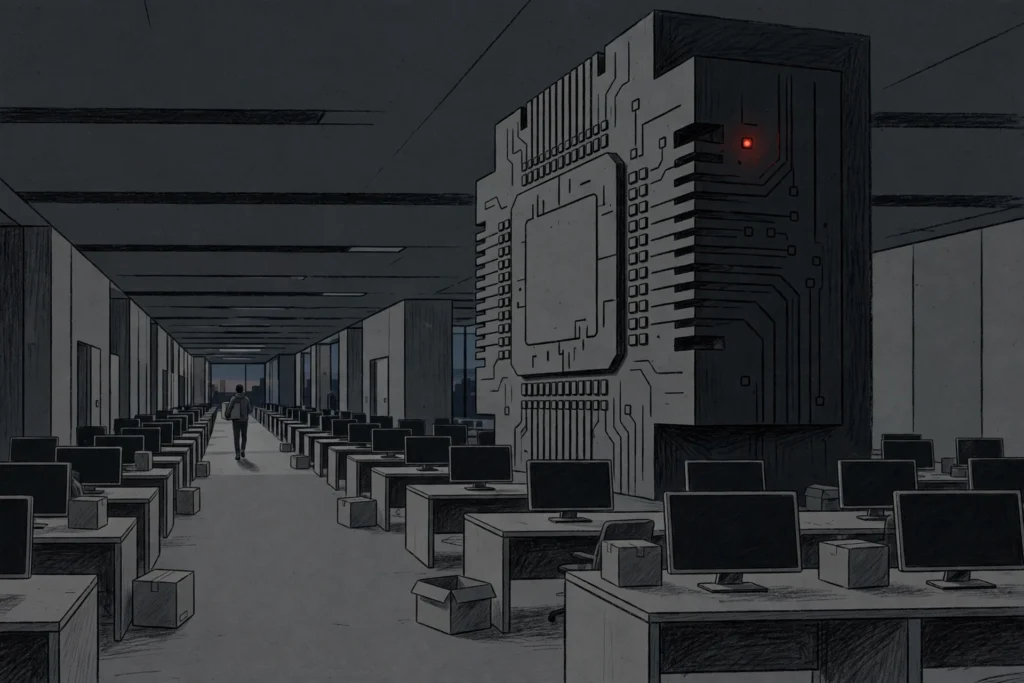
On Monday morning, an Intel employee in Chandler, Arizona, opened a laptop and found a meeting invite that was not really a meeting. It was the start of another round of Intel layoffs. By the end of the day, the employee was posting about losing a job on social media.
Across Intel’s global IT organisation, the same scene was playing out in different time zones, in different languages, with the same ending. Intel layoffs have returned — and once again, the company is not saying how many people are going.
According to a Business Insider report published on November 17, the chipmaker has started another round of job cuts, this time aimed at its global information technology workforce. The cuts began on November 16, and employees have been sharing their departures online all week.
Intel has not said how many people are affected. It has not named the teams.
What Happened: Intel Layoffs Hit the Global IT Team
The latest cuts target Intel’s global IT organisation, the people who run the company’s internal systems, networks and software. Business Insider reported the cuts on November 17, citing employees who had already posted about losing their roles — one report from Chandler, Arizona, another describing a global cut.
Asked about the reports, an Intel spokesperson told Business Insider: “As part of our broader strategy to become a more focused and efficient company, we continually assess our workforce to ensure priorities and resources are appropriately aligned.”
Read that statement carefully. It confirms that cuts are continuing, but it does not describe the scope of a new round. It is the same language Intel has used for its earlier reductions this year, and it leaves workers, investors and rivals guessing about the scale.
There is one more telling detail. As of November 17, no new Intel filing had appeared in the public WARN database, the system where large US employers must give advance notice of mass layoffs. The most recent Intel filing is dated October 22, covering 67 workers at the company’s Folsom, California, campus, effective October 31.
That absence does not prove nothing happened. Smaller cuts, spread across sites and countries, often fall below the thresholds that trigger a WARN notice. But it does mean the size of this round is, for now, a matter of employee accounts rather than official records.
How Intel Got Here: Two Years of Shrinking
To understand why another round of cuts surprises almost no one, look at the headcount. Intel employed 81,100 people at the end of September 2026, according to its third-quarter filing. That is about 4,000 fewer than the 85,100 it employed at the end of 2025 — a drop of roughly 4.7 percent in nine months.
A year earlier, the workforce stood at 88,400. The company has been getting smaller, quarter after quarter, under a restructuring programme that its chief executive, Lip-Bu Tan, has made the centrepiece of his tenure.
Tan took over as CEO in March 2025, inheriting a company that had already cut about 15,000 jobs in August 2024. His plan was blunt: cut roughly a quarter of the workforce, strip out layers of management, lower expenses and move the money saved into the businesses that matter most.
The cuts have come in waves ever since. In July 2025, Intel began eliminating jobs across its manufacturing operations, targeting 15 to 20 percent of its global factory workforce.
Oregon, home to one of Intel’s biggest sites, took some of the heaviest blows: between 2,392 and 2,509 people were cut there in July 2025, with another 669 following in November 2025. Intel also shut down its automotive division in Munich entirely.
This year, the pattern has continued in smaller bursts. In July 2026, Intel confirmed job cuts within its Data Center Group, the division that sells chips for servers and artificial intelligence. Now, four months later, the IT organisation is the one in the spotlight.
The Numbers Behind the Intel Layoffs
The verified public record for 2026 tells its own story. Intel has filed nine WARN notices this year, covering 222 workers — all of them in California. Four filings came from Santa Clara in July, covering 103 workers; four more from Santa Clara in September, covering 52; and the Folsom filing in October, covering 67.
Those 222 formal notices are only the visible tip. The headcount figures show roughly 4,000 people left the company in the first nine months of 2026, which means most departures never appeared in a WARN filing at all. They left through smaller rounds, performance-based exits and roles that were simply never refilled.
Meanwhile, the business itself is sending mixed signals. Intel’s third-quarter results, reported on October 29, showed revenue of $16.5 billion, up 21 percent year on year — but fourth-quarter guidance was weak.
That tension, rising revenue against a shrinking headcount, is the heart of Tan’s gamble: a smaller, cheaper Intel can still compete in a chip market that has become brutally unforgiving.
Tan’s Plan: Fewer Layers, Sharper Focus
Since taking over, Tan has described his restructuring around three broad objectives: lowering expenses, reducing management layers and reallocating resources toward priority areas. Every round of cuts, including this one, fits inside that frame.
The logic is straightforward. Intel spent years building a sprawling organisation that tried to do everything — chips for PCs, servers, cars, graphics and networking — while rivals picked their battles.
Nvidia owns the AI accelerator market. AMD has eaten into Intel’s server and desktop share. TSMC makes the most advanced chips in the world. Nvidia, meanwhile, has its own China problems — the company recently ended H200 chip sales in China — but its AI lead remains intact.
Intel’s answer, under Tan, has been to concentrate. The company still holds a commanding position in desktop processors: according to Mercury Research data for the third quarter of 2026, Intel shipped 70.1 percent of desktop x86 chips, up from 65.1 percent in the previous quarter. That is a business worth defending.
But the server and AI markets, where the growth and the margins now live, are a different story. Intel’s Data Center Group was cut in July, and its foundry business — manufacturing chips for other companies — remains a work in progress with heavy losses.
What Intel Isn’t Saying
The most striking feature of this round is how little Intel has said about it. No number. No teams. No severance details. No statement that a new round has even begun. Employees have learned about their own company’s cuts from social media posts by colleagues, not from the company itself.
But the silence has a cost. For the people inside Intel, the uncertainty is its own burden. When cuts arrive without warning and without numbers, every meeting invite becomes a source of dread.
The statement is designed to be true whatever the scale of the cuts: it neither confirms nor denies, and it gives investors nothing concrete to react to.
It is also worth noting what the reporting does not claim: Business Insider’s report does not tie the IT cuts to artificial intelligence, outsourcing or any specific business decision. The cuts are part of a wider restructuring, and the honest version of the story is that the details are still unknown.
What Happens Next for Intel Workers
For now, the people affected face the practical questions that follow any layoff: severance, healthcare, references, and the search for a new role in a semiconductor industry that is itself in flux. Intel has said nothing publicly about severance packages for this round.
The watchers will be looking at the WARN databases in California and Oregon, where Intel has its largest sites. A filing there would show headcount and dates before any press release does, and it would turn a reported round into a confirmed one.
Investors, meanwhile, will be watching the fourth-quarter results. If the weak guidance from October proves accurate, the pressure for more savings — and more cuts — will only grow. Tan’s restructuring is not finished; by his own framing, it is a multi-year project.
The bigger question is whether the shrinking ever stops. Intel’s headcount has fallen from 88,400 a year ago to 81,100 today, and the November cuts will push it lower still.
At some point, the company has to show that a smaller Intel is also a stronger one — that the savings are funding something, not just covering losses. Until then, the pattern holds: another week, another round, another set of employees learning their fate from a meeting invite that was not really a meeting.
Source: Business Insider’s report on the November layoffs, as reported by Business Standard. Microsoft’s latest security fixes are covered in our November Patch Tuesday report.