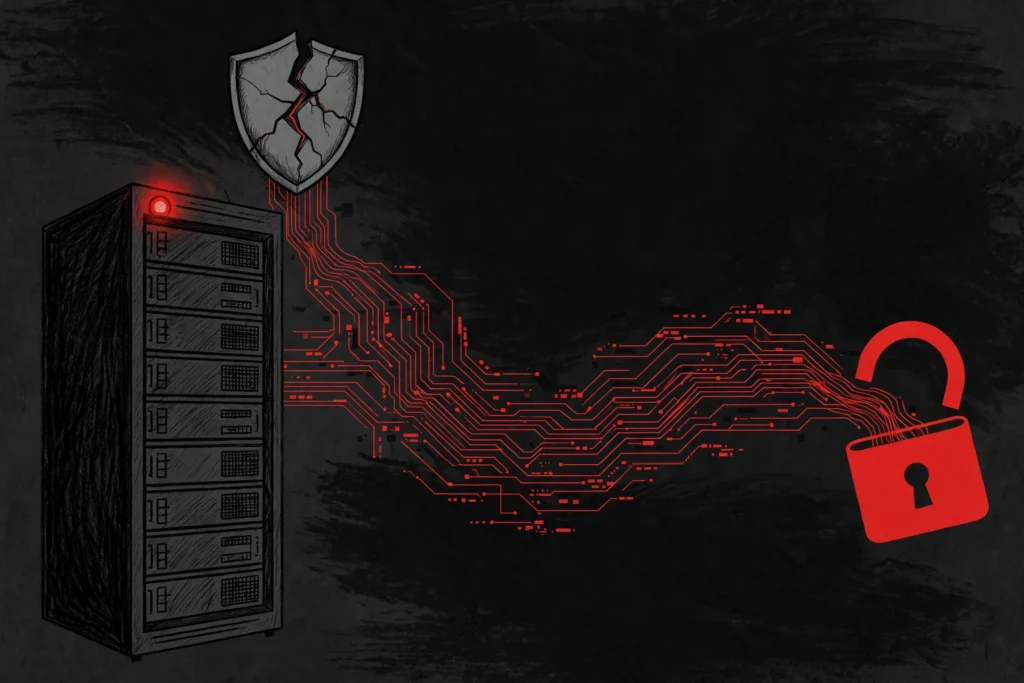
Somewhere in a server room, a login page waits for a username and a password. Nothing about it looks dangerous. Then a short string of scrambled characters arrives — the kind of gibberish computers trade a thousand times a second — and the server quietly hands over control. No password. No warning. That is Java4Shell.
Security firm Calif disclosed the flaw on November 17, 2026, and Oracle released a fix the same day. Within hours, the US cybersecurity agency CISA was urging every organisation running Java to patch immediately. The warning is blunt, and the reason is simple: this bug lives in Java itself.
What Is Java4Shell?
Java4Shell is tracked as CVE-2026-114938. It is a memory-corruption flaw in the Base64 decoder inside OpenJDK, the open-source Java platform that powers countless business systems. The bug sits in HotSpot, the Java virtual machine that runs applications on x86-64 computers.
Calif rates the flaw 9.2 out of 10 under the CVSS 4.0 scoring system, which puts it firmly in the critical range. Oracle scores it 8.1 under the older CVSS 3.1 scale, while Red Hat has given it a preliminary score of 9.8. The numbers differ, but every assessor agrees on one thing: this is serious.
The name is no accident. It echoes Log4Shell, the Java logging flaw that rattled the internet in December 2021. Like its predecessor, Java4Shell hides in a piece of software so common that most people never think about it. Java underpins systems used by 90 percent of Fortune 500 companies.
How Java4Shell Works
Base64 is one of computing’s quiet workhorses. It turns binary data into plain text so it can travel safely through web requests. Login headers, security tokens and file uploads all pass through Base64 decoding, often before a user has even signed in.
The vulnerable code is handwritten assembly that speeds up Base64 decoding with AVX-512 processor instructions. A short, malformed input makes that code write 62 bytes past the end of a memory buffer — before Java gets a chance to reject the input as invalid.
That small overrun is enough. An attacker with no credentials can corrupt the Java heap, read secrets sitting in memory, and reach remote code execution. Private keys, session tokens and personal data can all be exposed before a single line of attacker code runs. The same crafted input can also crash the virtual machine, knocking a service offline.
Which Systems Are at Risk
Calif demonstrated remote code execution without any login on default installations of six widely used products: Keycloak, Atlassian Jira, Atlassian Confluence, JFrog Artifactory, Jenkins and PingFederate. The researchers stress that the list is not exhaustive.
Identity providers sit at the top of the danger list for an obvious reason. They issue the tokens every other system trusts. Build and artifact servers come next, because they sign and ship the software a company depends on. Compromise either one, and the damage spreads far beyond a single machine.
With a logged-in account, the researchers also reached code execution in Apache Kafka Broker, Apache Solr, Elasticsearch, Gerrit and Netflix Spinnaker. They did the same in sample applications built on Apache Struts and Spring Boot. Even Java clients are exposed: a program can be compromised simply by connecting over TLS to a malicious server.
Two conditions decide whether a system is in scope. It must run an unpatched OpenJDK build from version 17.0.6 onward — versions 17, 21, 25 and 27 are affected — and it must run on an x86-64 processor with AVX-512 VBMI support. That covers Intel Xeon chips from Ice Lake through Granite Rapids and AMD EPYC processors from Zen 4 onward. Older Java releases and ARM-based systems are not affected.
An AI Tool Found the Bug in About an Hour
There is an irony at the heart of this story. Calif researcher Quang Luong found the flaw while examining OpenJDK’s HotSpot code with the help of an AI coding tool. The bug took about an hour to find. A first working exploit followed two hours later, for under $200 in AI token costs.
Oracle credits Luong and fellow researcher Albert Yang with reporting the vulnerability. But the details leaked before the fix was ready, which is why the disclosure felt rushed and why security teams had so little warning. Calif says it expects others to repeat its work quickly.
The discovery fits a pattern that has been building all year. AI tools are now finding real vulnerabilities in real software at remarkable speed, as OpenAI’s GPT-6 Cyber showed when it uncovered hundreds of Linux kernel flaws. The same capability that helps defenders is available to attackers, and the gap between discovery and exploitation keeps shrinking.
Is Java4Shell Being Exploited?
As of November 18, there is no publicly confirmed exploitation in the wild. That sentence should comfort nobody. GreyNoise has reported exploitation attempts against its sensors, though none confirmed successful, and security firm VulnCheck says a full working exploit is available to its customers. Public repositories are already claiming working attack chains, without independent verification.
Calif is holding back its product-specific exploits for now, to give organisations time to upgrade, and plans to publish them later. The flaw has not yet been added to CISA’s Known Exploited Vulnerabilities catalogue. Every one of those facts is temporary. The trigger is a short malformed string, the root cause is public, and each product needs only its own exploit chain.
There is also a limit worth knowing. No universal exploit exists, and the technique is sensitive to network conditions, which slows mass exploitation. That does not protect a specific target. An attacker who wants your identity provider can afford to build a chain just for it — the same lesson the Fireworks AI breach taught about targeted attacks on AI infrastructure.
How to Patch Java4Shell
Updating the Java runtime is the only complete fix. Oracle’s fixed builds are Java SE 17.0.21.1, 21.0.13.1, 25.0.5.1 and 27.0.1.1, plus 8u513-perf for the Java 8 Enterprise Performance Pack. Other vendors are shipping their own fixes on their own schedules — Amazon Corretto has already released a patched build.
If patching cannot happen today, there is a temporary workaround. Add the startup flag -XX:-UseBASE64Intrinsics to switch off the fast Base64 decoder where the bug lives. Java falls back to its standard decoder and everything else runs as before, though applications that decode large amounts of Base64 may run slower. An alternative flag, -XX:UseAVX=2, switches off a wider set of processor optimisations.
Either way, every Java process must be restarted. A patch or a flag takes effect only when the virtual machine restarts, so verify the running process and not just the installed package. CISA advises patching internet-facing systems first and checking for runtimes bundled with third-party software, container images and appliances, which often do not appear in software inventories.
Work in this order: internet-facing identity providers such as Keycloak and PingFederate first, then Jira, Confluence, Jenkins and Artifactory, then other internet-facing Java services that handle logins, tokens or file uploads, and finally internal systems such as Kafka, Solr and Elasticsearch. The week has already been busy for security teams — Microsoft’s November Patch Tuesday shipped more than a thousand fixes, including an Outlook zero-day already under attack.
What Happens Next
The next few days will decide how bad Java4Shell becomes. Vendors are still publishing fixed builds, and the researchers’ full exploits are still to come. Once those land, the barrier to attacking a specific product drops sharply, and the organisations that patched early will be glad they did.
South Korea has already issued its own security advisory, and Canada’s cyber security centre contributed to the CISA alert. The flaw’s reach — every OpenJDK distribution, from Oracle and Eclipse Temurin to Amazon Corretto and Microsoft’s build — means the patching job touches almost every corner of enterprise computing.
Log4Shell taught the industry that a Java flaw with a catchy name can take months to fully clean up, because the vulnerable code hides inside products nobody thinks of as Java. Java4Shell is narrower in scope, but the lesson is the same. Somewhere, a login page is waiting. Patch it before the scrambled characters arrive.


