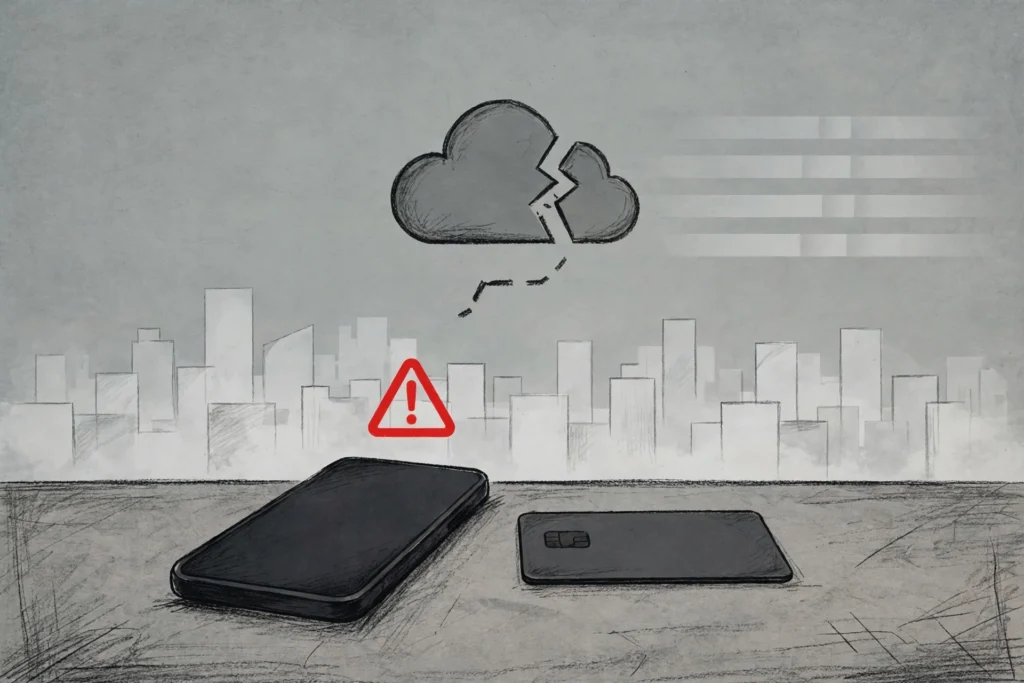
Picture the scene — an Apple outage in full swing. It is Tuesday morning, and you are standing at a coffee counter with your phone ready. You double-click the side button, hold it near the reader, and wait. Nothing happens. Apple Pay refuses to work.
You open your phone to check what is going on. iCloud asks you to sign in again, then refuses to let you in at all. The App Store will not load. Apple Music has gone quiet. In the space of a few minutes, the ecosystem that is supposed to just work has stopped working.
That was the experience of thousands of Apple users on Tuesday, November 17, 2026. One of the most polished technology companies on the planet suffered a widespread outage that knocked out iCloud, the App Store, Apple Pay, Apple Music and more — and the cause, according to Apple itself, was an internal software update.
What happened during the Apple outage
The first signs of trouble appeared shortly before noon on the US East Coast. According to outage-tracking platform Downdetector, reports of problems with Apple Pay began rising at around 11:40 am ET and peaked at roughly 12:15 pm ET.
Reports about iCloud surged at around the same time. Users said they could not sign in to their accounts, reach their photos and documents, or sync files between devices. The disruption spread quickly across the ecosystem.
The App Store stopped loading for many users, and downloads stalled. Apple Music would not stream. Apple TV, Apple Support and AppleCare all showed problems. Apple’s own System Status page eventually acknowledged full outages affecting Apple Music, the App Store and AppleCare, along with problems for iCloud sign-in.
The complaints came from several countries, including the United States, Brazil, Greece and Latvia. By 5 pm ET, reports had dropped significantly as systems began to recover.
Some users reported an especially unsettling symptom: they were unexpectedly signed out of their Apple ID accounts on their iPhones and Macs, and could not sign back in.
Others were setting up brand-new Apple devices and hit errors when the phones tried to reach Apple’s activation servers.
Apple outage hits stores as well as phones
The damage was not limited to people’s pockets. Apple’s physical retail stores felt it too. According to Firstpost, store employees struggled to process customer purchases, access repair records and handle device trade-ins after the company’s point-of-sale systems ran into problems.
Internal employee portals and customer-support databases were also temporarily unavailable. Staff could not pull up the information they needed to answer technical support requests, which meant that even people who managed to reach Apple Support found little help waiting.
Developers were affected as well. App Store Connect and other backend tools became difficult to reach, leaving app makers unable to manage their listings while the outage lasted.
Apple blames an internal update, not hackers
As the reports piled up, speculation on social media turned quickly to the worst possibility. Was this a cyberattack? A ransomware incident? A distributed denial-of-service attack aimed at Apple’s infrastructure?
Apple moved to shut that speculation down. The company told reporters that an internal software update had caused the disruption, and that there was no cyberattack behind it.
“Many of our systems are back up and running after an internal update caused some outages this morning,” an Apple spokesperson told the New York Post. “We’re working to get the remaining systems online as soon as possible.”
The company gave the same message to Bloomberg and Fox Business. Engineers, Apple said, were working to isolate the faulty update and restore the remaining affected services.
There was one awkward detail. Apple’s System Status page initially listed several affected services as operational even as complaints mounted, before it was updated to reflect the outages. For users trying to work out whether the problem was their device or Apple’s servers, the official page was, for a while, no help at all.
One bad week for the internet’s biggest names
The Apple outage did not happen in isolation. It landed in the middle of a remarkable run of technology disruptions in the United States, touching banks, airlines, government networks and some of the biggest names in tech.
On the same day, the National Security Agency’s internal classified network, known as NSANet, suffered an outage. The White House said there was no evidence of a cyberattack, while an NSA spokesperson described the disruption as a temporary degradation during scheduled routine maintenance.
Microsoft and Cloudflare have also been hit by outages in recent days, and banks and airlines have reported disruptions of their own.
US officials have been at pains to say the incidents are not connected. Secretary of State Marco Rubio was blunt about it, saying, “We are not under systemic attack. These events — one has nothing to do with the other.”
He added that there was no indication or evidence that the incidents were related to each other. The Department of Homeland Security’s chief said artificial intelligence may be behind some recent US outages, while ruling out signs of a cyberattack.
Not every incident in the wave was innocent, though. Norwegian energy company Equinor disclosed a genuine cyberattack against some of its IT systems on the same day.
That contrast is exactly why Apple’s quick denial mattered: in a week when a real attack did happen somewhere, companies need to be precise about what hit them and what did not.
Why the Apple outage matters
Apple sells its ecosystem as a seamless whole. Your photos live in iCloud, your music in Apple Music, your payments in Apple Pay, your apps in the App Store, and your devices activate through Apple’s servers. When it works, the integration feels invisible. When it breaks, the integration is the problem.
Tuesday showed how a single internal change can ripple across that whole stack. A faulty update did not just take down one service. It took down the sign-in system that gates the others, the payment system people use at shop counters, and the activation servers new devices need on day one.
That last point deserves attention. A new iPhone that cannot reach Apple’s activation servers is, for a few hours, an expensive rectangle — the kind of experience Apple works hardest to avoid.
There is also a trust question. Apple asks users to store their most personal data — photos, documents, health records, payment cards — in its cloud. An outage is not a data breach, and Apple was clear that this one was not.
But every hour users cannot reach their own files is an hour in which that trust is tested. That trust is also what Apple is banking on as it charges for more of its services, including Apple Intelligence usage packs for its creative apps.
The status page delay matters here too. When a company’s own dashboard says everything is fine while thousands of users report otherwise, people stop believing the dashboard.
What happens next after the Apple outage
By late Tuesday afternoon, most of Apple’s systems were back online, according to the company. Engineers were still working on the remaining affected services, and Apple said it would restore them as soon as possible.
What Apple has not yet done is explain the update in detail. Which change went wrong, how it slipped through testing, and what will change in the rollout process are all questions the company has yet to answer publicly.
Apple’s next big software moment is not far off either: iOS 27.3, expected in the first half of December, is set to bring Siri AI deeper into the Health app. The company is also preparing to switch on Apple Intelligence in China in December, after clearing regulatory registration for iPad and Mac.
For now, the immediate lesson is a familiar one. No company, not even one with Apple’s resources and reputation for polish, is immune to a bad update.
The difference between a bad morning and a bad week is how fast the systems come back — and how honestly the company talks about why they went down.
Apple’s systems did come back, most of them within hours. The honest conversation about the update that broke them is still to come.