It is just after noon in Spring, Texas, and lunch is on its way. Not in a car, and not on a bicycle. Somewhere above the rooftops, a small aircraft hums toward a suburban driveway, carrying a sandwich and a bag of fries.
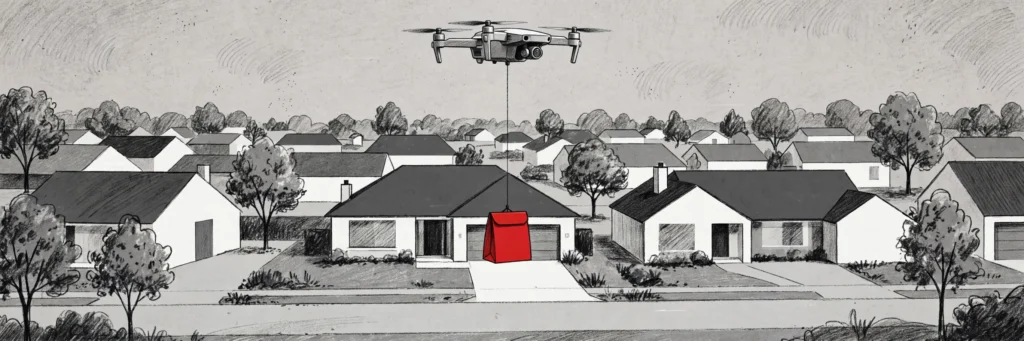
Minutes later, the drone stops high above the yard. It never lands. A tethered pod lowers gently to the ground, releases the order, and the aircraft climbs away again. Lunch has arrived — by air.
This is Uber Eats drone delivery, and as of Tuesday, November 17, 2026, it is real. Uber Eats customers in Spring, a suburb north of Houston, can now have their food delivered by a Zipline drone, according to TechCrunch.
It is the first commercial launch of a partnership Uber and Zipline announced in August, and the opening move in a plan to reach one million drone deliveries a day by the end of 2029.
How Uber Eats Drone Delivery Works
The service runs on Zipline’s home-delivery drone, known as Platform 2, or P2. The aircraft carries orders weighing up to eight pounds and flies at speeds of up to 70 miles per hour, about 300 feet above the ground.
That is roughly ten miles of range from a participating restaurant, which covers a large slice of a Houston suburb.
When the drone reaches a customer’s home, it hovers and lowers the food in a small pod on a tether, then retracts the line and flies off. There is no landing pad and no need for a flat patch of lawn — just a clear spot below.
Ordering is built into the Uber Eats app. Customers in the service area tap a new drone icon on the home page to see which restaurants offer the option.
At launch, the list includes national chains such as Jersey Mike’s and Zaxby’s, along with dozens of local restaurants such as Urban Bird and Abu Omar Halal.
The service runs from 8 a.m. to 10 p.m. to start, and Zipline says its aircraft can operate in rain and other bad weather. The company promotes delivery times of under ten minutes — a target, not a promise, for every order.
No Driver, No Tip, No Extra Fee
For customers, the most striking detail may be what is missing. Uber says there are no extra fees for choosing a drone delivery, and customers are not prompted to tip. The courier is a machine, and there is nobody to tip.
That changes the economics of a delivery in a subtle but important way.
A driverless trip removes the labour cost of the last mile, which has always been the most expensive part of getting food to a door. If the drones can fly often enough, and cheaply enough, the savings could reshape how delivery apps price their service.
It also changes the experience. A drone does not get stuck in traffic, does not circle the block looking for parking, and does not need directions to the door. It flies in a straight line.
For a suburban order that might take a driver twenty minutes, a drone can do the same job in a fraction of the time.
There are limits. Orders must weigh eight pounds or less, and the address has to sit inside the service area with a clear drop-off point. Not every home in Spring qualifies yet.
The 1-Million-Deliveries-a-Day Ambition
Spring is only the beginning. Dallas is next, according to the companies, followed by dozens of other American cities. The stated goal is one million drone deliveries per day by the end of 2029.
That number is enormous. Zipline currently delivers thousands of orders a day in the Dallas–Fort Worth area, where it began restaurant delivery in Rowlett in August 2025. Reaching a million a day would mean scaling roughly 233 times in about three years.
Uber and Zipline clearly believe the scale is possible.
The partnership, announced on August 17, 2026, came with a strategic investment from Uber in Zipline, though the size was not disclosed. Earlier this month, on November 5, Zipline announced a $1.5 billion funding round led by Paradigm, WCM Investment Management and Layer Global, with Uber among the backers.
The money is flowing into a company that has spent more than a decade proving drones can deliver reliably.
Zipline was founded in 2014 and first made its name delivering blood and medical supplies by drone in Rwanda. In 2022, it received Part 135 air carrier certification from the US Federal Aviation Administration, the licence that allows long-range commercial drone deliveries.
Zipline’s Long Road to Your Doorstep
Zipline is not the first company to try drone delivery, and it will not be the last. Amazon, Alphabet’s Wing and others have all flown food and packages to customers in limited trials. What sets Zipline apart is how much flying it has already done.
The company’s drones have completed hundreds of thousands of commercial deliveries across Africa, the United States and elsewhere, mostly for healthcare. That track record matters to regulators, to restaurants and to customers who are being asked to trust a machine with their dinner.
The P2 drone is built for this job. It is quiet enough for neighbourhoods and precise enough to lower a meal onto a driveway, and the tethered drop means it never has to land — keeping it away from pets, children and parked cars.
Uber brings the other half of the equation: demand. Uber Eats is one of the largest food-delivery platforms in the United States, and putting a drone button inside an app that millions of people already use removes the biggest barrier to adoption — finding the service in the first place.
Why Texas Is the Testing Ground
It is no accident that this is happening in Texas. The state has become the proving ground for driverless technology of every kind. Robotaxis already operate in Las Vegas, Austin and Houston, and delivery drones have been flying in the Dallas–Fort Worth area for more than a year.
Texas regulators have been more welcoming than their counterparts in many other states, and the state’s wide suburbs — with their yards, driveways and relatively open skies — are ideal territory for a delivery drone. A dense city centre would be far harder; a sprawling suburb is the sweet spot.
The timing is also notable. The launch comes on the same day that California moved in the opposite direction, banning Waymo from the state’s freeways after the company’s robotaxis repeatedly entered active construction zones. One state is pulling back on driverless technology, while another is racing ahead with it.
That contrast will shape the next few years. Companies like Uber and Zipline need friendly regulators, clear rules and room to scale — and Texas is offering all three.
What Happens Next
Dallas is the next stop, though Uber has not given a date. Expansion will follow Zipline’s own growth into new markets, so the rollout will be gradual rather than sudden.
The real test is whether customers use it more than once. A drone delivery is a novelty the first time; to matter, it has to become a habit. That depends on reliability, the range of restaurants, and whether it feels as easy as ordering from a driver.
Questions remain, too. How will it handle apartments and homes without a clear drop-off space? What happens in genuinely bad weather? And how will neighbours feel about drones buzzing over their gardens at dinner time?
For now, though, the story is simple. In one Texas suburb, dinner can arrive from the sky. The drone hovers, the pod lowers, and lunch is served — no driver, no tip, and no traffic in between.
If Uber and Zipline get their way, that scene will play out a million times a day by 2029. Spring, Texas, is where it starts.
Sources: TechCrunch