Picture a minister in a foreign capital, weighing two offers for her country’s first national AI system. One comes from Beijing: cheap, fast, and already wired into half the region. The other, until this week, did not really exist as a single offer at all.
That changed on November 16, when the US Commerce Department named the first 33 packages under its new US AI export program, the American SI Exports Program. For the first time, Washington is selling American artificial intelligence the way a carmaker sells a car: as a complete, ready-to-drive system, not a box of parts.
The list is led by the biggest names in American technology. AMD anchors 11 of the 33 packages, more than any other company.
Nvidia, Microsoft, Amazon Web Services and OpenAI lead one each, alongside IBM, Intel, Cisco, Dell, Hewlett Packard Enterprise, Salesforce, ServiceNow, Snowflake, Palo Alto Networks, Cognizant’s government unit, Armada, Sand Technologies, Zipline and 19Labs.
In total, 19 different companies lead the 33 groups. Several of them appear more than once: Hewlett Packard Enterprise leads three packages, while Cisco and Dell lead two each.
Anthropic, the maker of Claude and one of the most valuable AI companies in the world, leads none of them — a notable absence that Commerce has not explained.
What is inside a US AI export package?
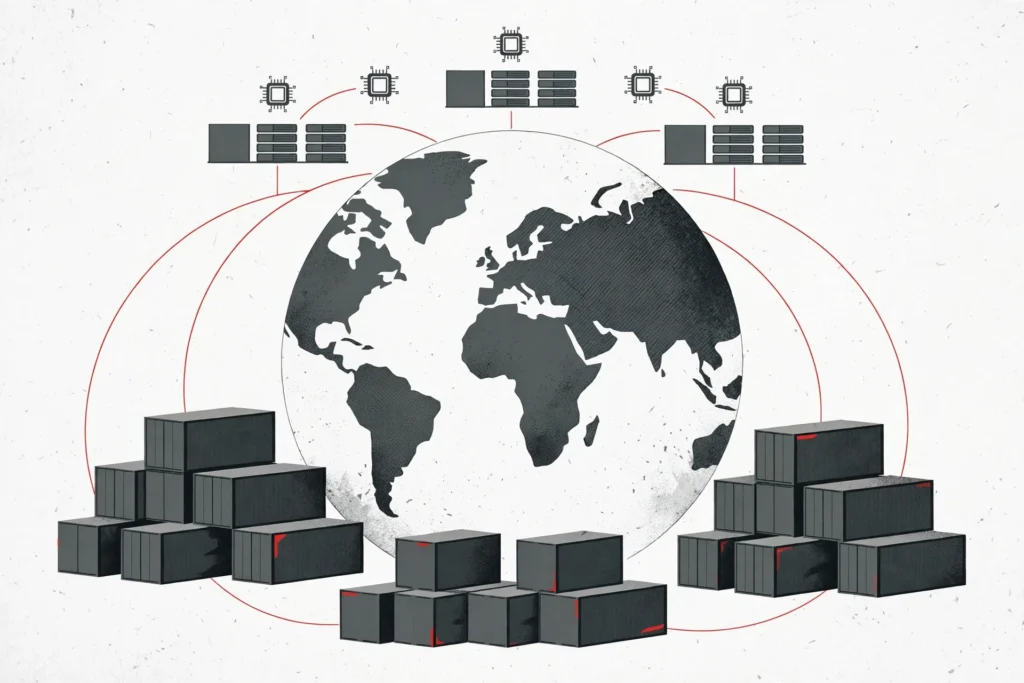
Each package is a full technology stack, assembled by a consortium of companies. The layers cover chips and data-centre hardware, data pipelines, AI models, cybersecurity tools and the applications that sit on top.
The idea is simple. A foreign government or business should be able to buy the whole American system in one go, instead of shopping for servers from one vendor, models from another and security from a third — and then discovering the pieces do not fit together.
Commerce staff and other US agencies will now offer the packages to overseas buyers through what the department calls a menu. Its Commercial Service officers, posted in embassies and consulates around the world, will pitch the packages to foreign governments and companies as part of their normal trade-promotion work.
AMD’s packages show how the consortia work in practice. Its 11 groups pair AMD processors and accelerators with partners including Cohere, Dell, Hewlett Packard Enterprise, Liquid AI, OpenAI, Vultr and Japan’s NTT. The chipmaker supplies the hardware; the partners supply the models, the software and the cloud capacity around it.
Why Washington is pushing American AI abroad now
The program carries out an executive order signed by President Donald Trump on July 23, 2025, directing the Commerce Department to build a coordinated system for exporting American AI technology. A second order, on September 29, told federal agencies to use the phrase “Super Intelligence” — the “SI” in the program’s name.
The timing is no accident. The day before the announcement, The Wall Street Journal reported that the Trump administration planned to name more than two dozen AI companies as “national champions” to compete with China.
Commerce did not use that phrase in its own announcement, but the purpose is the same: to help American firms win overseas customers that Chinese rivals are chasing hard.
China’s AI companies have been winning that race in much of the developing world, offering complete systems at prices American firms struggle to match. Washington’s answer is to stop competing company by company and start competing stack by stack, with the full weight of the US government behind the sale.
The announcement also lands in the middle of a tightening US export regime. Just a day earlier, the Commerce Department’s Bureau of Industry and Security moved to close the remote-access loophole in US AI chip export controls, a rule that affects how American AI technology can reach buyers in five countries.
The two moves pull in opposite directions on purpose: stricter controls on who can get the technology, and stronger promotion for everyone else.
What the designation does not promise
Being named on the list is not a contract. Commerce was explicit that designation does not guarantee an export licence, federal financing, government advocacy or an actual sale. The companies still have to win the business — and still have to clear the export-control checks that apply to their products.
That caveat matters, because the politics around AI exports are volatile. Nvidia H200 chips have turned up at a blacklisted Chinese university despite the rules, and the Commerce Department is under pressure from Congress to show that its controls actually work. A sales push and a crackdown are now running side by side.
The first application window for the program opened on April 1 and closed on June 30. Commerce said on July 6 that it had received 78 applications from industry groups, which were reviewed against national security, foreign policy and program requirements before the 33 were chosen.
Commerce called the 33 an “initial” group, and its menu says more will be added as further designations are made.
The Indian-American CEOs on the list
Four of the anchor companies are led by Indian-American chief executives, according to IANS. Microsoft is run by Satya Nadella, IBM by Arvind Krishna, Palo Alto Networks by Nikesh Arora and Snowflake by Sridhar Ramaswamy.
Each of them now carries responsibility for organising and leading a consortium — not just selling their own company’s products, but coordinating a group of suppliers into a single offer a foreign buyer can actually use.
It is a role that mixes diplomacy with deal-making, and it puts the four executives at the centre of Washington’s AI trade strategy.
The pattern is not new. Indian-American executives already lead many of America’s largest technology companies, and their firms dominate the country’s AI supply chain. What is new is the government formally organising that leadership into export teams.
What happens next for the US AI export program
A second route opens on November 30. Instead of offering a complete stack, companies will be able to apply for specific overseas deals, supplying only the technology layers that particular transaction requires. That on-demand round is aimed at buyers who already have part of a system and need the rest.
Commerce Secretary Howard Lutnick is expected to lead the announcement effort, and he is reportedly travelling with Trump to China this week — a trip where AI exports, and the new rules curbing chip diversion into China, are likely to feature in the talks.
The test of the program will come in the deals it produces. A place on the menu costs the companies nothing and guarantees them nothing.
But if foreign governments start buying American AI as a single package instead of assembling their own, the 33 designations will have done something no American AI company could do alone: turn a collection of products into a national export.
For the minister weighing two offers, the choice just got simpler. The American option now arrives as one system, with one price and one government behind it.
Whether that is enough to beat Beijing’s offer is the question the next year will answer — and, as TSMC’s $1 billion bet on Anthropic and OpenAI showed, the companies at the heart of the AI race are already placing their own money on the same contest.
For more detail on the full list of 33 packages, see the breakdown at AI Stock Wire.