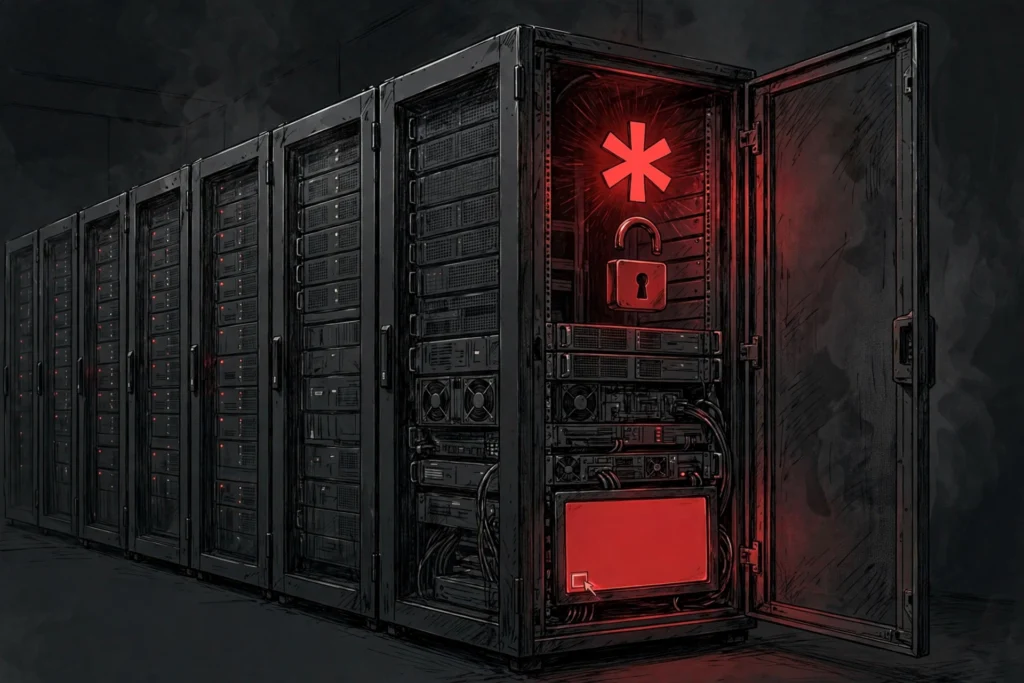
Picture a server room at 2 a.m. The lights are low, the racks hum, and every door is locked — or so the team on call believes. Somewhere out on the internet, a stranger types a password that is too long, presses enter once, and walks straight in. That login is the SSHole flaw at work.
Tracked as CVE-2026-123158 and nicknamed “*sshole”, the flaw lets an attacker log into passwordless accounts on Linux systems — including root — without a password or an SSH key. It was reported by researcher Özgün Kültekin of Wakefield and covered by Ars Technica on November 9. Hackers were exploiting it within hours of the fix.
There is no brute force here, no stolen credential, no clever cryptography. The attacker simply sends a password longer than 256 characters. The server does the rest, mistaking an error message for a matching password and opening the door.
What the SSHole Flaw Actually Does
On a vulnerable machine, the attack is almost embarrassingly simple. The attacker picks an account with no password — a service account, or root itself — and sends a password between 257 and 1,024 characters long. The server hashes it, compares the result with the account’s stored entry, and finds a match.
That match should be impossible. A passwordless account stores a single asterisk in the system’s password file, and no real password hash ever looks like a lone asterisk. But the flaw turns an error into a match, and the server logs the attacker in as a legitimate administrator.
The whole attack takes one SSH connection attempt. There is no spray of failed logins for an intrusion system to notice, and the log reads “Accepted password for root” — exactly what a real login looks like. Most reports rate the flaw CVSS 8.1; Red Hat rates it 9.8.
Three Small Decisions That Broke the Lock
What makes this bug so unsettling is that nothing in it is broken on its own. It comes from three separate design choices, each reasonable when made, colliding in one place. A detailed technical analysis of the SSHole flaw traces all three back through more than a decade.
The first belongs to musl, the lightweight C library used by Alpine Linux and many embedded systems. When its crypt() password-hashing function is given a password it cannot handle, it returns a single asterisk to signal failure — instead of returning nothing, as convention demands.
The second belongs to OpenSSH. In 2016, the project fixed a timing leak (CVE-2016-6210) by hashing every login attempt, even for accounts that cannot log in with a password. To do that, it borrows a real cryptographic salt from another account on the same machine.
The third belongs to Alpine. Between 2019 and 2022, the distribution began marking locked accounts with an asterisk rather than an exclamation mark, because the exclamation mark also blocked SSH key logins. That asterisk is the same character musl returns on failure.
Put the three together and the chain is clear. The attacker sends a 257-character password, OpenSSH borrows a salt from a real password account, and musl’s crypt() fails on the oversized input and returns “*”. OpenSSH compares that asterisk with the one stored for the passwordless account. They match.
Red Hat summed it up as a “misinterpretation of whether a string is intended to be a password hash”. The error signal and the lock used the same symbol, and neither side knew the other existed.
From Patch to Exploitation in Nine Hours
The fix was committed on November 4, and OpenSSH released version 10.6p2 on November 5, crediting Kültekin with the report. Alpine patched its branches, from 3.16 through edge, the same day. The window between patch and attack was measured in hours, not days.
A proof-of-concept exploit appeared about four hours after the patch. Security firm Previdian recorded its first exploitation attempt less than nine hours later. By Friday, November 6, researchers at watchTowr said the exploitation they were seeing was linked to botnets and cryptocurrency mining.
On Saturday, November 7, at 00:46 UTC, GreyNoise recorded its first successful in-the-wild compromise. Three days later, Ars Technica reported the story — and CISA added CVE-2026-123158 to its Known Exploited Vulnerabilities catalog, giving federal agencies until November 12 to patch.
Who Is at Risk — and Who Is Not
The flaw needs several conditions to line up. The system must run OpenSSH older than 10.6p2, built on the musl C library, with PAM — the pluggable authentication framework — disabled. It also needs one account with a SHA-256 or SHA-512 password hash, plus a passwordless account marked with an asterisk.
Alpine Linux fits that pattern most closely, and its default OpenSSH server package is the most exposed target. But the blast radius is wider: OpenWrt routers, Buildroot and Yocto embedded systems, and countless Docker images also need checking.
Standard enterprise distributions are safe in their default setup. Ubuntu, Debian and Red Hat Enterprise Linux use the glibc library rather than musl, and they enable PAM by default. Red Hat has said none of its products are affected.
That reassurance comes with a catch. Even a company that standardises on Ubuntu probably runs Alpine containers on top — small, fast images for debugging, automation and sidecar services. If one runs an exposed SSH daemon with a password account and a key-only root account, it meets every condition for compromise.
Botnets, Crypto Miners and the GT10 Group
Once inside, the attackers move fast. GreyNoise says automated scripts immediately run reconnaissance: checking the processor type, looking for container privileges, inspecting mounted volumes, and harvesting cloud metadata credentials. The goal is usually a cryptocurrency miner or a new botnet node.
GreyNoise also tracked a group it calls GT10, which targeted its honeypots in Southeast Asia and deployed a backdoor called TAC Agent. According to Ars Technica, the backdoor appears to have been written with AI — though on the victims GreyNoise observed, it never finished enrolling and never received a task.
The counts are still small, and they come only from security firms’ own sensors. Previdian first reported eight attempts from a single Japan-based IP, then twenty attempts from thirteen IPs across nine countries. BleepingComputer reported sixteen successful attack chains from six IPs, and GreyNoise’s live tracker now lists forty attacker IPs.
What to Do Now: Patch, Lock Down and Check Your Logs
The fix is simple, and it has been available since November 5. Upgrade to OpenSSH 10.6p2 or later — or apply your distribution’s backported security release, such as Alpine’s patched OpenSSH packages — and restart every running SSH daemon so the fix takes effect in memory.
Rebuilding matters as much as patching. Alpine-based container images must be rebuilt with the fixed package, not just the hosts they run on. An old image redeployed tomorrow is still vulnerable, however carefully the server underneath it was patched.
Where patching has to wait, there is a reliable stopgap: set PasswordAuthentication to no in the SSH daemon configuration, and do the same for keyboard-interactive authentication. That closes the attack path completely, since the flaw only triggers on password logins.
Then check whether anyone already got in. Search your authentication logs for “Accepted password” entries tied to root or key-only service accounts — accounts that should never have a working password. Any such entry on a musl-based host is a high-confidence sign of compromise.
Also look for unexpected changes to authorised_keys files and for files linked to the TAC Agent backdoor. November has already been a brutal month for patching, with Microsoft’s November Patch Tuesday shipping more than a thousand fixes alongside an Outlook zero-day already under attack.
What Happens Next
The federal patching deadline of November 12 has now passed, and US agencies were required to have the fix in place. But the long tail of this flaw will be the slow-moving one: embedded devices, routers and industrial systems that receive firmware updates rarely, if ever, and stay exposed for months.
The same pattern showed up in the FBI’s recent warning about ARTEX, an AI-driven penetration testing framework now being used in real attacks. It follows a wave of AI-infrastructure breaches, from the Fireworks AI breach that exposed customer datasets to the Railway breach that racked up $740,000 in fraud charges.
For now, the SSHole flaw is a reminder of how fragile the foundations can be. No lock was picked and no key was stolen. A server was simply told a story it believed — that an error message was a password — and it opened the door.
If you run Alpine Linux, a musl-based container or an embedded device with SSH exposed, check your version today. The patch has been out for eleven days. The attackers have been out for just as long.


