Picture a sales rep on a Monday morning. A deal worth six figures has gone quiet, and the answer is buried somewhere in the CRM. Normally that means opening Salesforce and clicking through tabs before the first coffee has even cooled. That is the morning Dreamforce 2026 set out to change.
At Dreamforce 2026, Salesforce showed a different morning. The rep simply asks Claude what is wrong with the deal, and the answer comes back with the context, the risk, and a suggested next step. No tabs. No digging. The CRM never even opens.
That small scene, played out live on the keynote stage in San Francisco, was the whole point of this year’s event. Salesforce is no longer asking people to come to its software. It is sending its software to wherever people already work.
Dreamforce 2026: The Agentic Enterprise Takes the Stage
Salesforce’s flagship event wrapped up in San Francisco with 53,000 people at the Moscone Center and another 10 million watching live on Salesforce+, according to Dotsquares’ wrap-up of the keynote. It was one of the most product-heavy keynotes in the event’s history.
Chief executive Marc Benioff opened with a phrase he expects the industry to repeat: the Agentic Enterprise. In his telling, humans and AI agents now work side by side across company data, applications, and business processes, without being trapped inside one interface.
Benioff also used the stage to swat away months of talk that AI will kill software. He called that idea “crazy nonsense”, then spent the rest of the keynote making the case in product form.
The architecture he laid out has four layers. Data 360 holds harmonised data, metadata, and memory as the trusted context. Customer 360 carries the business logic, processes, permissions, and actions.
Agentforce is the agent platform. And the new AIforce layer pulls all three into AI interfaces that live outside Salesforce itself.
What AIforce Actually Does
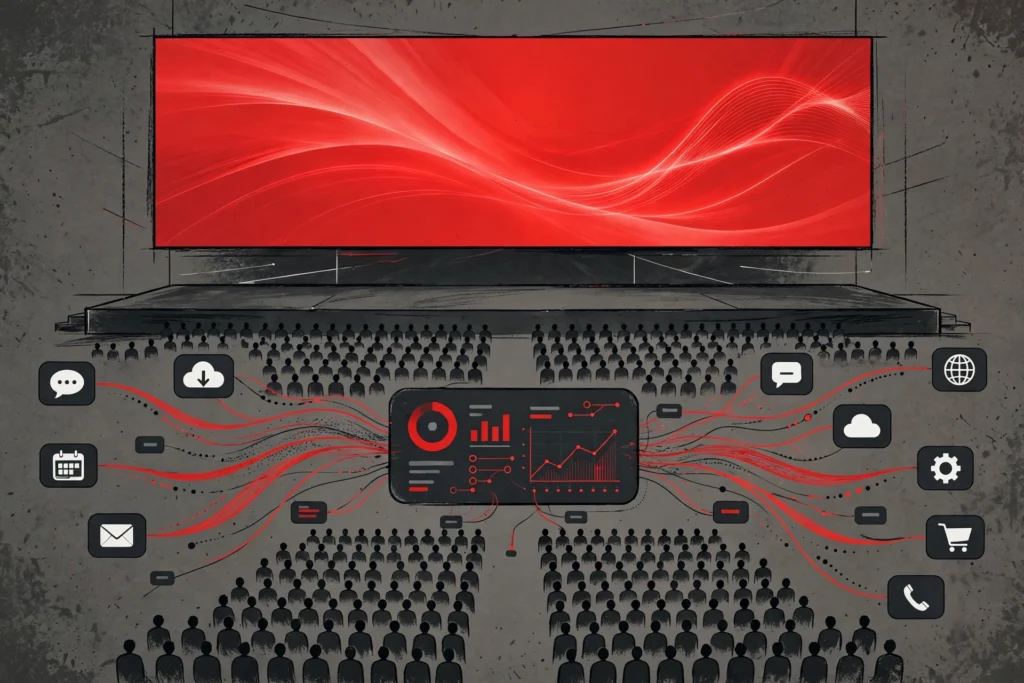
AIforce is a live interface layer. It exposes Salesforce data, workflows, business logic, semantics, permissions, security, and governance to AI tools that sit outside the traditional Salesforce user interface.
In practice, an employee can ask a question, update a record, or trigger a workflow from Claude, Slack, Google Gemini Enterprise, or Amazon Q. The work still runs on Salesforce’s rules, and the permissions already configured inside Salesforce still apply.
AIforce ships in several configurations. ClaudeForce runs it inside Claude, SlackForce runs it inside Slack, and Agentforce Coworker runs it inside Lightning. An SDK is available for teams building custom interfaces, and an AIforce Max Edition bundles everything into a single SKU.
Salesforce confirmed zero data retention across every version, and said customer data is not used to train the underlying models. For companies that have spent years guarding their CRM data, that line matters as much as any feature.
ClaudeForce: Salesforce Inside Claude
The headline act of Dreamforce 2026 was ClaudeForce, which brings Salesforce data and capabilities directly into Claude. It is built as a pre-configured MCP server with 37 prebuilt sales skills ready from day one.
Before the open beta, Salesforce and Anthropic had already been running ClaudeForce internally as “customer zero”, with roughly 4,000 daily active users. It is now available in open beta through AppExchange and Claude’s Enterprise Marketplace.
The live keynote demo built an entire Salesforce command centre just by talking to Claude. No traditional interface, no manual configuration. Deal signals were surfaced by an AI-generated avatar of co-founder Parker Harris, and a stalled mid-six-figure deal was flagged in a security review.
The presenter then confirmed the account and triggered a Slack message to the team, all from inside Claude. The demo’s real message was that none of it required leaving Claude or touching a traditional Salesforce screen.
Anthropic is putting Claude everywhere at work, and Salesforce is now one of the places it lives — a direction Anthropic pushed further with its own Claude office suite earlier this month.
SlackForce Turns Slack Into the Front Door
SlackForce takes Salesforce’s earlier Slackbot and turns it into a full working interface inside Slack. Teams can create records, code with agents, and generate live dashboards without switching platforms.
The new addition is Slackforce Surfaces: rich, interactive applications generated directly inside Slack channels, pulling from Salesforce and Slack data in real time. A channel becomes a place where work happens, not just where work is discussed.
Seven Job-Ready Agents Join Agentforce
Agentforce was the centrepiece of last year’s Dreamforce. This year it matured from a platform for building agents into a platform for deploying job-ready ones.
Salesforce introduced seven specialised agents, each built for a specific business function with the context, data access, and tooling that role requires. Piper handles inbound pipeline, Hunter covers outbound sales, Casey takes customer service, Paige runs operations, Fin manages finance, Carter handles commerce, and Marshall covers supply chain and HR.
Beyond the named agents, Salesforce announced four capability expansions. Long-horizon execution lets agents pursue goals over days or weeks, not just single sessions. Agent Script gives granular control over how individual agents behave.
Multi-Agent Orchestration lets several agents coordinate across workflows, and Agent Optimizer tunes performance automatically over time. The always-on AI coworker pitch is familiar — Databricks’ Genie made a similar case recently — but Salesforce is applying it to the largest CRM install base in the world.
Agentforce Coworker Hits 100,000 Users in 35 Days
First announced in May 2026, Agentforce Coworker gives employees an agentic interface layered directly on top of the standard Salesforce Lightning interface. Staff can ask questions, find information, take action, and hand work to specialised agents without switching tools.
The adoption number Salesforce shared is striking: 100,000 users within its first 35 days of availability. It is a figure the company would not surface unless the early usage data was genuinely strong.
Koa: A Reasoning Model Built Only for CRM
Koa is Salesforce’s first purpose-built CRM reasoning model, developed with NVIDIA and built on the Nemotron 3 Super architecture. It is trained specifically to reason through CRM workflows, make decisions, use tools, and complete tasks step by step.
The model was post-trained entirely on synthetic enterprise scenarios, not on real customer records or call logs. That choice is meant to answer the data question before customers even ask it.
Koa is already in pilot with customers including 1-800Accountant, Baxter Credit Union, Formula 1, UChicago Medicine, and Xero. The three CRM tasks it was built to reason about are lead qualification, service escalation, and resolution. General availability in the US is planned for winter 2026.
Alongside Koa, the Enterprise AI Harness gives IT and security teams monitoring, tracing, security, and governance capabilities across all AI agents operating within Salesforce. As agent usage scales, that governance layer becomes as operationally important as the agents themselves.
Builder Central: Build by Describing What You Want
Builder Central shifts Salesforce development from configuration to conversation. Teams describe a business requirement in natural language, and the system generates data models, agents, flows, validations, and tests, while coordinating multiple agents across the workflow.
For administrators without deep developer backgrounds, that lowers the barrier between having a business need and having a working implementation. For developers, it cuts the scaffolding time on standard builds significantly.
What Happens Next
Taken together, the Dreamforce 2026 announcements shift Salesforce from a system your teams go into to a data and AI layer that goes wherever your teams already are. AIforce is what makes that possible.
ClaudeForce and SlackForce are the first expressions of it. Koa is the reasoning engine that makes CRM-specific AI decisions better than a general-purpose model can.
The new Agentforce capabilities — long-horizon execution, multi-agent orchestration, and job-ready named agents — move AI from task automation toward genuine digital labour. That is the same direction the whole enterprise AI market is heading, as seen in the IBM and Microsoft Imagine Enterprise platform announced earlier this month.
For businesses already running Salesforce, the near-term implications are practical. Teams that live in Slack can access Salesforce data and take actions without leaving the interface. Koa’s winter 2026 US general availability is close enough that organisations should be planning what CRM reasoning capability means for their use case now.
There are still open questions. Salesforce has not published pricing details for much of what was announced, and the delivery dates vary: some features are available now, some are in pilot, and a few arrive with the winter release. The follow-through is what market watchers will track next.
But the direction is unmistakable. Dreamforce 2026 made one thing clear: the next phase of Salesforce is not about adding AI features to a CRM. It is about a CRM whose data, logic, and agents travel into every tool a business uses. That is a meaningfully different product from the Salesforce of twelve months ago.