Picture a laboratory in Yorktown Heights, New York, where a chip colder than deep space hangs inside a golden tangle of wires. It does not look like a computer. It looks like a chandelier built by engineers who stopped caring what a computer is supposed to look like.
Inside that machine, IBM is quietly redrawing the map of what quantum computers can do. On November 11, at its annual Quantum Developer Conference, the company unveiled its next processor, IBM Nighthawk r3, and a plan to link two of them into a single system with 1,040 qubits in 2027.
It is the biggest jump IBM has ever promised in quantum hardware. It is also, for now, a promise rather than a product. The chip does not exist yet in working form. What IBM announced was a set of design targets, plus proof that the pieces needed to reach them already work in the lab.
What Is IBM Nighthawk r3?
IBM Nighthawk r3 is a superconducting quantum processor designed to run 10,000 quantum operations across 520 programmable qubits. That is the headline figure, and it needs a little unpacking.
A qubit is the basic unit of a quantum computer, the rough equivalent of a bit in an ordinary machine. But not every qubit on a chip can be programmed. Some exist to support the others, handling error correction and the wiring that keeps the system stable.
IBM Nighthawk r3 will carry 2,034 physical qubits in total. Of those, 520 will be programmable. The rest do the invisible work that makes the programmable ones useful.
The 10,000-operation figure is equally important. Quantum operations are the individual steps of a calculation, and every extra step is a chance for errors to creep in. A machine that can run 10,000 operations accurately can tackle problems a shorter-lived machine cannot finish.
IBM has not given a price for access, nor a date when customers can run jobs on the new chip. The announcement, according to Quantum Computing Report, was a roadmap reveal at the company’s Quantum Developer Conference, not a product launch.
Two Chips, One Machine: The Road to 1,040 Qubits
The most ambitious part of the announcement is not the single chip. It is what IBM plans to do with two of them.
In 2027, the company intends to connect a pair of Nighthawk r3 processors into one system with 1,040 programmable qubits. It would be the first IBM machine to pass the 1,000-qubit mark, a threshold the industry has long seen as the point where quantum computers start becoming genuinely useful.
Linking two quantum chips is not like plugging two ordinary processors together. Quantum information is fragile. Moving it between chips without destroying it is one of the hardest problems in the field, and the reason most quantum computers today are single chips working alone.
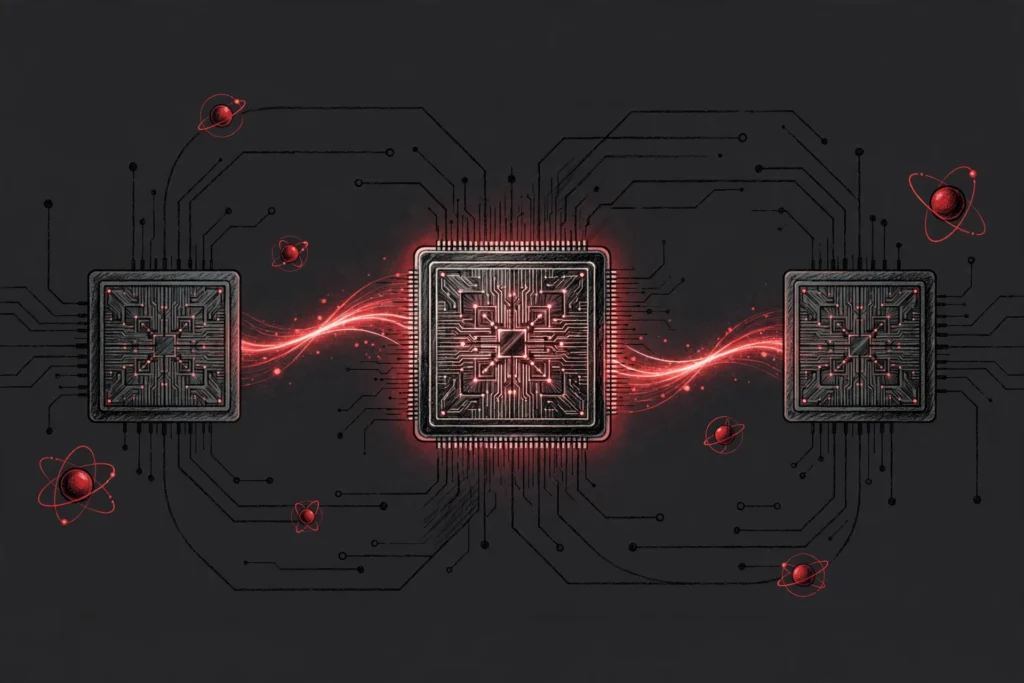
IBM’s answer is a component called an l-coupler, a chip-to-chip connector designed to pass quantum states between processors. The Nighthawk r3 design includes ten of them. The company says it has already demonstrated the connection in the lab, with a transfer fidelity of 99.3 percent.
That number is close to, but not yet at, IBM’s target of 99.9 percent. The gap matters, because every lost fraction of fidelity compounds across thousands of operations. Still, 99.3 percent is a real measured result, not a projection.
Nighthawk r2 Already Proved the Design Works
Sceptics have a fair question: why trust a roadmap from a company whose last big chip is only two months old? The answer is that the last big chip is working, and working well.
Nighthawk r2, introduced in September 2026, carries 120 programmable qubits and can run more than 7,500 quantum operations. It can deliver up to 100,000 samples per second, a measure of how quickly it can repeat a calculation and average out the noise.
Since it went live, partners including energy company E.ON, drug-discovery firm Algorithmiq and quantum software company Q-CTRL have run more than 34 billion circuits on it. IBM reports speedups of up to 19 times over its older processors for some workloads.
Those figures are company-reported, and independent benchmarks have not yet confirmed them. But the scale of usage is hard to fake. Thirty-four billion circuits means real customers are running real work, not just watching a demonstration.
That is the foundation the r3 roadmap rests on. The new chip is not a fresh start. It is the same architecture, scaled up by more than four times, from 120 programmable qubits to 520.
IBM also announced managed hybrid workflows, software that lets a classical supercomputer and a quantum processor share one problem, each doing the part of the job it is best at.
Why 1,040 Qubits Matters — and What It Does Not Mean Yet
It is tempting to treat the qubit count as a scoreboard, and to declare whichever company has the most qubits the winner. That would be a mistake, and IBM’s own announcement is careful not to make that claim.
More qubits only help if they are good qubits. A thousand noisy qubits can be less useful than a hundred stable ones, because errors multiply as calculations grow longer. The real measure of a quantum computer is how many useful operations it can complete before errors overwhelm the answer.
That is why the 10,000-operation target matters as much as the 520-qubit figure. It is IBM saying, in effect, that the new chip will not just be bigger, but better at finishing long calculations. The two-chip system in 2027 is the test of whether that claim holds at a much larger scale.
It is also worth being clear about what 1,040 qubits will not do. It will not break modern encryption or replace your laptop. Quantum computers remain research and enterprise machines, rented by the hour through the cloud.
What a 1,040-qubit system could do is take on bigger versions of familiar problems. Simulating a complex molecule for drug discovery needs more qubits as the molecule grows. So does modelling a new battery material or optimising a power grid.
For now, though, the 1,040-qubit machine is a plan, not a product. IBM has not disclosed a release date for the single r3 chip, let alone the linked system. The 2027 target should be read as an intention, not a guarantee.
The Bigger Goal: Fault-Tolerant Quantum Computing by 2029
Nighthawk r3 is not the destination. It is a stepping stone on IBM’s roadmap toward a machine called Starling, a fault-tolerant quantum computer the company aims to build by 2029.
Fault tolerance is the holy grail of the field. Today’s quantum computers are noisy: their qubits make mistakes, and those mistakes limit how long a calculation can run. A fault-tolerant machine would correct its own errors as it works.
Reaching that point requires many more qubits than any useful calculation needs, because most of them would be devoted to error correction. That is why the roadmap runs through ever-larger machines: r2 at 120 qubits, r3 at 520, a linked pair at 1,040, and eventually Starling.
IBM is not alone on this road. Google, whose Gemini 4 Carbon model leads several AI benchmarks, is chasing the same goal with its Willow chip. Microsoft is betting on a different kind of qubit altogether. The race is real, and nobody has won it yet.
What Happens Next
The next milestone to watch is the first working Nighthawk r3 chip. IBM has not said when it will appear, but the 2027 two-chip target implies the single chip must be running well before then.
Watch, too, for the l-coupler fidelity number. If IBM can push it from 99.3 percent to its 99.9 percent target, the case for linking chips becomes much stronger, and the 1,040-qubit system becomes a real engineering project rather than an aspiration.
Quantum computing has spent decades being five years away. A 1,040-qubit system, if it arrives in 2027, would be the largest quantum machine ever built, and the first to cross a threshold the industry has chased for a decade. IBM has drawn the map. Now it has to build the road.