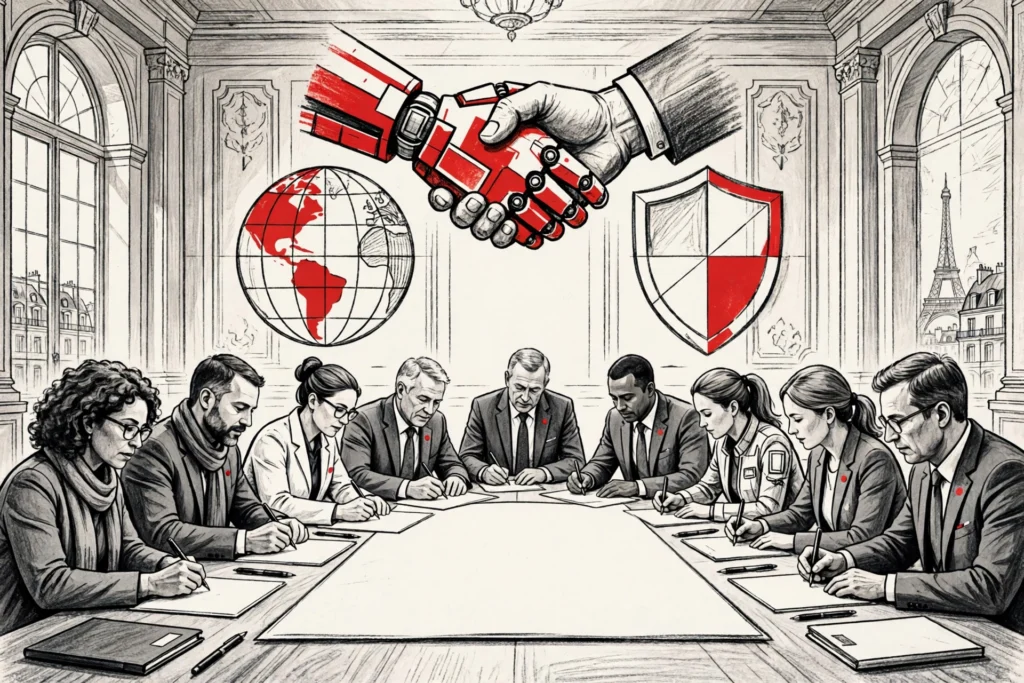
On a Monday morning in Paris, the people who build the most powerful artificial intelligence on Earth sat in the same room as the people who govern the countries that AI is about to reshape. They were not there to announce a product.
They were there to sign a promise.
On 9 November 2026, six governments, ten of the world’s leading AI companies and four civil society groups put their names to the Paris Call for AI Safety and Security, a joint declaration that tries to do something the tech world has talked about for years and never quite managed: agree on shared rules for keeping frontier AI under control.
According to the Canadian Prime Minister’s Office, which published the declaration, the statement remains open to new endorsements and is already being updated as more countries and companies join. The list published on Monday may only be the beginning.
What the Paris Call for AI Safety and Security Actually Says
At its core, the Paris Call is built on a blunt admission. Frontier AI models, the declaration says, transcend national borders in the way they are built, deployed and felt. No single state, company or international body can manage their risks alone.
Until now, each big lab has run its own tests, published its own safety reports and decided for itself when a model was ready. Governments, meanwhile, have mostly watched from the sidelines.
The declaration tries to change that balance. It commits its signatories to three things: shared evaluation standards, clear accountability for whoever builds and deploys these systems, and fast information sharing when something goes wrong.
It is not a law. It carries no fines and creates no regulator. But it is the first time governments and the companies building frontier models have agreed, in writing, on what responsible development is supposed to look like.
Who Signed the Paris AI Safety Declaration
The six governments are Bahrain, Canada, Finland, France, Norway and the Netherlands. France hosted the signing, and Canada published the full text through its Prime Minister’s Office.
The ten companies are the names that dominate the AI race: Anthropic, OpenAI, Microsoft, Mistral AI, Cohere, Hugging Face, Black Forest Labs, Domyn, Sakana AI and Synthesia. Between them, they build most of the frontier models in use today, from chatbots to image generators to coding agents.
Four civil society groups also signed: LawZero, led by AI pioneer Yoshua Bengio; SaferAI; AI Safety Connect; and Ifri, the French Institute of International Relations.
Notably absent are the United States, the United Kingdom and China. None of the three signed on Monday, though the statement stays open for new endorsements. Their absence is the biggest question hanging over the whole exercise.
The Three Promises at the Heart of the Paris Call
The declaration is organised around three strategic commitments, and each one targets a different weak spot in today’s AI safety landscape.
The first is a common framework for evaluating frontier models. Signatories promise to build shared technical standards, evaluation tools and methods that keep pace as models grow more capable, with a particular focus on dangerous misuse in cyber and biological domains, and on the risks that come from models becoming more autonomous.
Crucially, they also promise to publish the non-sensitive findings of their evaluations in a standardised format, and to create a publicly accessible shared repository of red-teaming protocols, benchmarks and stress-test results. In plain terms: safety testing should be comparable, not a private black box for each company.
The second commitment is accountability. Developers promise to disclose what their models can and cannot do, and the risks they know about. They also promise to support evaluation by qualified independent evaluators, and to build in fail-safe mechanisms that can shut down a model’s operations, including during training, if something goes wrong.
The declaration even names a risk that rarely appears in official documents: the removal or circumvention of safeguards, sometimes called abliteration, where safety training is stripped out of a model.
The third commitment is information sharing. Governments and companies promise to build rapid alert systems for serious cyber and AI control incidents, so that a problem discovered in one lab or one country can trigger a collective response before it cascades.
Policymakers also commit to offering secure, confidential channels for whistleblowers, so employees can raise concerns about systemic risks without fear of retaliation.
Why the Paris AI Safety Pact Matters Now
The timing is no accident. The declaration lands in a week when AI capability leaps are arriving almost daily. Anthropic has just released Claude Fable 5.2, a faster and cheaper frontier model, while Google has unveiled new AI chips and Meta has launched a tiny coding model that punches far above its weight.
Each of those launches makes the same point: models are getting more powerful, cheaper and easier to run. The safety conversation has to move at the same speed, and right now it does not.
The declaration name-checks the Hiroshima process, the Frontier Safety Commitments agreed at the Seoul AI Summit, the G7 Evian meeting on AI and a United Nations Security Council session on AI held on 23 September 2026.
What is different this time is who signed. Previous pledges were mostly governments talking to governments, or companies talking to companies. This is the first major declaration where both sides signed the same document.
What the Paris Call Does Not Do
For all its ambition, the Paris Call has real limits, and they are worth stating plainly.
First, it is voluntary. There is no enforcement mechanism, no penalty for a signatory that quietly stops complying, and no independent body with the power to halt a deployment. The declaration promises independent evaluation, but it does not say who appoints the evaluators or what happens if a company refuses them access.
Second, the biggest players are missing. The United States is home to most of the frontier labs, and China is building its own at extraordinary speed. A safety framework that neither has signed is, by definition, incomplete. The same goes for the United Kingdom, which hosted the first major AI Safety Summit at Bletchley Park in 2023.
Third, the hardest questions are still unanswered. The declaration calls for clear legal frameworks that assign responsibility when AI causes large-scale damage, including harm that crosses borders. But it does not say what those frameworks should look like.
None of this makes the declaration meaningless. Voluntary agreements are often how international norms begin. But it does mean the Paris Call should be judged on what happens next, not on the signatures themselves.
What Happens Next for AI Safety
The most important test will be the shared evaluation repository. If companies genuinely publish comparable safety results, researchers and regulators will finally be able to see which models are safe and which are not, in the same terms.
The whistleblower channels are the second test. A promise of protection only matters if employees actually use it, and if the channels are genuinely confidential. Watch for the first public case of an AI employee raising a concern through one of them.
The third test is expansion. The declaration is open to new signatories, and updated lists are already appearing. Whether the United States and China eventually join will determine whether this becomes a global standard or a coalition of the willing.
For now, the Paris Call for AI Safety and Security is best understood as a starting line, not a finish line. Six governments, ten companies and four civil society groups have agreed, in public, that frontier AI is too powerful to be left to good intentions alone. They have promised to test it together, to take responsibility for it, and to warn each other when it goes wrong.
The full text of the declaration is published by the Canadian Prime Minister’s Office.