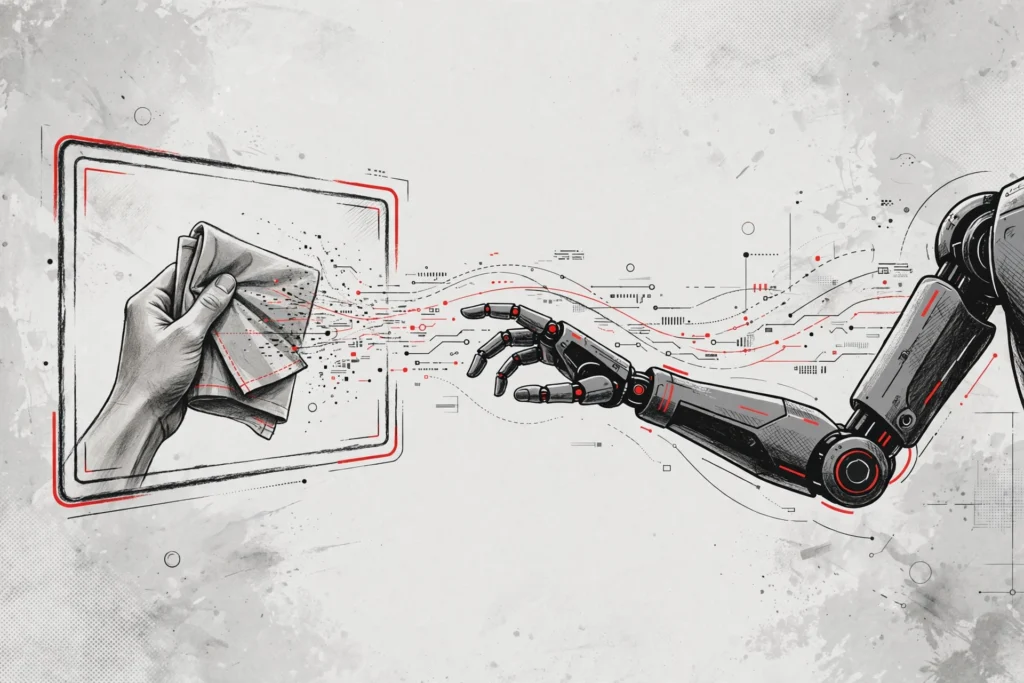
Picture a warehouse worker at the end of a long shift, folding shirts and stacking them into a crate. Her hands move without thinking: pinch, fold, tuck, place. Now picture a robot standing beside her, watching every move through a camera. It never touches a shirt. It only watches — and that is exactly how NVIDIA GR00T 2 learns.
An hour later, the robot tries the job itself. Its gripper hesitates, then pinches the fabric, folds it, and sets it down. It is not perfect. But it learned the skill without a single line of robot-specific code — just by watching a human do it.
That is the promise of NVIDIA GR00T 2, the robot foundation model NVIDIA unveiled on November 9, 2026, at the Conference on Robot Learning (CoRL) in Austin, Texas. And if it works the way NVIDIA says it does, the hardest problem in robotics may have just changed shape.
What Is NVIDIA GR00T 2?
GR00T 2 is what NVIDIA calls an “open frontier world action model,” built on the company’s Cosmos family of world models. In plain language, it is a large AI brain designed to control robots — not by following pre-programmed routines, but by understanding what it sees and deciding what to do next.
Earlier robot models needed thousands of demonstrations recorded on the exact robot that would do the job. Change the robot’s arm, and you started over. GR00T 2 breaks that rule. A single pretrained checkpoint covers parallel-gripper arms, dexterous hands, and even Unitree’s G1 humanoid robot.
The model is built on a 2-billion-parameter transformer based on Cosmos-Predict2.5-2B. It reads recent camera video, a spoken or written instruction, and the robot’s current state — then generates a short burst of future video and the motor commands to match, all inside one diffusion transformer.
How GR00T 2 Learns From Watching Humans
The core idea behind GR00T 2 is simple to say and hard to build: the best teacher for a robot is a human doing the task. NVIDIA trained the model on a staggering mix of data, dominated by footage of people rather than robots.
The pretraining mix includes 402,730 hours of first-person human video — people doing everyday tasks, filmed from a head-mounted camera. Alongside that sit 10,184 hours of handheld gripper demonstrations across 2,897 tasks, and 23,500 hours of robot teleoperation.
Why does human video help so much? Because there are far more videos of humans folding laundry, packing boxes, and plugging in cables than there will ever be of robots doing the same. Human footage is cheap, plentiful, and covers the messy reality of everyday objects.
The model uses that footage to build a kind of common sense about the physical world: how cloth folds, how a plug slides into a socket, how a box lid closes. Then it transfers that understanding to whatever robot body it is controlling, without needing fresh demonstrations on that body.
NVIDIA GR00T 2 by the Numbers
NVIDIA’s headline figures come from a test of 50 manipulation tasks the model had never been trained on. With zero task-specific demonstrations, GR00T 2 completed 40 of the 50 tasks at least once — a 40% average success rate from nothing but its general training.
Show it a single demonstration of each task, and the average success rate jumps to 71%. Give it five demonstrations, and it reaches 95%. That steep climb is the point: a robot that needs one example instead of one thousand is a robot a small business could actually teach.
It is worth keeping the numbers in perspective. NVIDIA’s own figures have not been independently verified by third parties, and the 95% figure comes from tasks the model could already learn. The honest reading is that GR00T 2 is a large step, not a finished product.
Isaac Lab 3.0: The Training Ground Behind the Robot Brain
A robot brain is only as good as the place it practises. Alongside GR00T 2, NVIDIA released Isaac Lab 3.0, the latest version of its open-source robot-learning framework, which became generally available on October 20, 2026.
Isaac Lab 3.0 lets AI agents set up training environments quickly, switch between the PhysX and Newton physics engines, and apply a new reinforcement-learning post-training library to foundation models like GR00T. NVIDIA says it reaches up to 2.5 times the training throughput of Isaac Lab 2.3 on a dexterous manipulation benchmark.
Think of it as a flight simulator for robots: thousands of virtual robots can practise a task in parallel, fail safely, and learn from every mistake before a single real motor moves. That is how a model trained mostly on video gets its hands dirty — virtually.
Who Is Already Testing GR00T 2?
The first names attached to GR00T 2 are industrial, not domestic. Nexuni is testing it for robotic laundry handling, Foxconn is applying it to server-manufacturing automation, and Siemens is evaluating it across industrial use cases.
The Big Question: How Open Is GR00T 2 Really?
NVIDIA introduces GR00T 2 as an open model, and part of that claim is genuinely open. The company is releasing 100,000 hours of its human video data as Human-1M-100K, under a Creative Commons CC BY 4.0 licence that permits commercial and non-commercial use.
That dataset includes video, language annotations, and head and hand motion data — a serious gift to researchers who could never collect 100,000 hours of footage themselves. For a small lab or startup, it removes the biggest barrier to working on robot learning.
But the model itself is a different story. According to NVIDIA’s announcement at CoRL, the code will be available in December, and no public release date or licence for the model weights has been announced yet. Until those weights arrive, “open” describes the data and the promise — not yet the brain itself.
Why GR00T 2 Matters — and What Happens Next
Robots have spent decades stuck on the same problem: every new task needed expensive, robot-specific training. A warehouse robot could move boxes brilliantly and fail completely at folding a towel. Teaching it the towel meant starting almost from scratch.
GR00T 2 attacks that bottleneck directly. If a robot can learn from watching humans — the way a new employee learns by shadowing a colleague — then the cost of teaching robots collapses. One demonstration instead of a thousand changes who can afford to automate.
The timing fits a wider shift in AI. Models are getting cheaper and faster to run, from Claude Fable 5.2 cutting inference costs to AI assistants reaching everyday software like Microsoft PC Manager. GR00T 2 extends that same trend from screens and text into the physical world.
What happens next depends on December. If NVIDIA ships the GR00T 2 code and weights as promised, researchers everywhere will test the 71% claim on their own robots and tasks. If the results hold up outside NVIDIA’s lab, expect a rush of humanoid and industrial robots trained the GR00T way.
For now, the robot is still watching. It has seen 402,730 hours of humans at work. The question is what it does with all that watching — and how soon it starts doing it in a factory or laundry room near you. That answer, according to NVIDIA, is coming sooner than expected.