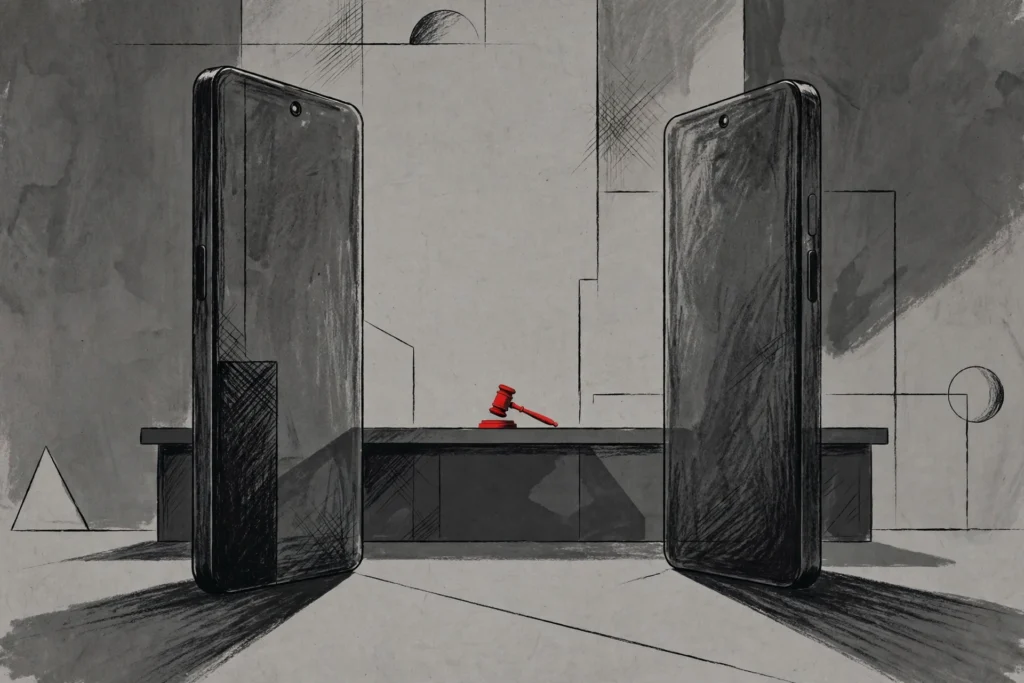
It was meant to be a quiet Friday. The day after Thanksgiving, Wall Street closed early, and Silicon Valley was easing into a long weekend. Then OpenAI walked into a federal court in San Jose and turned its legal fight with Apple upside down.
OpenAI countersues Apple in a filing that accuses the iPhone maker of the very thing Apple accused it of months ago: stealing trade secrets. But the ChatGPT maker goes further. It also claims Apple has been using its size to bully the suppliers that OpenAI needs to build its own devices.
The two companies were partners not long ago. Apple put ChatGPT inside the iPhone. Now they are suing each other, and the prize is the next generation of personal AI hardware.
What OpenAI Filed on Friday
OpenAI filed its counterclaims on Friday, November 27, 2026, in the federal court in San Jose, California, according to the Financial Times. The filing was made in the same case Apple started in July, which means the two lawsuits will now be fought as one.
According to Reuters, OpenAI accuses Apple of trying to “compete unfairly by any means available”. The filing says Apple used its “size and wealth to forestall competition”, including by “coercing and threatening” suppliers that work with the ChatGPT maker.
The counterclaims run to 12 causes of action, according to Unite.AI, which reviewed the filing. They include trade secret theft under federal law, interference with OpenAI’s contracts, and unfair competition under California law.
Apple did not immediately respond to a request for comment, according to Reuters. The claims in OpenAI’s complaint have not yet been established in court.
The Employee at the Centre of the Case
At the heart of OpenAI’s complaint is an employee who left OpenAI and went back to Apple. OpenAI says that employee sent more than 100 confidential files about an unreleased OpenAI device to personal accounts.
The files included device images, engineering information, supplier details, manufacturing data, and standards for cosmetic finishes and sealants. That is the kind of detail a rival would need to understand how a product is built, and how much it costs to make.
OpenAI first raised the matter in October, when it told the court that its own investigation had turned up evidence of trade theft by Apple. It also sent Apple a cease-and-desist letter on October 9, 2026, asking the company to investigate, preserve evidence, and account for the material.
The filing also alleges that Apple encouraged its employees to store corporate files on personal devices and cloud storage accounts, and to do company business over personal iMessage accounts. That practice, OpenAI suggests, made it easier for sensitive material to leave the building.
Apple’s Original Lawsuit From July
The fight began in July 2026, when Apple sued OpenAI, its hardware unit io Products, and two former Apple employees, Tang Tan and Chang Liu. Apple alleged the two men took confidential hardware details to OpenAI after leaving the company.
According to Apple’s filing, the former employees “surreptitiously accessed and downloaded dozens of Apple’s confidential hardware-related files, including voluminous, detailed information about unreleased products, engineering presentations, technical specifications and proprietary project data.”
Apple said the material was taken to benefit OpenAI’s consumer device efforts. OpenAI denied the allegations in August, describing the lawsuit as an attempt to stop it from hiring Apple’s people.
Apple has also asked the court for a preliminary injunction, an order that would bar further use of the secrets before a verdict. The case is scheduled to go to trial on July 19, 2027, under a schedule set by Judge Edward Davila in October.
Suppliers Caught in the Middle
The most striking part of OpenAI’s countersuit may not be the trade secret claims. It is the allegation that Apple has been leaning on the supply chain itself, threatening companies that might work on OpenAI’s upcoming hardware.
For a company trying to build its first devices, suppliers are everything. The factories that make screens, batteries, chips and casings are shared across the industry, and losing access to a good one can delay a product by months.
OpenAI’s hardware ambitions are no secret. The company acquired Jony Ive’s io Products, the design studio behind its device plans, and has been hiring hardware engineers from across the industry. Apple, meanwhile, sells hundreds of millions of devices a year and is one of the largest buyers in the world.
If the claims are proven, the supplier pressure could matter more than the stolen files. A court can order files deleted. Rebuilding trust with a frightened supplier takes far longer.
From Partners to Rivals
What makes this fight so unusual is how close the two companies once were. Apple built ChatGPT into the iPhone as part of Apple Intelligence, giving OpenAI’s chatbot a place on hundreds of millions of devices.
That partnership still exists on paper, but the relationship has changed. OpenAI is no longer just a software partner. It is becoming a hardware rival, working on the kind of personal AI devices that could one day sit beside, or even replace, the phone.
Apple’s own AI hardware plans add to the tension. The company is preparing smart glasses and other devices of its own, and its AI features are now rolling out in markets like China after clearing regulatory hurdles.
Both companies are now hiring from the same small pool of hardware talent, buying from the same suppliers, and racing toward the same future. When two companies want the same people and the same factories, the courtroom is never far away.
What Happens Next
The short answer is: not much, and then everything. Cases like this move slowly, and the trial is still more than seven months away. But the filing changes the shape of the dispute.
Apple is no longer just the accuser. It now has to defend itself against the same kind of claims it brought, in the same courtroom, before the same judge. That gives OpenAI leverage it did not have before, whether the case ends in a settlement or a verdict.
Apple’s request for a preliminary injunction will be an early test. If the judge grants it, OpenAI could face limits on how it uses the disputed material. If the judge refuses, Apple loses one of its strongest weapons.
Investors, for now, seem unbothered. Apple shares rose 0.8 percent in Friday’s shortened session and were little changed in after-hours trading. The market appears to view the lawsuit as a sideshow, not a threat to either company’s business.
That may be the wrong read. The real fight is not about the files. It is about who gets to build the device that comes after the smartphone, and who controls the factories that make it.
Why This Case Matters
Trade secret cases between tech giants are common, but this one is different because the stakes are not just legal. They are structural. The winner of the AI hardware race will not be decided by a single product, but by who can hire the best engineers and secure the best suppliers.
OpenAI’s countersuit argues that Apple is using its market power to choke off both. If a court agrees, the ruling could set limits on how far a dominant company can go to protect its supply chain.
For now, the two companies will keep building, keep hiring, and keep suing. The devices at the centre of the case are still unreleased, still secret, and still months away from the public.
But the fight over them has already begun, in a courtroom in San Jose, on a quiet Friday afternoon.
The story was first reported by the Financial Times via Reuters.
Related reading: Apple Intelligence China: iPad and Mac Clear Regulatory Hurdle Ahead of December Launch
Related reading: Claude Office Suite: Anthropic Takes on Microsoft and Google as OpenAI Fires Back
Related reading: ChatGPT Enterprise Hits AWS Marketplace: Buy OpenAI’s Workplace AI Through Your AWS Bill


