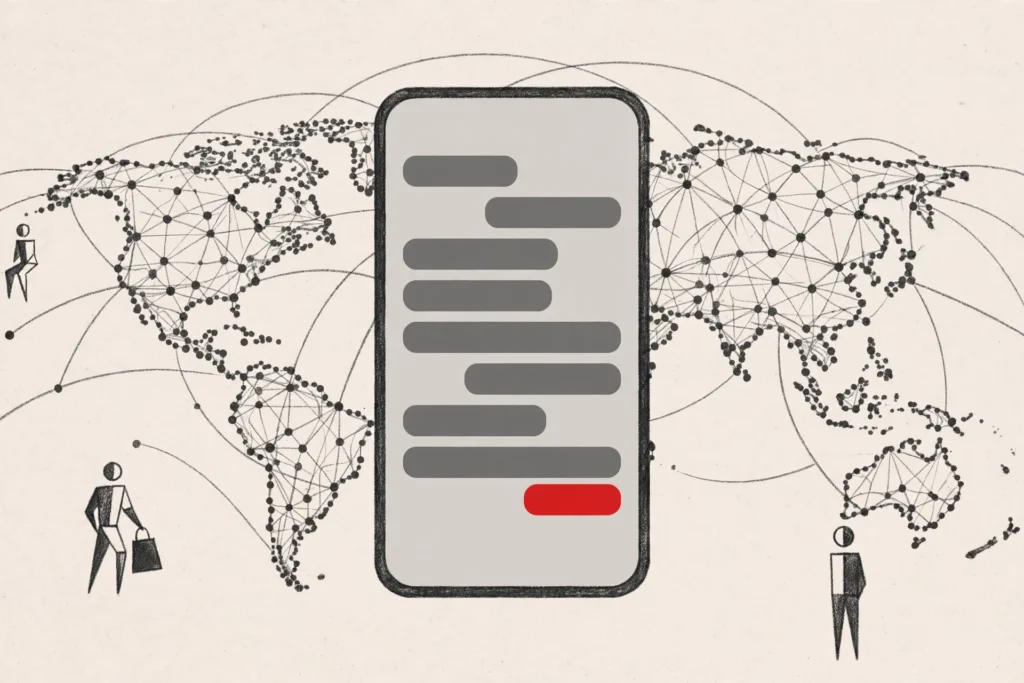
A shop owner in Medellín types a question into ChatGPT on a Tuesday morning. She wants ideas for promoting her small bakery online, and the chatbot answers in seconds, as it always does.
Then something new appears below the answer. A small, clearly labelled box suggests a local marketing tool she has never heard of, with a link to try it.
That little box is the future OpenAI is betting on. And from today, it is arriving in 44 more countries, from Argentina to Ukraine to Saudi Arabia.
ChatGPT Ads Reach 44 New Markets Through Aleph
OpenAI announced on November 12 that it has named Aleph the exclusive reseller for ChatGPT Ads in 44 countries, according to Adgully. Brands and agencies in those markets can now contract, pay and get support locally through Aleph’s regional teams.
The deal covers 14 markets in Latin America, 16 in Europe and Central Asia, 10 in the Middle East and Africa, and four in Asia-Pacific. It includes countries such as Argentina, Chile, Colombia, Peru, Hungary, Romania, Ukraine, Egypt, Saudi Arabia, South Africa, the United Arab Emirates, Bangladesh and Sri Lanka.
For advertisers, the practical change is simple. Instead of dealing with OpenAI directly in dollars and English, they work with a local Aleph team that speaks their language, bills in their currency and can extend credit, said Aleph founder and chief executive Gastón Taratuta.
Aleph will handle onboarding and first-line support in each market. OpenAI, meanwhile, keeps control of the ad product itself, including where ads appear and what rules they follow.
From a US Test to 89 Countries in Nine Months
ChatGPT Ads began as a small experiment. OpenAI started testing sponsored placements below ChatGPT’s answers in the United States on February 9, 2026, for free users and subscribers to its cheaper Go plan.
The format is deliberately restrained. Ads appear in a separate, labelled box beneath the AI’s answer, never inside the answer itself. OpenAI says the ads do not influence what ChatGPT writes, and advertisers never receive chats, chat history, memories or personal details.
The rollout moved fast. By late August, OpenAI said the ads had reached a $1 billion annualised revenue run rate in under 200 days. On October 21, the company added 26 more countries, taking ChatGPT Ads to 89 markets worldwide.
The scale behind that number is enormous. OpenAI says ChatGPT now reaches 1.2 billion people a week, and more than 100,000 advertisers have run campaigns since the ads launched. The Aleph deal extends that machine into markets where OpenAI has no local sales team of its own.
New formats are arriving too. On October 5, OpenAI said it would begin testing visual ads that appear while an image is being generated, starting in the US. Users on free tiers have already started seeing sponsored visuals during image rendering.
Who Sees ChatGPT Ads — and Who Never Will
Not every ChatGPT user will see an ad. The ads appear only on the Free and Go plans. Subscribers to Plus, Pro, Business, Enterprise and Edu accounts stay ad-free, and OpenAI has given no sign that will change.
There are other limits as well. Ads are not shown to accounts identified as belonging to users under 18, or in Temporary Chats. They do not appear near sensitive topics such as personal health, mental health or politics, and political advertising is not allowed at all.
Users can turn off ad personalisation based on chat history, and OpenAI says it does not sell conversation data to advertisers. Free users can also choose an ad-free experience, though it comes with fewer messages per day and no access to tools like image generation.
The rules matter because trust is the product. If users start to suspect that an answer was written to please an advertiser, the whole idea of asking an AI for advice falls apart. OpenAI knows it, which is why it repeats the same line in every announcement: ads do not influence answers.
Why OpenAI Needs the Advertising Money
The push into advertising is not a side project. It is a response to a brutal arithmetic problem that every AI lab now faces: the models cost far more to run than subscriptions alone can cover.
OpenAI’s own numbers show the strain. The company reported roughly $10 billion in revenue for the third quarter of 2026, its first quarter above that mark, yet its operating loss widened to $10.9 billion in the same period, as we reported in our look at OpenAI’s Q3 results.
Advertising gives OpenAI a third source of income alongside consumer subscriptions and business products. A $1 billion run rate is small next to a $50 billion annual revenue run rate, but it is growing fast, and it comes from the hundreds of millions of people who use ChatGPT for free.
The same logic explains the company’s other recent moves. Just two days before the Aleph announcement, OpenAI launched Businesses in ChatGPT, a hub that lets companies claim a profile and list products with prices and stock.
Eventually, AI agents will be able to sell on those businesses’ behalf, as covered in our report on the Claude office suite launch.
The Rest of the AI Industry Is Following — Except One
OpenAI is not alone in turning to advertising, though its biggest rival is holding out. Anthropic has said it does not plan to put ads in its AI tools, citing data protection and its users’ interests.
Anthropic is about to list on the Nasdaq at a valuation of up to $1.4 trillion, as we noted in our coverage of the Anthropic IPO.
Everyone else is moving the other way. Microsoft has shown ads in the public version of Copilot since 2023. Perplexity has experimented with ads in the United States since 2024. Google is considering ads in Gemini, according to reports.
Michael Komasinski, chief executive of the advertising agency Criteo, told AFP this week that he expects most AI platforms to adopt advertising eventually. “Advertising is the most scalable business model in the world,” he said on the sidelines of the Web Summit in Lisbon.
Criteo itself works with OpenAI in 89 countries on AI chatbot campaigns. Komasinski said around 3,600 brands have trialled AI advertising, and their spending on ChatGPT has been rising, if modestly so far.
What Happens Next for ChatGPT Ads
The Aleph deal is, in one sense, plumbing. It does not change what users see, and it does not invent a new ad format. What it does is put a sales force behind a product that already exists, in 44 places where OpenAI could not easily sell it alone.
The more interesting question is what comes next. OpenAI has already tested sponsored agents that can complete tasks inside ChatGPT, and visual ads are now appearing during image generation. Each step moves advertising closer to the centre of the conversation.
For users in the new markets, the change will be quiet at first. A labelled box here, a sponsored suggestion there, always below the answer and never inside it. The test is whether people keep trusting the answers above the ads — and whether advertisers keep paying for the space below them.
If both hold, the little box below the answer could become one of the most valuable pieces of screen space on the internet. OpenAI is betting that it will. The next 44 countries are where that bet gets tested.