It was 7 a.m. on launch week, and the first message in the team’s Slack channel did not come from a person. It came from a bot — one of the AI teammates in SpaceXSI’s Grok Bot 1.0, launched on Wednesday.
Nobody had asked it to do any of that. The Launch Bot had already posted that the product ships in two weeks, that it had created a channel to keep everyone on track, and that the countdown had begun.
That scene, from the demo video SpaceXSI released with the launch, is the whole pitch in miniature. The company’s AI agents are no longer personal assistants that wait for instructions. They are teammates now — shared by a whole group, present in its chats and calls, and, if the marketing holds up, offering to take work off people’s plates before anyone asks.
SpaceXSI took Grok Bot 1.0 out of beta on November 11, calling it a major update to its AI teammates, according to WebProNews. The launch lands in a week when workplace AI agents are everywhere.
Databricks turned Genie into an always-on coworker, Anthropic shipped an office suite, and United Airlines banned third-party agents from booking its flights. The race is no longer about who has the smartest model. It is about whose agent actually shows up to work.
What Grok Bot 1.0 actually changes
Grok Bot began in early beta on August 11, 2026, as a personal agent with its own computer, connected to a single user’s apps. Shared Team Bots arrived in public beta on September 28, giving each team a Slack handle to talk to.
Version 1.0 pulls those pieces together and adds the two things that were missing: Microsoft Teams and meetings. A Bot can now be created for yourself, shared with your team, or brought into Slack, Microsoft Teams and video calls.
That sounds like a small step. In practice, it changes who the Bot works for. Before, one person owned the context, the history and the habits. Now the whole team shares one Bot, one memory of the project, and one set of lessons learned.
SpaceXSI says a Bot learns more about a team’s work as more people use it. Something one person teaches a Team Bot can benefit everyone who uses it — though only after an owner or manager approves it.
The company also says Bots are faster at browser work, better at writing documents and building slide decks, and able to create interactive Pages that teammates edit together. It published no figures to back any of those claims.
Grok Bot 1.0 joins your meetings
The most visible change is also the strangest to picture: an AI agent sitting in your video call. A user pastes a meeting link into a chat with the Bot, asks it to join and take notes, and approves the card it presents.
When the meeting starts, the host admits the Bot. It appears under its own name, followed by “transcribing”, and listens, takes notes and answers in the meeting chat when addressed by name.
It works on Google Meet, Zoom and Microsoft Teams, and a Bot that follows a calendar can join scheduled meetings on its own. When the call ends, it sends a summary and action items in its chat.
If the team uses Pages, a longer report lands on a page instead, with the link dropped in chat. The summary or transcript of a past meeting can be requested later, whenever someone needs it.
There are limits, and they matter. The Bot will not share credentials in a meeting. If someone asks for something it held back, it tells the person who added it and offers to send the answer.
In Zoom, a private chat message to the Bot gets a private reply. Meetings run on the settings of the person who started them — which means the Bot’s behaviour is only as careful as that person’s setup.
Bots that offer to take on work
The pitch centres on initiative. SpaceXSI says Bots can recognise work that needs doing and offer to take it on, follow up on unfinished tasks, and bring people in when a decision requires their judgment.
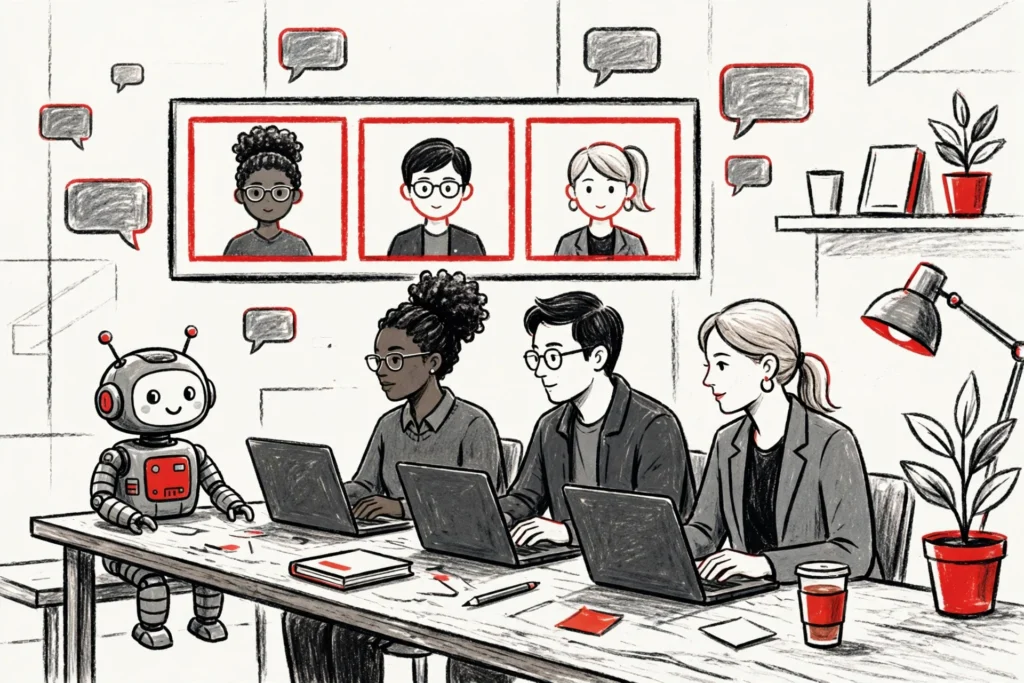
The launch video shows how that is meant to look. A Research Bot joins a call with three colleagues, summarises feedback from 80 testers, reports that testers love how light the headphones are, and asks whether it should ping marketing.
It does, tagging a Copy Bot, which replies “I’m on it” and rewrites an ad headline in a design tool, changing “Sound, reimagined.” to “A lighter fit for longer days,” across two ad sizes.
Later, asked to share a deck with an ad agency, a Deck Bot warns that slide six holds sensitive financials and offers to send a version without it. “Good catch, yes,” the user replies.
It is a polished demo, and demos are easy. The real test is whether a Bot that volunteers for work knows the difference between a task it should grab and one it should leave alone.
SpaceXSI’s answer is control: Bots “respect each person’s permissions” and “ask before taking sensitive actions.” How much unprompted work companies let Bots take on will depend on those settings — and on how much managers trust them.
What it costs, and who can use it
Team Bots are available on Team and Enterprise plans, and meetings run on Team, Enterprise and Ultra plans. Enterprise admins must switch meetings on, and connecting a Bot to Microsoft Teams takes a team admin, an owner or manager, and a Teams admin to approve it.
SpaceXSI published no price with the launch. Existing pricing lists Premium at $30 a month, Super at $100 and Ultra at $200, with Teams seats from $30 — though those figures predate the 1.0 announcement.
One detail will surprise people used to choosing their model: there is no model selector. Once you submit a task, the system decides which model handles it — one of SpaceXSI’s own, or a third-party model — and the bill simply says “Grok Bot”.
Two smaller additions arrived the same day. Gopuff is now built into Grok Bot, so it can order groceries and essentials end to end in the US, delivered in as little as 15 minutes, according to the company.
And Grok Bot can now join a personal or company Tailscale tailnet, reaching private MCP servers, internal tools and apps that are not exposed to the internet — a quiet but important door into corporate systems.
The safeguards — and the questions
Administrators hold the controls, at least on paper. What teammates teach a Team Bot waits for an owner’s or manager’s approval, and admins can limit who shares Bots at all.
But the launch arrives with a shadow. This week researchers published claims about Grok Bot’s cloud sandbox that SpaceXSI has not yet answered, and wasl.tech reported earlier this week that share links from Grok Build exposed tens of thousands of apps.
A Bot that sits in meetings, reads calendars and reaches internal tools is a Bot with a lot of access. The safeguards SpaceXSI describes — permissions, approvals, no credential sharing — are the right shape. Whether they hold under pressure is the question every buyer will ask.
There is also the question of what “teammate” means when the teammate never sleeps. A Bot that follows up on unfinished work at any hour, and learns from everyone it meets, could quietly become the colleague who knows the most about a project — and the one nobody can question.
Why Grok Bot 1.0 matters now
The timing is not an accident. Every major lab is racing to put an agent inside the working day: Anthropic’s Claude office suite, OpenAI’s businesses in ChatGPT, Databricks’ always-on Genie. SpaceXSI’s answer is to make its agent the most present one — in the chat, in the call, in the document.
Presence is a bet. If Bots prove genuinely helpful, the team that shares one will move faster than the team where everyone keeps their own. If they prove noisy, intrusive or leaky, they will be switched off just as fast — and Enterprise admins have the switches.
For now, Grok Bot 1.0 is live, and the experiment has begun in earnest. The Bot has joined the meeting. The question is whether the team will be glad it came.