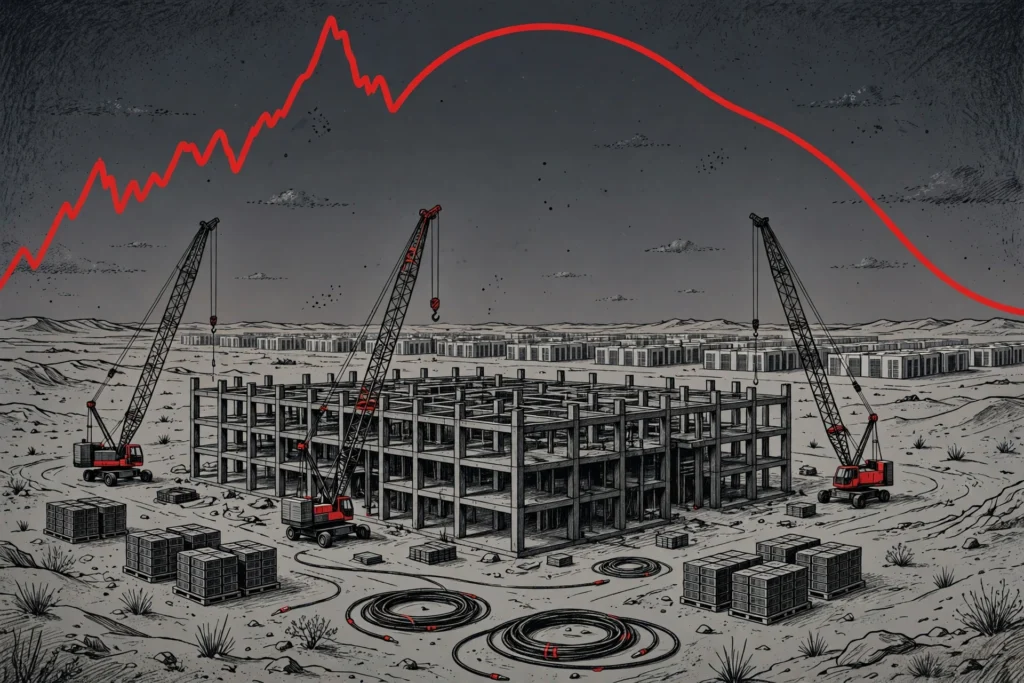
Picture a construction site in the Texas desert. Cranes swing over a half-finished data centre the size of a shopping mall. The concrete is still wet, the power lines are not connected yet — and the bill for all of it, billions of dollars, has already been borrowed.
That image is the American AI boom in a single frame. For two years, companies have raced to build the machines behind artificial intelligence, borrowing staggering sums to do it. Now a powerful voice in American finance is asking the question others have avoided: what if the money coming back is not enough?
Federal Reserve Vice Chair for Supervision Michelle Bowman delivered the warning on Tuesday, November 10, to the Council on Foreign Relations in Washington. Her message was calm and precise — and deeply uncomfortable. If AI returns fall short of expectations, she said, America could face “a large correction in equity valuations”.
It was the first time a senior Federal Reserve official had put numbers on the risk, and the numbers were enormous. The AI bubble, Bowman argued, is not just about expensive shares. It is about debt — and how that debt is connected to almost everything else.
The $800 Billion Bill for the AI Bubble
Bowman told her audience that AI-related debt is on track to exceed $800 billion this year alone. That figure covers corporate bonds, private credit and project finance raised to pay for data centres, chips and the power to run them.
But the headline number is only part of the story. Other obligations tied to the AI buildout — long-term leases, contract commitments and residual-value guarantees — carry potential payments estimated at more than three times that debt. The true bill could run into trillions.
None of those figures are losses, and Bowman was careful to say so. They describe what companies owe, or may owe, not what has already gone wrong. The danger is what happens if the revenue does not arrive on schedule to pay for it.
AI revenues are rising quickly, Bowman acknowledged. The problem is that they do not yet cover the cost of keeping today’s models running and building tomorrow’s. Companies have filled the gap by turning to credit and equity markets, borrowing more as their capital spending has surged.
That is a workable strategy while investors stay confident. It becomes a trap the moment they stop.
What Circular Financing Really Means
One of Bowman’s sharpest warnings concerned something she called out without naming names: circular financing. In the AI industry, the companies that make the chips and cloud infrastructure sometimes invest in the very customers buying their products.
A chipmaker might fund a data-centre operator. That operator then buys the chipmaker’s chips. On paper, both sides look healthy. In reality, the money is going around in a circle, and the demand it creates may be weaker than it appears.
Bowman warned that these arrangements, along with off-balance-sheet liabilities, make it harder to judge who really owes what to whom. When risk is difficult to assess, it is also difficult to price — and that is exactly when markets are most likely to be surprised.
Why the AI Bubble Warning Lands Now
The timing of Bowman’s speech was no accident. Anthropic, the maker of the Claude chatbot, is preparing to go public — the first frontier AI lab to list its shares. The company is expected to price its shares on November 18 and begin trading the following day.
According to Semafor, the valuation Anthropic is seeking has already fallen below initial expectations. That has made some investors nervous about the wider AI trade. Tore Opsahl, who leads Nomura’s quantitative solutions advisory group, said uncertainty around the listing could prompt a selloff in the broader “AI theme”.
Meanwhile, the industry’s own numbers tell a mixed story. OpenAI reported roughly $10 billion in revenue for the third quarter of 2026 — the first quarter it has passed that mark — but its operating loss widened to $10.9 billion in the same period. Revenue is growing fast. So are the losses.
CoreWeave, the cloud provider that rents out AI computing power, reported a 168% jump in quarterly revenue to $3.66 billion. Its share price still sits far below its 2026 highs, and the company carries tens of billions of dollars in debt. The market is rewarding growth, but it is no longer rewarding it blindly.
What Happens If the Returns Don’t Come
Bowman laid out the chain reaction she fears. If AI revenue fails to keep up with sharply rising costs, the first consequence would be a sharp correction in the share prices of AI companies.
That would not stay contained. Higher financing costs and reduced access to credit would follow, making it harder to fund the next round of data centres. The buildout would slow. And because the AI boom has become a main engine of economic growth, the shock would likely soften overall economic activity and inflation.
Lower stock prices could also weaken consumer spending, Bowman said, because households feel poorer when their investments fall — and spend less as a result. The risk is not just a bad week for tech stocks. It is a slowdown that spreads.
She was careful to describe all of this as a conditional risk, not a prediction. A correction could happen. It is not inevitable. But the Fed, she made clear, is watching.
Who Holds the Risk
The exposure is not limited to Silicon Valley. Bowman said the largest American bank holding companies have some exposure to AI financing, and that this exposure is examined in the Federal Reserve’s annual stress tests.
Life insurers, pension funds, private-credit investors and mutual funds also hold AI-related debt, she said. Most of these institutions are well capitalised with stable funding — the reassuring part. The worrying part is that the web of exposure is now wide enough that a shock in one place could be felt in many others.
About a quarter of American businesses and roughly one in ten workers now use AI every day, according to figures Bowman cited. The technology is real, and it is spreading. What is not yet proven is whether it can generate enough money, quickly enough, to justify the spending spree it has triggered.
Interest Rates Add to the Pressure
Bowman’s speech was not only about AI. She also spoke about inflation, and her message there was equally sobering. Tuesday’s consumer price report suggested 12-month core inflation likely moved up further to 3.3% in October — still well above the Fed’s 2% target.
Bowman supported the Federal Open Market Committee’s October decision to hold the federal funds rate at 3.75% to 4%. She announced no new rate decision and set no fixed course for December, saying policymakers would assess the data at each meeting.
But she also said the benefits of further tightening must be weighed against the costs for rate-sensitive sectors such as housing and smaller businesses. Some reports read her remarks as leaving the door open to a December rate increase. Others noted she pointedly did not call for one.
What Comes Next
So what should investors and ordinary people watch in the coming weeks? The first test arrives with Anthropic’s listing on November 19. If the shares trade well, it will calm some nerves. If they stumble, expect the word “bubble” to appear a lot more often.
The second test comes from the companies themselves. Nvidia reports quarterly results on November 17, and the market will be listening for any sign that demand for AI chips is softening. OpenAI is raising fresh capital at a reported $1.25 trillion valuation while spending an estimated $50 billion on computing this year alone.
None of this means the AI boom is over. The technology is improving fast, and companies are finding real uses for it every day. But Bowman’s speech marks a shift: the conversation about AI is no longer only about what the models can do. It is about whether the money behind them adds up.
The cranes in the Texas desert will keep swinging for now. The question Bowman has put on the table is what happens if the customers for all that computing power do not show up fast enough — and who pays when they don’t.
The Fed does not usually warn about bubbles while they are still inflating. When it does, markets would be wise to listen.
Source: JBizNews report on Michelle Bowman’s November 10 speech, with additional reporting from Bloomberg Law.