The Moment That Sold the Idea
Picture a meeting room in Tokyo. A colleague is explaining a deadline in fast Japanese, and you are nodding along, catching maybe half of it.
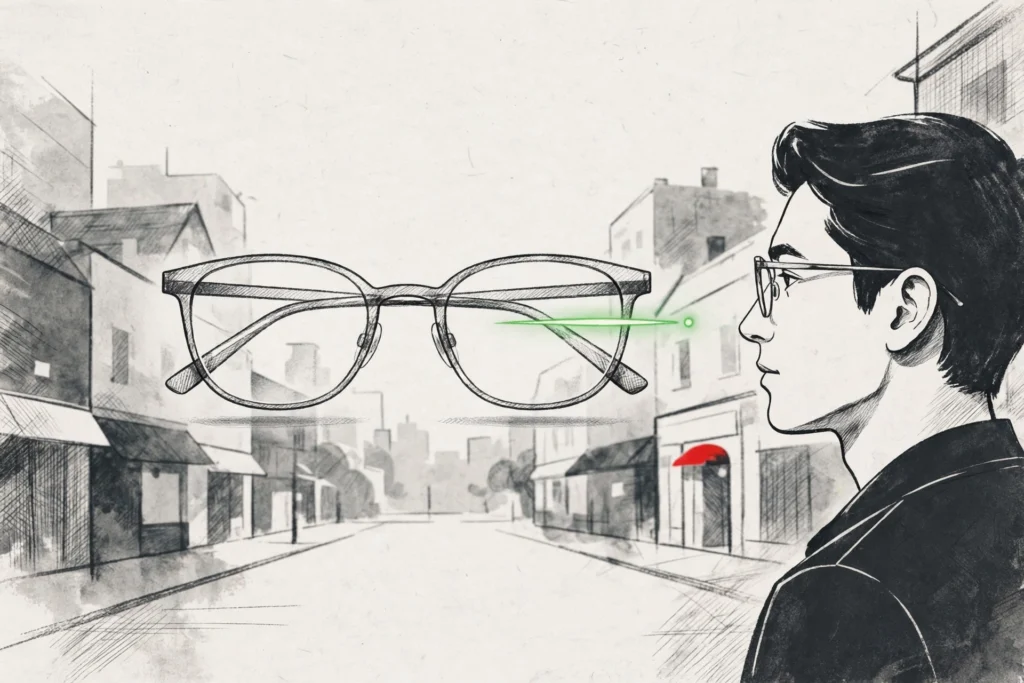
You do not reach for your phone. You do not interrupt. Instead, a quiet line of green text appears in the corner of your right eye, translating the words as they are spoken. Then it vanishes.
That is the scene AROTI wants you to imagine. The Hong Kong startup introduced its first product, the AROTI R1 AI glasses, on November 10, 2026, and the pitch is deliberately small.
These are not glasses that try to replace your phone or paint a digital world over the real one. They show you one useful line of text, exactly when you need it, and then get out of the way.
At under 27 grams, the AROTI R1 is lighter than most ordinary spectacles. It has no camera and no built-in speakers. Its Kickstarter campaign opens on November 16, and until then, the company is keeping the price to itself.
What the AROTI R1 AI Glasses Actually Do
The R1 works with a smartphone and a companion app. A small display projects green text into the wearer’s right-eye field of view, and everything else happens on the phone in your pocket. The glasses are a window, not a computer.
Conversation translation is the headline feature. When someone speaks another language, the translated words appear as text, so you can follow the exchange without staring down at a handset.
A teleprompter mode keeps speaking notes in view during presentations. Instead of holding a script or glancing at a laptop, a presenter can read their prompts while looking at the room.
Walking navigation works the same way. The next turn appears at a glance, so you can keep your eyes on the street instead of on a map. Notifications and reminders arrive as short updates.
Meeting notes come from user-initiated audio recording, with AI-assisted summaries you can revisit later. None of this is spectacular on its own, and that is the point.
One Line of Green Text in Your Right Eye
The display itself is deliberately modest. A single line of green text, in the right eye only, appears when there is something to show and disappears once you have read it.
There is no colour video, no floating window, no augmented-reality overlay trying to impress you. AROTI is betting that a handful of genuinely useful moments, delivered quietly, will matter more than a long list of features you never use.
That restraint is also about attention. A full-colour display in both eyes would demand more battery, more weight and more of your focus. A single green line asks for almost nothing.
You read it, it goes away, and your eyes are back on the person in front of you. Where rivals chase immersion, AROTI is chasing invisibility. The glasses are meant to feel like ordinary eyewear first and technology second.
Why the AROTI R1 Has No Camera
The most talked-about choice in the R1 is what it leaves out. There is no camera, so the glasses cannot take photos or record video. There are no built-in speakers, so nothing is ever played aloud to the people nearby.
That matters in the places where glasses are actually worn: meetings, dinner tables, face-to-face conversations. A camera on someone’s face changes how the people around them behave, even when it is switched off.
The glasses do include microphones, which power translation and audio recording. Users choose when to start those functions.
The company is careful to say the camera-free design is a hardware choice, not a claim that the glasses cannot record anything at all. It is an honest distinction, and a rare one in a product announcement.
AROTI R1 vs the Smart Glasses Crowd
The smart glasses market has been moving fast in 2026, and the R1 arrives into a crowded field. Rokid’s glasses, marketed as the world’s lightest full-function AI glasses, weigh 49 grams and pack a camera, speakers and a binocular display.
Even Realities’ G2, another camera-free design, weighs 36 grams and pairs with a smart ring. At under 27 grams, the AROTI R1 undercuts them both on weight, but it does so by doing less.
No camera, no speakers, no binocular display, no colour. That is the trade-off, and it is the whole story of this product. Lighter, quieter, simpler, and useful in fewer situations, but better in the ones it targets.
There is a real question about whether buyers will accept that trade. Smart glasses have repeatedly failed when they asked people to wear something heavy, strange-looking or socially awkward.
The R1’s bet is that the failures were about weight and weirdness, not ambition, and that a device that disappears on your face has a better chance than one that announces itself.
Kickstarter Launch: What We Still Don’t Know
The AROTI R1 Kickstarter campaign opens on November 16, 2026. Until then, visitors to the company’s site can sign up for launch notifications and early-bird information, but the details that matter most to buyers are still missing.
Pricing has not been announced. Reward tiers, supported features and estimated delivery dates will only be published when the campaign page goes live.
That is normal for a crowdfunding launch, but it means nobody can judge the R1’s value yet. A pair of glasses that costs less than a dinner out is an easy experiment.
The same glasses at a premium price would need to prove themselves against established rivals, and AROTI has not given buyers the numbers to make that call.
There are also practical questions the announcement does not answer: battery life, charging, prescription lens options and how many languages translation supports at launch. These are the details that decide whether a device gets worn every day or left in a drawer.
Who the AROTI R1 Is Really For
The clearest audience is the frequent traveller and the person who presents for a living. If you regularly sit through conversations in a language you do not speak fluently, a discreet line of text in your field of view is a genuinely useful tool.
The second audience is anyone who has been put off smart glasses by the camera. Teachers, doctors, lawyers and anyone whose work involves private conversations may find the no-camera design the feature that finally makes the category acceptable.
Who should wait? Anyone who wants a camera, music, calls or a full augmented-reality display should look elsewhere. The R1 is not a smaller version of those glasses. It is a different idea entirely.
What Happens Next
November 16 is the date to watch. When the Kickstarter page goes live, the price, the reward tiers and the delivery timeline will finally be public, and the R1 will stop being a press release and start being a product people can judge.
If the campaign takes off, AROTI will have proved something useful about the smart glasses market: that doing less, deliberately, can be a strategy rather than a weakness.
If it stalls, the lesson will be the opposite, that buyers still want the camera, the speakers and the colour, and that minimalism alone does not sell.
Either way, the R1 is a sign of where wearable AI is heading. The big launches of 2026 have been about putting more intelligence into more devices, from Google’s Pixel Drop bringing Gemini Intelligence to the Pixel 10 to Apple charging for extra AI usage when its monthly limits run out.
The AROTI R1 asks a quieter question: how little intelligence do you actually need, worn on your face, to make your day easier? For now, the answer is one line of green text, in one eye, gone once read.
On November 16, we find out what that is worth. According to GlobeNewswire, the company is based in Hong Kong, and its first product is built to the standard of eyewear first, weighed, fitted and finished at the edges. Whether that standard is enough, the market will decide.